
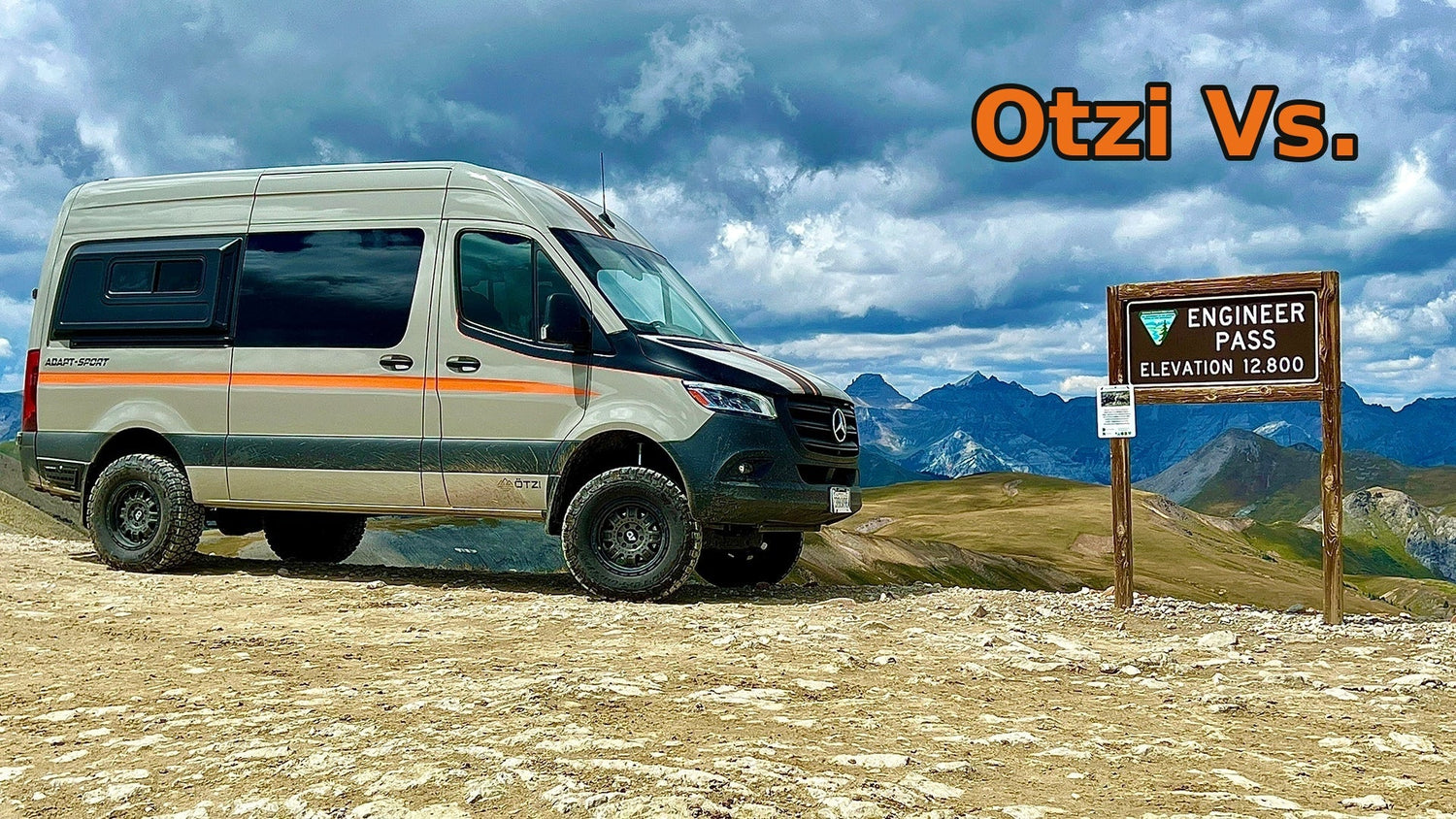
Storyteller Overland Alternative: Why Lightweight Sprinter Engineering Matters Off-Road
The best Storyteller Overland alternative is a lighter, more modular Sprinter adventure van that preserves payload, clearance, towing confidence, and real off-road usability. Otzi Adapt-Sport models start at 6,300 lb curb weight, pair that weight discipline with 11.5 inches of centerline clearance, and use a modular interior instead of a fixed RV layout.
Storyteller Overland is one of the best-known professional Class B adventure van builders in the country, and its MODE vans are built around a polished, ready-to-travel RV formula. That formula works for buyers who want a fixed layout, a full RV feature set, and a national dealer network. But if your priority is a Sprinter that stays light, clears terrain, carries gear without crowding GVWR, and adapts around bikes, boards, tools, dogs, kids, and off-grid travel, the evaluation criteria change.
At Otzi Adventure Gear, we build the Adapt-Sport 144 and Adapt-Sport 170 in Temecula, California, around a simple engineering rule: weight is capability. The Adapt-Sport starts at 6,300 lb curb weight according to Otzi’s 2026 internal build spec, uses powder-coated aluminum structures with bamboo accents, retains the Sprinter 2500’s 5,000 lb tow rating, and gives owners more than 48 Lifestyle Bed System configurations.

Is Otzi a Better Storyteller Overland Alternative for Off-Road Use?
Otzi is the better Storyteller Overland alternative for buyers who care more about lightweight engineering, payload margin, terrain clearance, and layout flexibility than fixed RV furniture. Storyteller publishes strong 2026 MODE specs, including 9,050 lb GVWR and 10.5 inches of ground clearance on 144-inch MODE vans, but it does not publish current curb weight on the reviewed 2026 MODE pages (Storyteller Overland 2026 MODE Vans).
That missing curb-weight number matters because GVWR does not tell you how much usable capacity remains. GVWR is the maximum allowable loaded vehicle weight. Curb weight is what the van weighs before you add passengers, water, food, recovery gear, bikes, boards, tools, dogs, spare parts, or a trailer tongue load. The difference between the two is the real-world margin you live with on every trip.
Mercedes-Benz lists the 2026 Sprinter 2500 cargo van at a 9,050 lb maximum available GVWR, a 5,000 lb maximum towing capacity, and a 24.5 gallon fuel tank across relevant 2500 cargo configurations (Mercedes-Benz Vans). Storyteller’s 2026 144-inch MODE vans also list 9,050 lb GVWR, while Otzi’s 6,300 lb starting curb weight leaves approximately 2,750 lb of theoretical starting margin before options, occupants, water, and cargo are added (Storyteller Overland 2026 MODE Vans).
The Department of Energy states that a 10% reduction in vehicle weight can result in a 6%-8% fuel economy improvement, and it explains that lighter vehicles require less energy to accelerate (U.S. Department of Energy). The same principle shows up in how a loaded Sprinter feels on mountain roads, washboard, sand, snow, and long descents: lower mass reduces the work demanded from the engine, brakes, tires, suspension, and driver.
How Much Lighter Is Otzi Than Storyteller Overland?
Otzi Adapt-Sport models start at 6,300 lb curb weight, while Storyteller’s current public 2026 MODE pages reviewed for this article do not publish current curb weight. The strongest official-style Storyteller weight reference found in this audit is a dated 2020 Family RVing spec sheet listing the original MODE4x4 at 7,800 lb unloaded vehicle weight, while newer third-party and owner-reported references commonly point to high-8,000 to roughly 10,000 lb MODE weights depending on year, model, water, fuel, accessories, and whether the number is dry, wet, or loaded.
That comparison is useful, but it should be used honestly. The 2020 Storyteller MODE4x4 was built on a Mercedes-Benz Sprinter 2500 144 4x4 chassis and was listed at 7,800 lb UVW, 9,050 lb GVWR, 13,930 lb GCWR, and 1,250 lb cargo carrying capacity (Family RVing Magazine, 2020). More current public signals include an RVshare rental listing for a 2023 Storyteller Beast MODE 4x4 that lists 8,500 lb dry weight, 9,050 lb gross weight, and 550 lb cargo weight, a Bearfoot Theory 2024 firsthand review describing a 2023 Classic MODE AWD as a “9,000 lb camper van,” and a 2026 Reddit owner post describing a 2021 Classic MODE as “a hefty 10,000 lbs” (RVshare, Bearfoot Theory, 2024, Reddit, 2026).
These owner- and listing-reported weights provide historical context. Compare curb weight and payload margin using the completed vehicles and their actual loading conditions. Storyteller’s current 2026 MODE pages publish modern specs such as 10.5 inches of ground clearance, 8.4 kWh or 16.8 kWh M-Power systems, 37 gallons of freshwater, and 100W solar expandable up to 325W, but those reviewed pages do not publish current curb weight (Storyteller Overland 2026 MODE Vans).
That creates a clear buyer question: if two vans share a 9,050 lb GVWR, which one leaves you more margin after the build? Otzi answers that question directly by publishing and using a lightweight build target internally. Starting at 6,300 lb means the Adapt-Sport is designed around carrying real gear after the conversion, not just looking complete on a showroom floor.

Why Does Curb Weight Matter More Than GVWR in an Adventure Van?
Curb weight matters because GVWR is only the ceiling; payload margin is the freedom below it. A lighter adventure van can carry more real trip equipment before approaching its legal and mechanical limits, and it puts less stress into brakes, tires, suspension, driveline parts, wheel bearings, and recovery points.
The Department of Energy states that an extra 100 lb in a vehicle can reduce fuel economy by around 1%, with the effect based on the added weight as a percentage of total vehicle weight (U.S. Department of Energy, 2021). The Department of Energy also reports that lightweight materials can reduce component weight by 10%-60% in the short term, depending on material choice and application (U.S. Department of Energy).
In a van build, that is not an abstract engineering statistic. A 37 gallon freshwater tank adds more than 300 lb when full before the tank, plumbing, and mounting hardware are counted. Storyteller’s 2026 MODE pages list 37 gallons of freshwater and 24 gallons of grey water for multiple MODE configurations, which are useful RV features but also part of the loaded-weight calculation every owner needs to understand (Storyteller Overland 2026 MODE Vans).
Otzi’s approach is different. The Adapt-Sport uses a modular platform that lets you carry what the trip requires and remove what it does not. You are not locked into a permanent furniture plan that makes the van weigh the same whether you are hauling bikes to the desert, towing a boat to Baja, carrying kids to Mammoth, or running a fast overnight to a trailhead.
How Does Otzi Adapt-Sport Compare to Storyteller MODE on Measurable Specs?
The clearest Otzi vs. Storyteller Overland comparison is not about who has more features on a brochure. It is about which van publishes the measurements that determine real-world use: curb weight, remaining payload, centerline clearance, side rail clearance, tow rating, power architecture, solar input, and interior flexibility.
What Separates Otzi From Fixed-Layout Competitors?
Otzi separates itself from fixed-layout competitors by treating the van as a platform, not a miniature apartment. The Adapt-Sport is engineered to keep mass low, protect payload margin, and reconfigure around the trip, while many Class B adventure vans prioritize permanent RV amenities that are carried whether they are needed or not.
“The heaviest thing in most van conversions is not one part. It is a chain of early decisions,” says Adam Sullivan, Co-founder of Otzi Adventure Gear. “If you choose heavy cabinet materials, a fixed furniture plan, a bulky electrical layout, and accessories before you protect payload, the van gets less capable every step of the build. We designed the Adapt-Sport by asking what the van needs to do in the dirt first, then building the interior around that.”
That philosophy shows up in the material choices. The Adapt-Sport uses a fiber-infused composite subfloor that is 40% lighter than plywood and 3x more insulating, according to Otzi’s 2026 engineering spec. Instead of drilling or screwing through the Sprinter chassis floor, Otzi bonds the subfloor to the chassis with structural adhesive and adds metal backing plates at all L-track tie-down and floor-trim locations. That keeps the chassis floor intact, avoids new underside puncture points, and creates a stronger foundation for real cargo.
The garage tie-down system is built for motorcycles, tools, recovery gear, bikes, and heavy equipment, not just duffel bags. Otzi’s metal-backed L-track system creates more than 100,000 lb of tensile load capacity across the garage area, according to Otzi’s 2026 engineering spec. That matters because the rear garage is where heavy loads create the highest dynamic forces during braking, washboard, steep climbs, and rough trail impacts.
Storyteller publicly confirms that MODE vans include a garage cargo area with L-track and promotes a “blank slate” garage with an integrated L-track system (Storyteller Overland garage article, Storyteller Overland MODE comparison). The public Storyteller pages reviewed for this article do not disclose subfloor material, L-track backing structure, fastener method, whether the chassis floor is drilled, or how underside penetrations are protected from water intrusion and corrosion (Storyteller Overland garage article, Storyteller Overland MODE comparison). Any buyer comparing professional van builders should ask those questions directly.
The rest of the Adapt-Sport build follows the same logic. The Adapt-Sport 144 page describes lightweight aluminum cabinetry, bamboo accents, insulated and sound-dampened armored wheel wells, L-track throughout the interior, and a 2,048 Wh LiFePO4 battery system expandable to 5,048 Wh (Adapt-Sport 144). The Lifestyle Bed System can move between sleep, seating, lounge, table, bunk, and gear-hauling modes, which is a different design language than a fixed Class B floor plan.

How Do Otzi and Storyteller Compare for Off-Grid Power?
Storyteller wins on published battery capacity, while Otzi wins on system efficiency. The Adapt-Sport uses a smaller, lighter 48V LiFePO4 power system, then reduces demand with extensive insulation, insulated flares, a ceramic-insulated floor, efficient appliances, and high solar input. The result is a similar real-world user experience with less battery weight and less system complexity.
This is not a simple “bigger battery is better” comparison. Storyteller’s 2026 MODE vans list 8.4 kWh M-Power systems on Classic MODE variants and 16.8 kWh M-Power systems on BEAST and DARK variants, with 3,000W inverters and 100W solar panels expandable up to 325W on the 144-inch MODE lineup (Storyteller Overland 2026 MODE Vans). The Adapt-Sport uses a smaller 2,048 Wh LiFePO4 battery bank expandable to 5,048 Wh, but pairs that capacity with 48V architecture, up to 1,400W of solar charging capacity, rapid alternator charging, and a modular self-contained power module (Adapt-Sport 144).
The weight savings come from not solving every comfort problem with more battery. A larger fixed battery bank can be valuable for running air conditioning and other high-draw loads, but it also adds weight, wiring complexity, service complexity, and cost. Otzi’s approach is to lower the load first: the Adapt-Sport wall and ceiling system adds thermal insulation, the armored wheel wells are insulated and sound-dampened, and the floor uses a CNC-machined marine-grade subfloor layered with sound deadening and ceramic insulation for better temperature regulation (Adapt-Sport 144). Otzi’s build also uses insulated flares as part of the thermal envelope, which helps reduce heat gain and heat loss in one of the hardest areas of a Sprinter to insulate cleanly.
That thermal envelope matters most when the air conditioner is running. A well-insulated van does not need the air conditioner to work as hard or cycle as often to maintain the same perceived comfort, so the owner can get a similar practical experience from a lighter power system. The same strategy applies to appliances: Otzi specifies an energy-efficient Dometic NRX 60S refrigerator/freezer with a variable-speed compressor and Eco, Performance, and Silent modes; high-efficiency MaxxAir ventilation; LED smart lighting; a compact 700W microwave; and an induction cooktop selected around clean, efficient electric use (Adapt-Sport 144).
LiFePO4 chemistry is a strong choice for mobile power because quality LiFePO4 batteries are commonly rated for thousands of cycles. Battle Born Batteries states that its LiFePO4 batteries are designed for 3,000-5,000 deep discharge cycles and that its testing shows 75%-80% battery life remaining after 3,000 full discharge cycles in extreme conditions or after 5,000 cycles for average users not operating in extreme conditions (Battle Born Batteries).
The solar contrast is one of the cleanest Otzi advantages. Otzi lists up to 1,400W of solar charging capacity for the Adapt-Sport 144, while Storyteller lists 100W solar expandable up to 325W for 2026 BEAST, DARK, and CLASSIC 144-inch MODE configurations (Adapt-Sport 144, Storyteller Overland 2026 MODE Vans). In practice, that means Otzi is not trying to win the spec-sheet battery race; it is designing the van so the battery has less work to do.

Which Van Is Better for Ground Clearance and Trail Geometry?
Otzi has the stronger clearance story because it provides three terrain-relevant measurements: 11.5 inches of centerline clearance, 9.5 inches of rear differential clearance, and 18 inches of side rail or midpoint clearance. Storyteller’s reviewed 2026 MODE pages publish 10.5 inches of ground clearance but do not publish centerline, side rail, or midpoint clearance measurements.
Ground clearance is often discussed too generally in the van world. The number that matters depends on what the trail is trying to hit. Centerline clearance determines whether the van high-centers on a crown, rock, berm, or raised rut. Rear differential clearance determines the lowest hard-point risk. Side rail and midpoint clearance determine whether the van can straddle uneven terrain without dragging the body.
That is why Otzi’s 18 inch side rail clearance should be a major rewrite theme. A van can have an impressive-looking tire package and still drag bodywork if the side rail and midpoint geometry are not protected. Otzi’s spacer-free wheel offset strategy also matters here because the stance is engineered through wheel geometry rather than a bolt-on spacer approach.
Storyteller’s 2026 MODE vans publish 10.5 inches of ground clearance across 144-inch BEAST, DARK, and CLASSIC MODE configurations, which is a strong published number for a Class B adventure van (Storyteller Overland 2026 MODE Vans). Otzi’s advantage is that it gives buyers more specific clearance dimensions tied to the actual obstacles that stop heavy vans in the backcountry.
Which Interior Is Better: Modular Otzi or Fixed Storyteller?
Otzi is better for owners whose gear, passengers, and trip style change often; Storyteller is better for owners who want a fixed RV layout ready on day one. The Adapt-Sport’s 48+ Lifestyle Bed System configurations let the same interior become a bed, lounge, gear garage, work surface, seating zone, or open cargo platform.
Storyteller’s 2026 MODE lineup is organized around OG, XO, and XL floor plan families with defined seating, sleeping, bath, and water systems (Storyteller Overland 2026 MODE Vans). The Classic MODE OG includes a DreamWeaver bed/convertible work surface, GrooveLounge 2-seater convertible sofa bed, Halo shower system, portable toilet, and a gear garage beneath the bed (Storyteller Overland 2026 Classic MODE OG).
That is a strong RV package, but it is not the same thing as a modular adventure platform. Otzi’s system is built for changing the van around the trip, not changing the trip around the van. That difference matters if you alternate between motorcycles, mountain bikes, boards, fishing gear, family travel, off-road recovery gear, or a week of remote work.
The Adapt-Sport 144 also keeps serviceability in mind. Otzi’s product page describes removable wall and ceiling panels mounted via L-track, an integrated self-contained power module that can be replaced in under an hour, and threaded ports throughout the interior for future mounting and upgrades (Adapt-Sport 144).
Should You Choose the Adapt-Sport 144 or Adapt-Sport 170?
Choose the Adapt-Sport 144 if technical access, tighter roads, easier parking, and off-road maneuverability matter most. Choose the Adapt-Sport 170 if your trips prioritize families, groups, extra sleeping capacity, more gear volume, and longer off-grid stays where interior space matters more than breakover angle.
The 144-inch wheelbase is the more direct Storyteller MODE competitor because Storyteller’s BEAST, DARK, and CLASSIC MODE configurations are built around 144-inch Sprinter platforms (Storyteller Overland 2026 MODE Vans). The Adapt-Sport 144 is also the cleanest Otzi answer for buyers searching “Storyteller Overland alternative” because it competes in the same compact Sprinter adventure van space.
The Adapt-Sport 170 is the better choice when your van is more of a family basecamp than a tight-trail tool. It gives you more interior volume to work with while keeping the same Otzi mindset: low weight, modular function, durable materials, and a build that can be configured around real use.
For more Otzi buying guidance, the Adventure Van Knowledge Hub should be the internal link destination for layout education, model selection, and deeper owner-use content. Readers who want to understand the team and build philosophy behind the vans should also visit About Us.

Frequently Asked Questions About Storyteller Overland Alternatives
What is the best Storyteller Overland alternative?
The Otzi Adapt-Sport is the best Storyteller Overland alternative for buyers who want a lighter, more modular Sprinter adventure van with strong off-road clearance. Otzi Adapt-Sport models start at 6,300 lb curb weight, offer 11.5 inches of centerline clearance, and use a modular Lifestyle Bed System instead of a fixed RV floor plan.
Is Otzi lighter than Storyteller Overland?
Otzi Adapt-Sport models start at 6,300 lb curb weight according to Otzi’s 2026 internal build spec. Storyteller’s reviewed current 2026 MODE pages publish GVWR but not current curb weight, while a dated 2020 Family RVing spec sheet listed the original Storyteller MODE4x4 at 7,800 lb unloaded vehicle weight (Storyteller Overland 2026 MODE Vans, Family RVing Magazine, 2020).
How does Otzi Adapt-Sport compare to Storyteller MODE?
Otzi emphasizes lower starting curb weight, 11.5 inches of centerline clearance, 18 inches of side rail clearance, spacer-free wheel offset, 48+ bed system configurations, and a 48V modular power architecture. Storyteller MODE emphasizes a fixed Class B RV layout, 9,050 lb GVWR on 144-inch 2026 MODE vans, 10.5 inches of published ground clearance, and 8.4 kWh or 16.8 kWh M-Power systems depending on trim (Storyteller Overland 2026 MODE Vans).
Does Storyteller Overland publish curb weight?
Storyteller’s reviewed 2026 MODE pages publish specs such as GVWR, ground clearance, wheelbase, power system, solar, water, and seating, but they do not publish current curb weight in the publicly visible specification sections reviewed for this article (Storyteller Overland 2026 MODE Vans). Because of that, any current Storyteller curb-weight comparison should use actual dealer scale tickets, window stickers, or updated official spec sheets before being treated as current.
Why does van weight matter for off-road and off-grid use?
Van weight matters because every pound added by the conversion reduces the payload left for people, water, recovery gear, bikes, tools, food, and accessories. The Department of Energy states that a 10% reduction in vehicle weight can improve fuel economy by 6%-8%, and it also states that an extra 100 lb in a vehicle can reduce fuel economy by around 1% (U.S. Department of Energy, U.S. Department of Energy, 2021).
Why does Adapt-Sport subfloor construction matter?
Adapt-Sport subfloor construction matters because the floor is the structural interface between the Sprinter chassis, the interior, and the heavy gear in the garage. Otzi uses a fiber-infused composite subfloor that is 40% lighter than plywood and 3x more insulating, then bonds it to the chassis with structural adhesive instead of drilling holes through the chassis floor. Metal backing plates support all L-track tie-down and floor-trim areas, creating more than 100,000 lb of tensile load capacity across the garage area, according to Otzi’s 2026 engineering spec.
Which Otzi model is the closest Storyteller Overland alternative?
The Adapt-Sport 144 is the closest Storyteller Overland alternative because it competes directly in the 144-inch Sprinter adventure van category. The Adapt-Sport 144 is best for technical routes, tighter roads, and compact overlanding, while the Adapt-Sport 170 is better for families, groups, and buyers who need more interior volume.