
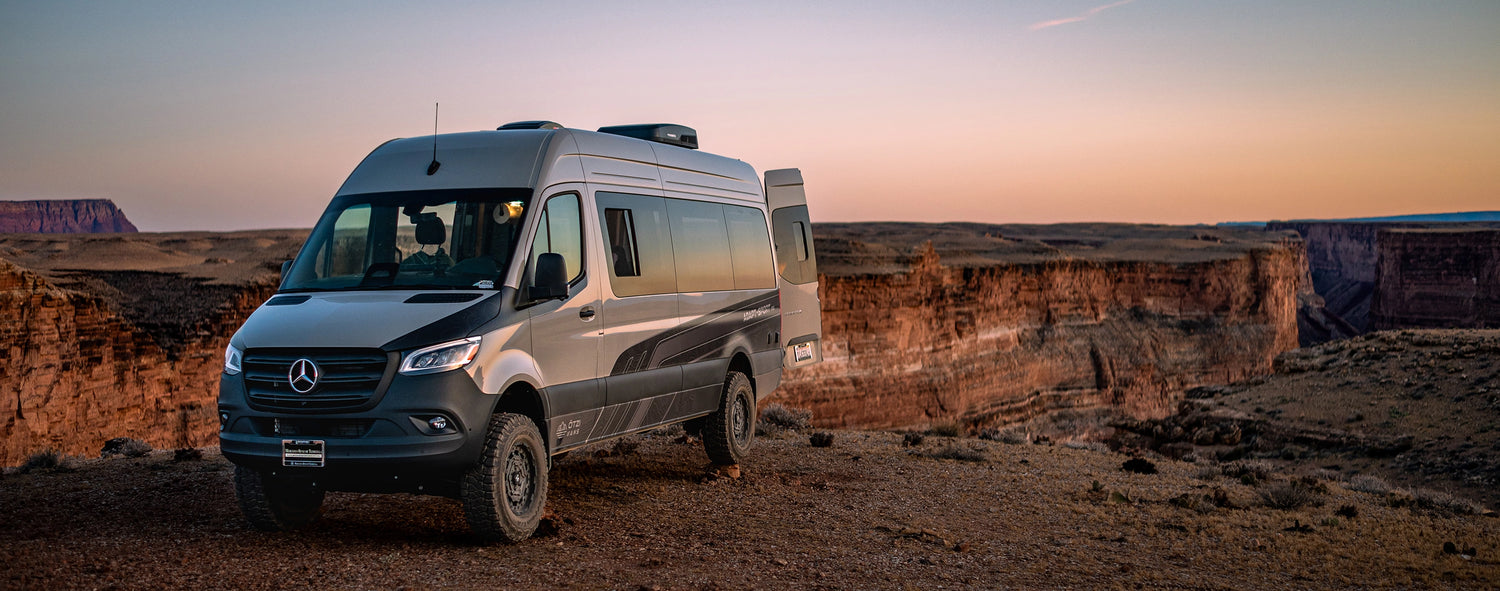
Adapt-Sport 170

Feature Packed
Family Galley
The Adapt‑Sport 170 adventure van galley is built for families and bigger crews who actually cook on the road, not just reheat snacks. A stainless steel sink with tempered glass cover connects to removable 6‑gallon fresh and gray water tanks, making it easy to fill, drain, and clean for healthier van life. An 1,800‑watt induction cooktop and overhead microwave let you handle everything from quick breakfasts to full dinners off‑grid, while the Dometic NRX 60S refrigerator/freezer keeps food and drinks cold for longer trips.
- Stainless steel sink with tempered glass cover
- 1,800‑watt induction cooktop
- Concealed Dometic cassette toilet
- Overhead storage and microwave
- Portable fresh and gray water tanks (6 gallons each)
- Dometic NRX 65S refrigerator/freezer


Reconfigure. Reload. Adventure.
The Adapt‑Sport 170 Sprinter adventure van is built for bigger crews who need a layout that flexes as hard as they travel. The integrated Lifestyle Bed System turns the rear of the 170 into a multi‑zone living space, with the bed platform raising up to create a large garage for bikes, boards, and bulky gear—securely tied down to the heavy‑duty L‑track floor—while you sleep above it. Drop the bed lower for a roomy, comfortable sleeping setup or convert the panels into extra seating, bunk‑style sleeping, a full dining table, or rear‑facing lounges that make the most of the view.
With more than 20 possible configurations, the Adapt‑Sport 170 can be set up for family road trips, group ski weekends, or long‑term van life without locking you into a single layout. Built on the longer 170‑inch wheelbase Sprinter with a reinforced chassis, armored wheel wells, and a quiet interior, this adventure van stays composed on rough roads while keeping your passengers and gear protected, organized, and ready for the next stop.


Engineered Interior for Long‑Haul Adventures
The Adapt‑Sport 170 Sprinter adventure van is designed as a quiet, durable mobile cabin for families and groups who spend serious time on the road. Wall, ceiling, cabinetry, ventilation, and floor systems work together to create a solid, refined interior that stands up to off‑road use while keeping the space comfortable and functional on long trips.
An advanced wall and ceiling system provides strong sound dampening and thermal insulation, helping the adventure van stay quieter and more stable in hot and cold weather. Panels can be removed through the integrated L‑track for easy access to wiring and future tech upgrades, so your 170‑inch wheelbase Sprinter can evolve with new gear, lighting, or connectivity. Lightweight but tough aluminum cabinetry with bamboo accents gives the cabin a warm, modern feel, while patented gear walls offer drill‑free mounting for Milwaukee Packout, MOLLE, RotopaX, and Otzi‑pattern accessories to keep adventure equipment organized and secure.
Smart ventilation combines dual pill windows in the sleeping area for passive cross‑breeze, a high‑efficiency MaxxAir fan for intake and exhaust, and a sliding galley window for targeted airflow while cooking. This keeps the interior fresher, drier, and more off‑grid friendly when the 170 is packed with people. Underfoot, a CNC‑machined subfloor is layered with sound deadening and ceramic insulation, then finished with ultra‑durable, moisture‑resistant flooring. Four rows of black‑anodized L‑track tie into the chassis to provide rock‑solid tie‑downs and full compatibility with the Lifestyle Bed System, creating a stable, adventure‑ready foundation for your gear and your crew.


Configure your day
The Adapt‑Sport 170 is designed to feel like a flexible adventure van living room, not a fixed RV cabin. Its integrated Lifestyle Bed System offers more than 20 configurations, so the rear of your Sprinter 170 can shift from travel mode to hangout space to sleeping area without a rebuild.
During the day, you can set it up with extra seating for the whole crew, bunk‑style sleeping for kids or friends, or a full dining table for six to host trailhead dinners. At night, it converts into a spacious, cozy bed for 4+ people, making the most of the 170‑inch wheelbase interior. Whether you’re on a family road trip or a long adventure van journey with friends, the adaptable layout keeps your space comfortable and functional from morning to night.

Lithium
POWERED CONVENIENCE
The Adapt‑Sport 170 adventure van steps up off‑grid capability with a larger 4,000‑watt portable lithium power station that’s built for family and group travel. It supports three fast‑charging methods—an exterior solar input port, DC‑to‑DC charging from the Sprinter’s alternator while you drive, and a 15‑amp 110‑volt shore‑power connection—so you can keep the system topped up whether you’re moving or parked.
This robust electrical setup easily runs your 1,800‑watt induction cooktop, LED smart lighting, microwave, and MaxxAir fan, with plenty of reserve for phones, laptops, power tools, and other essentials on longer road trips.
- 4,000‑watt continuous output
- 5,040 Wh lithium iron phosphate battery bank (expandable to 5,048 Wh)
- Up to 1,400 watts of solar charging capacity
- Rapid alternator charging while driving
- Super‑fast shore‑power charging when plugged in

Add on
Options
Customize your Otzi Adapt-Sport adventure van with a range of add-on options designed to match your travel style and comfort needs. From interior comfort to off-grid capability, you can tailor your build during the production process for the best results.
Popular options include an indoor hot water fold-down shower with integrated fresh and grey water tanks, or an outdoor on-demand hot water shower with a quick-deploy privacy curtain for easy rinsing at camp. You can upgrade cushions to a thicker foam with an integrated memory foam top layer, add a diesel heater with smart controls for cold-weather trips, or choose a second MaxxAir fan or a high-efficiency air conditioner for improved climate control. For increased performance and power, you can add rapid alternator charging, expand battery capacity, or choose an Evictus PreRunner suspension upgrade, along with accessories like rear door gas struts and insulated window covers to round out your build.

VIEW FULL GALLERY
FAQ
How many people can sit and sleep in an Otzi adventure van?
Otzi adventure vans are designed to safely seat and comfortably sleep couples, families, and small groups, depending on the wheelbase and layout you choose.
- Adapt‑Sport 144 WB (standard): seats 2, sleeps 2
- Adapt‑Sport 144 WB (upgraded): seats 3, sleeps 4
- Adapt‑Sport 170 WB: seats 4, sleeps 4
How much storage do Otzi vans have for gear, clothes, and equipment?
Otzi adventure vans are engineered for real-world adventure storage, prioritizing flexible space for gear, clothes, and equipment instead of bulky built-in RV cabinetry. This approach keeps the van lighter, more open, and better suited to multi-sport, van life, and overland travel.
Otzi vans use a modular storage system with extensive mounting points and tie-downs, so you can configure storage around your hobbies and gear:
- 5 rows of structural L-track in the rear garage area for bikes, bins, and large equipment
- Otzi proprietary gear wall system in the garage for tools and adventure gear
- MOLLE mounting points under the bed panels for pouches and small accessories
- Threaded ports in bed risers, walls, and ceiling for custom brackets and mounts
- L-track throughout the interior for flexible attachment of cabinets, hooks, and storage solutions
- L-track and peanut mounts in the overhead shelf for lightweight, elevated storage
- Integrated Milwaukee Packout mounts in the gear walls, with optional Packout mounts on the upper and lower rear doors
Standard built-in storage in an Otzi van includes:
- Cab overhead shelf for everyday essentials and soft goods
- Dry goods storage above the galley for food and kitchen items
- Stash cabinet on the passenger side of the bed for personal items
- Soft fold-down storage on the driver side for clothing and smaller gear
In addition, Otzi partners with Kitworks to offer custom-size, durable, lightweight storage boxes that fit neatly under the Lifestyle System bed without limiting any of its configurations. Together, this modular storage ecosystem creates a highly functional, adventure-ready layout that works for mountain biking, skiing, climbing, surfing, overlanding, and extended van life travel.
Can I provide my own van chassis?
Yes, Otzi is one of the few licensed and certified adventure van manufacturers that will build on a customer‑supplied Sprinter van chassis. However, there are a few important factors to weigh before choosing this route for your camper van build.
- Resale value impact: If you provide your own chassis, it will already be titled. When Otzi issues the second‑stage RV documentation to retitle it as a motorhome, the DMV may show it as a two‑owner vehicle, which can negatively affect future resale value.
- Financing limitations: Customer‑supplied chassis builds are typically not eligible for standard RV financing, so the conversion usually needs to be paid in cash. If you do not already own a van, Otzi strongly recommends purchasing the chassis through Otzi so the completed RV remains easier to finance.
- Pricing credit: If you provide your own qualified chassis, Otzi deducts $80,000 from the price of any Adapt‑Sport model, which can be appealing for buyers who already own a compatible Sprinter van.
What type of van chassis is best (Mercedes Sprinter, Ford Transit, Ram ProMaster)?
For our adventure van builds, we exclusively use the Mercedes‑Benz Sprinter chassis because it’s the only platform we trust to match the lifespan, quality, and performance of our interior systems. The Sprinter offers a proven diesel and AWD drivetrain, strong towing and payload capabilities, and a robust frame that holds up to off‑road use, washboard roads, and long‑mileage travel in a way that aligns with how our customers actually use their vans.
Sprinters also have excellent parts availability, dealer service networks, and aftermarket support geared specifically toward overlanding and van life, which helps keep long‑term ownership simpler and more predictable. While Ford Transit and Ram ProMaster are popular options for some van conversions, their drivetrains, geometry, and support ecosystems do not align as well with the demanding off‑road, multi‑sport, and high‑mileage use cases we design for. By focusing solely on the Mercedes Sprinter, we can engineer our floors, cabinetry, electrical, and safety systems around one chassis and deliver a more dialed, reliable, and cohesive adventure van.
What size or wheelbase should I choose (parking, drivability, or space)?
Otzi adventure vans are available in both short wheelbase (144 WB) and long wheelbase (170 WB) Mercedes Sprinter configurations, so you can prioritize either maneuverability and parking or maximum interior space for van life. Both are engineered for off‑road adventure, daily driving, and extended road trips, but they each shine in different use cases.
- 144 WB (most popular): Offers better breakover angle and ground clearance for off‑roading and rough forest roads, fits more easily in standard parking spots, and feels more maneuverable in cities, trailheads, and tight switchbacks (including easier U‑turns and tight turnarounds). This is a great choice if you value drivability, stealth, and trail access over maximum interior volume.
- 170 WB: Provides significantly more interior living space and supports additional layout options for families, Pull work, and long‑term van life. The 170 wheelbase allows for our pull tested bench seat that can swivel and convert, plus our 4‑panel Lifestyle System, which offers more configurations than the 3‑panel system in the 144—including more dining table space and the ability to set up two bench seats facing each other. This is ideal if you prioritize interior comfort, seating, and flexibility over tight‑space maneuverability.
How much does it cost to insure an Otzi van?
Otzi is a licensed and certified second‑stage RV manufacturer, and all Otzi camper van models are listed in the J.D. Power NADA database, which makes them easy for insurance companies to properly value and insure as true RVs rather than cargo vans. In many cases, owners find it costs roughly half as much to insure an Otzi adventure van as it does to insure a standard Sprinter cargo van conversion, while also securing significantly higher coverage limits that reflect the full camper van build instead of just the base chassis.
Do I need bigger wheels and tires for off-roading?
Not necessarily. Otzi adventure vans come standard with 275/70R17 BFGoodrich All‑Terrain tires, which are widely regarded as one of the best‑performing tire sizes and tread patterns for Sprinter off‑road and overland van applications.
Every Otzi model includes Otzi forged wheels for added strength and durability, along with a Mondo mud flap kit and professionally relocated rear mud flaps to properly clear the larger tire size. This setup delivers excellent off‑road traction, ground clearance, and highway manners right out of the box, so most owners don’t need to upgrade to bigger wheels and tires for typical adventure van use.
Gas or diesel—which is better for efficiency and maintenance?
For our builds, modern diesel is the better match for adventure van efficiency, performance, and long-term reliability. All Otzi vans use Mercedes’ 4‑cylinder high‑output diesel engine, which delivers excellent fuel economy on the highway, strong throttle response in the mountains, and more usable low-end torque to the wheels than comparable gas options—especially when fully loaded with gear, passengers, and off‑road accessories.
Diesel powertrains are also well suited to long-distance driving and heavy-duty use, which aligns with how most owners use their camper vans for road trips, overlanding, and van life travel. Paired with Mercedes’ advanced emissions and maintenance systems, this engine provides a proven balance of efficiency, performance, and durability for real-world adventure use.
What’s better—4x4 or AWD?
For most real-world adventure van and camper van use, the Mercedes AWD system is a better overall choice than traditional part-time 4x4. It constantly monitors wheel slip and uses advanced traction control to send power where it’s needed, which helps keep the van more stable and confident on gravel, dirt, and rough roads.
Mercedes’ AWD also shines in wet, snowy, and icy conditions, where automatic torque distribution and stability systems can react faster and more precisely than a manually engaged 4x4 system. For most van life, ski trips, overlanding, and all-weather highway driving, AWD delivers better all-around traction, safety, and ease of use than traditional 4x4 in a Sprinter-based adventure van.
What is the towing capacity of an Otzi van?
Otzi adventure vans retain 100% of the factory Mercedes‑Benz Sprinter 5,000 lb towing capacity. Our camper van builds are intentionally engineered to be lightweight and efficient, often coming in thousands of pounds under GVWR compared to many traditional RV and van conversions.
Because many other conversions push or exceed the Sprinter’s GVWR, their safe and legal towing capacity can be reduced. By keeping weight in check, Otzi preserves the full 5,000 lb rated towing capacity, giving you more margin for safely towing trailers, small campers, boats, or toy haulers behind your adventure van.
What power systems are best for adventure vans?:
For modern adventure vans and off-grid camper vans, a high-voltage lithium system is typically the best choice for efficiency, weight, and long-term reliability. Otzi takes a different approach by using a 48V self-contained power system instead of a traditional 12V house battery bank, which is usually heavier, bulkier, and less efficient for high-demand loads.
Our 48V architecture provides major weight savings and space savings inside the van, freeing up more room for gear, storage, and living space. It also simplifies wiring and improves efficiency when running high-draw appliances like induction cooktops, air conditioning, and inverters.
Because the system is modular and self-contained, it is easier to service and can be replaced more economically in the future if technology changes or a major component ever fails. This approach delivers a more future-ready, reliable power solution tailored to real-world van life, overlanding, and extended off-grid travel.
What is the repair process and cost for an Otzi power system vs. traditional systems?
Otzi’s 48V power system is designed to be much easier and more affordable to repair or replace than most traditional adventure van electrical systems, especially for full-time van lifers and long-term travelers. Instead of a complex, hard-wired, multi-piece setup, Otzi uses an integrated, self-contained unit that can be swapped quickly with minimal downtime.
Otzi power system repair/replacement
- Otzi vans use an integrated, self-contained power module rather than a web of separate components.
- If a repair is needed during the warranty period, the entire power unit is replaced—not just a single failing part—eliminating guesswork and repeat failures.
- Replacement can often be completed in under an hour through one of Otzi’s nationwide service partners.
- For remote or full-time van life, Otzi can ship a replacement unit (with the required tools) directly to the owner and provide live video support to walk through the swap step by step.
- Many owners have completed this process on the road, even picking up replacement units at shipping locations while traveling.
Traditional adventure van power systems
- Most traditional systems use multi-piece, hard-integrated components (separate batteries, inverters, chargers, DC distribution, etc.) wired deeply into the van.
- Because of the complexity and safety concerns, DIY or guided remote repair is rarely realistic.
- Owners typically must leave the van at a specialty service center, where it may sit for weeks or even months waiting for diagnosis, parts, and skilled labor.
- This can be especially disruptive for full-time van lifers or anyone who depends on their camper van for frequent travel.
Otzi power system replacement cost
- Even out of warranty, Otzi systems are generally much more affordable to repair or replace than traditional custom electrical builds.
- In many traditional systems, most of the total cost is hidden in labor-intensive installation, troubleshooting, and integration—not just the parts.
- Otzi’s self-contained design removes much of that labor, so replacement is primarily a parts cost.
- Otzi also offers replacement power systems at dealer cost to owners, further reducing expenses.
- Depending on the model and configuration, parts costs are typically in the roughly $1,000–$3,000 range.
Traditional power system replacement cost
- Replacing a conventional multi-piece integrated system can be extremely expensive due to the time required to remove, rewire, reprogram, and reinstall components.
- A widely known example in the industry involves Storyteller Overland vans equipped with the Volta system, where failures have led many owners to pursue full replacements through Lithionics—often costing $40,000+, largely due to labor required to replace a multi-piece integrated system.
- For many owners, this level of cost and downtime is a major pain point, which is exactly what Otzi’s modular, self-contained power architecture is designed to avoid.