
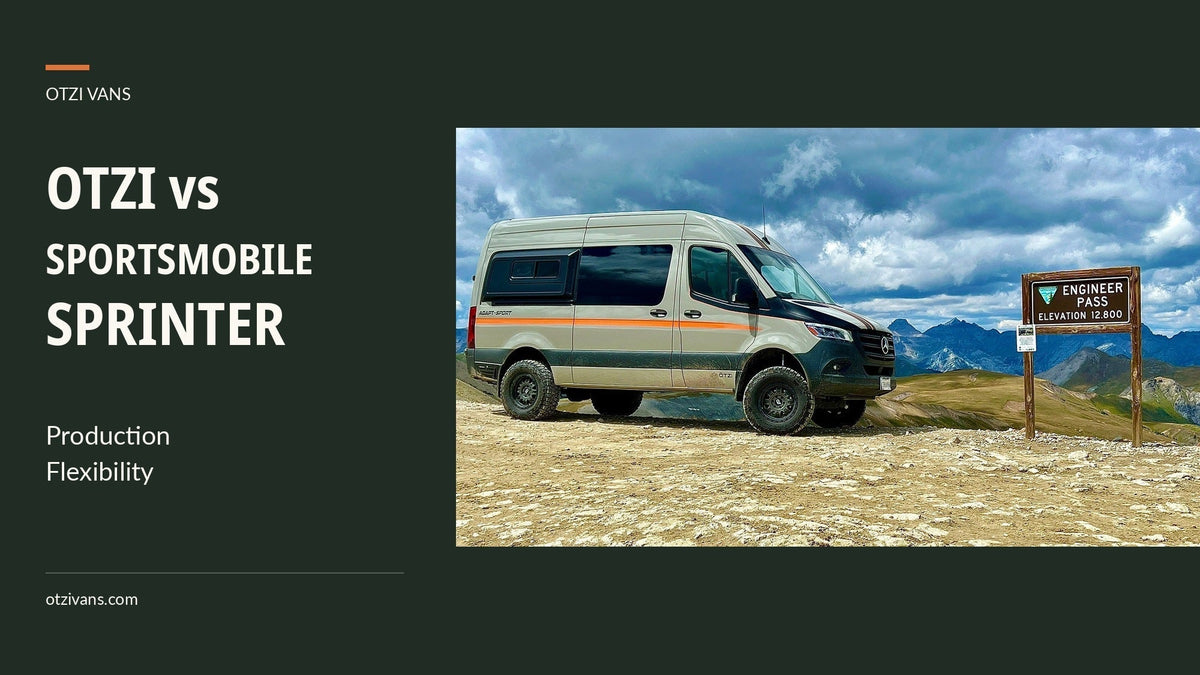
The Otzi advantage / Comparison 03
We recommend the Otzi Adapt-Sport over a Sportsmobile Sprinter because a well-designed adventure van should remain adaptable after delivery. Our production platform combines lightweight construction, configurable living space and accessible systems, giving you a complete van without making every future trip depend on one original floor-plan decision (Otzi Adapt-Sport 144).
We build and sell Otzi vans, so this is our case for choosing the Adapt-Sport. Sportsmobile offers both proven models and individually designed Sprinter conversions, making the exact chassis, roof and equipment important to any comparison (Sportsmobile Sprinter).
Manufacturer pages were reviewed in September 2026. Unless otherwise identified, Otzi electrical specifications below refer to the Adapt-Sport 144; the older Sportsmobile owner-weight report is historical context, not a specification for a new order.
Why choose Otzi instead of commissioning a different floor plan?
Choose Otzi for flexibility built into a finished production van, not flexibility that ends when the order is signed. The Adapt-Sport's Lifestyle Bed System supports sleeping, dining, lounging and equipment storage within the same interior (Otzi). You can keep a favorite arrangement and still have other useful options when your activities change.
A drawing can show where the furniture fits. A walkthrough reveals whether you can reach your jacket with bikes aboard, sit comfortably while someone cooks, or get into bed without unloading the equipment you wanted to protect inside. Those practical interactions are the reason we recommend experiencing a complete Otzi rather than assuming a more personalized drawing creates a better van.
Sportsmobile offers both established floor plans and design assistance for individual conversions (Sportsmobile). That does not make every Sportsmobile an experimental build. Our distinction is what remains adjustable after you have used the van enough to understand your routine.
Otzi's three-panel 144 system supports more than 20 published arrangements, including raised and lowered beds, benches, lounges, bunks and a table arrangement for six (Otzi). For travel, use only the designated passenger seats and restraints.
Changing how you use furniture is different from relocating a permanently installed cabinet or rebuilding a bathroom. We want your van to accommodate the next trip without turning ownership into another interior-design project. You are buying a complete production adventure van, not a DIY conversion kit.
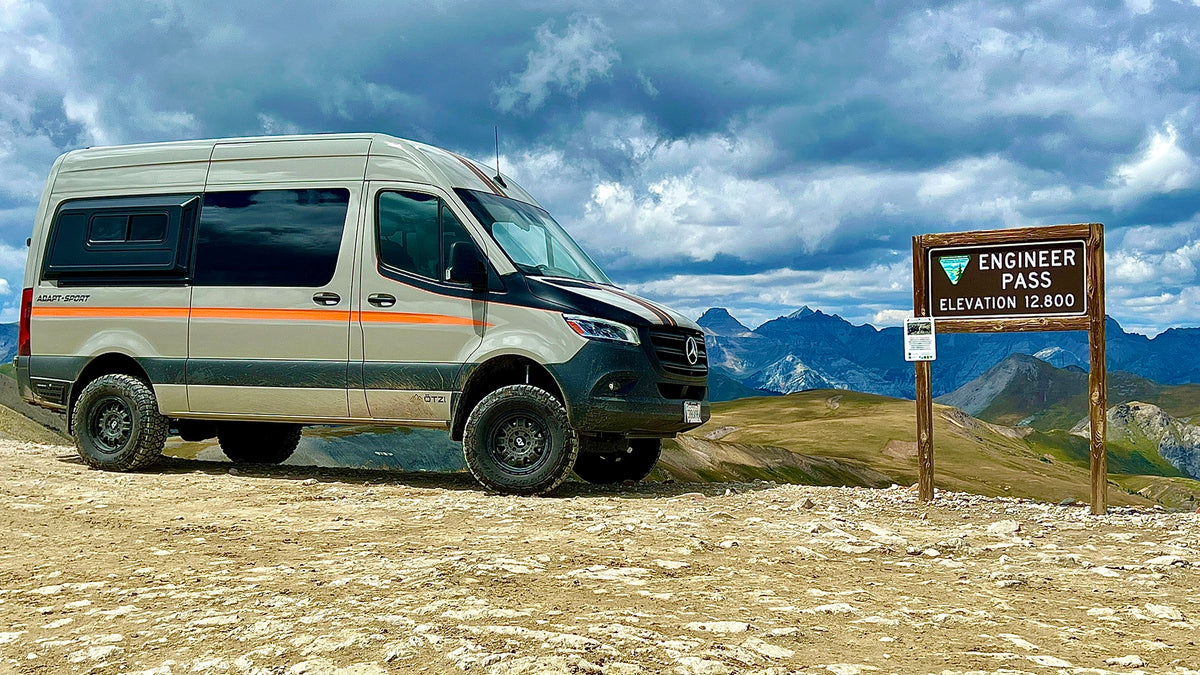
How do Otzi and Sportsmobile compare on the features that matter?
The useful comparison is the finished living experience, not the longest options list. Otzi combines a defined production interior with equipment choices, while Sportsmobile's published package and individual conversions can differ (Otzi; Sportsmobile). This table separates those facts so larger component numbers do not obscure layout flexibility, service access or ownership.
| Buying priority | Otzi Adapt-Sport | Sportsmobile Sprinter |
|---|---|---|
| Interior approach | Production platform with an integrated Lifestyle Bed System and modular storage (Otzi) | Proven models and individually designed conversions (Sportsmobile) |
| Wheelbase choices | Adapt-Sport 144 and 170 (Otzi) | 144-inch and 170-inch wheelbases; multiple body lengths (Sportsmobile) |
| Cabinet construction | Powder-coated aluminum structures with bamboo faces and accents (Otzi) | Published Baltic-birch cabinet choices with plastic or aluminum edging (Sportsmobile) |
| Finished weight | Can weigh as light as 6,500 pounds, depending on configuration (Otzi guide) | Build-specific; a historical owner example is discussed below, not assigned to the current range |
| Battery and power | 144: 2,048 Wh standard, expandable to 5,048 Wh; 2,500 watts continuous output (Otzi) | Current standard-equipment page lists lithium and a 3,000-watt inverter/charger; confirm the order's battery voltage and energy (Sportsmobile) |
| Cold-weather battery provision | Heated batteries; confirm controls and operating limits for the installed system | Battery heating not specified on the cited standard-equipment page; request the exact package (Sportsmobile) |
| Sink water | Removable six-gallon fresh and six-gallon gray containers (Otzi) | Standard package lists 10-gallon fresh and 7–12-gallon gray tanks; individual builds vary (Sportsmobile) |
| Otzi shower option | Fold-down indoor shower; our shower configuration adds separate 35-gallon fresh and 16-gallon gray tanks | Bathroom layout and tank equipment depend on the selected conversion (Sportsmobile) |
| Access for later service | Removable wall and ceiling panels, integrated L-track and self-contained power module (Otzi) | Inspect service access on the actual layout and equipment package |
| Warranty | One year/unlimited miles, with an optional five-year/unlimited-mile extended warranty; written terms apply | Published conversion warranty: three years/36,000 miles; appliances and chassis have their manufacturers' coverage (Sportsmobile) |
Equipment choices affect weight, space and capacity. Do not combine the lightest Otzi build with every optional upgrade, or a basic Sportsmobile package with specifications taken from an unrelated custom example.
How does Otzi make the same interior useful throughout the day?
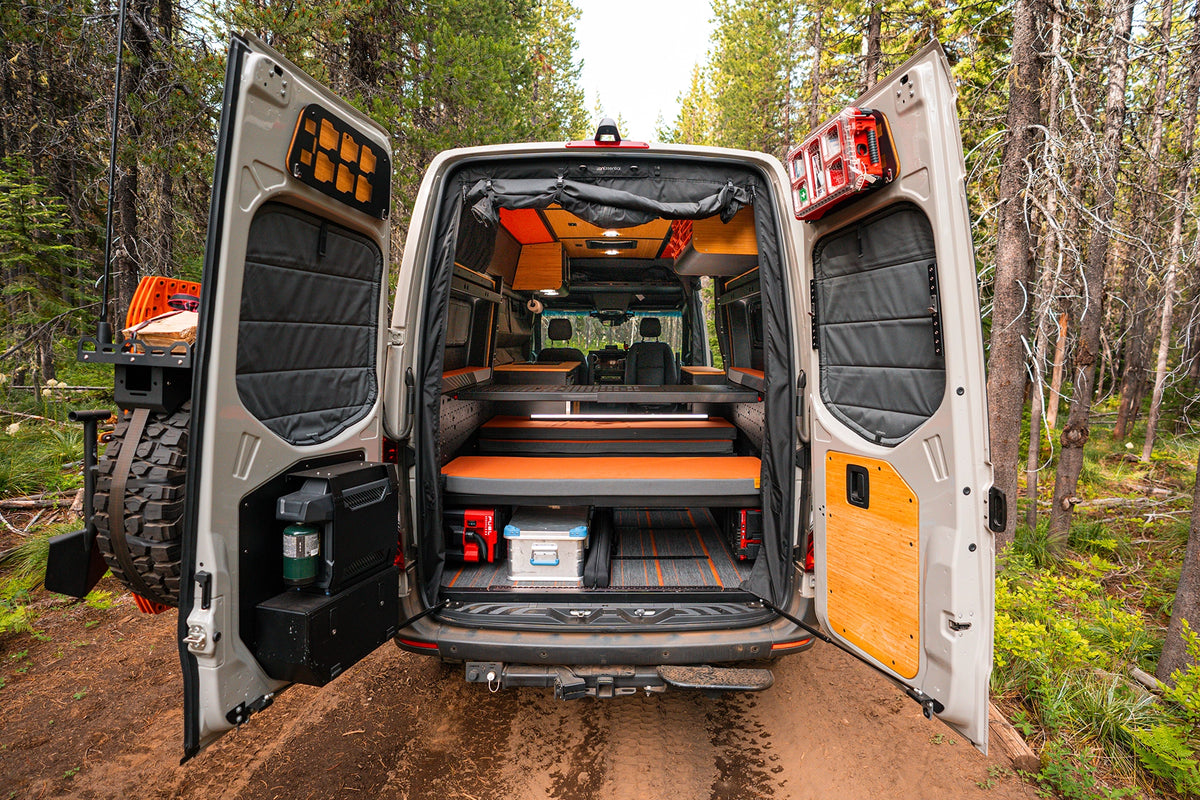
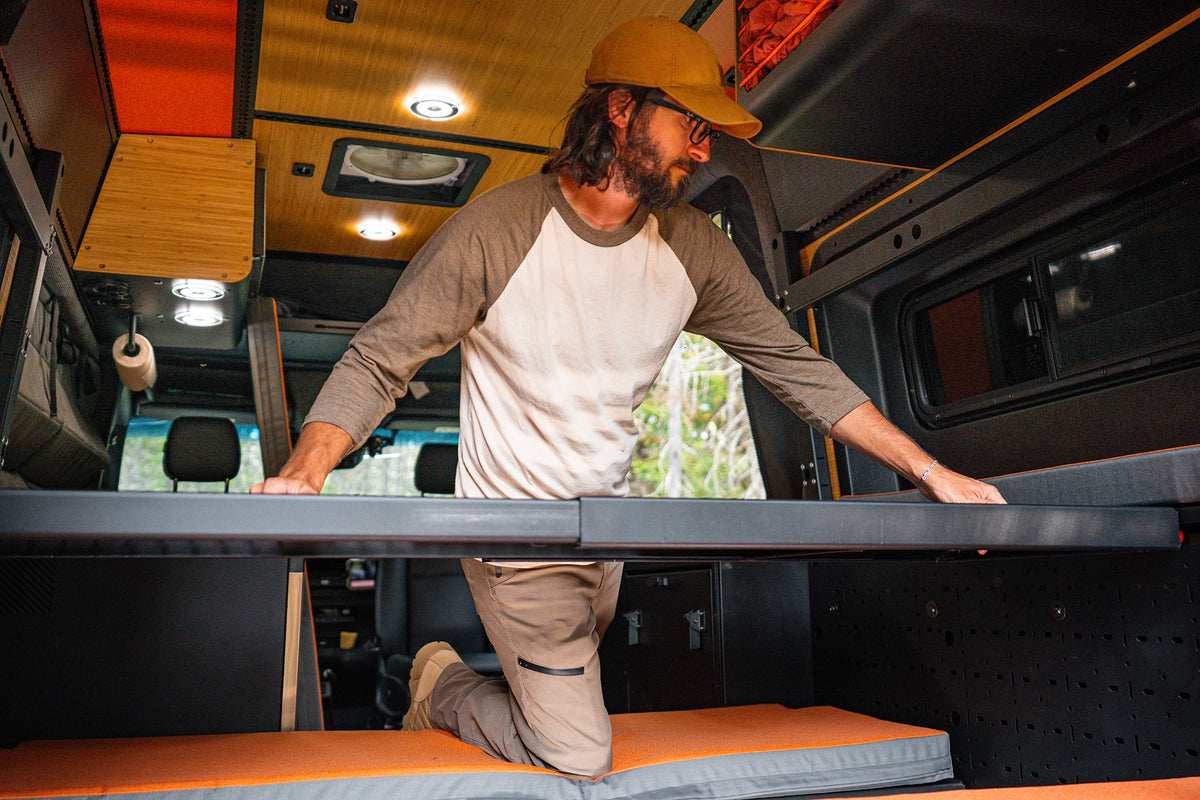
Otzi's interior can change function rather than merely change the height of a mattress. The bed panels support different living arrangements, and the raised platform creates space for secured equipment below (Otzi). The point is not constant conversion: it is having a comfortable default plus useful alternatives when you need them.
The Adapt-Sport 144 provides a 78-cubic-foot garage, giving gear storage a defined place in the living-space comparison. Bring your bikes, boards or other bulky equipment to a walkthrough and check their fit, securement and accessibility with your preferred bed arrangement in place.
Start with a familiar weekend. You arrive with bikes or boards, want somewhere to sit with the rear doors open, prepare dinner, and then settle in for the night. The best demonstration is completing that sequence with your equipment aboard rather than viewing each arrangement in an empty van.
Our published configurations include front- and rear-facing lounges, benches, raised sleeping and lower sleeping positions (Otzi). Try the arrangement you expect to use most often first. Then test how the same space can support work, a rainy afternoon or a different mix of gear.
For family planning, keep passenger restraints separate from campsite furniture. The standard Adapt-Sport 144 seats and sleeps two; its published upgraded arrangement seats three and sleeps four. The Adapt-Sport 170 seats and sleeps four and uses a four-panel Lifestyle System (Otzi 144; Otzi 170).
Have our team demonstrate the approved travel seats, sleeping positions and storage together. Adaptability should make the van easier to live with, not require you to learn every possible configuration before enjoying your first trip.
Does a pop-top have to be part of a versatile adventure van?
No. Otzi provides configurable sleeping and living arrangements inside the van rather than making a lifting roof central to the layout (Otzi). Before treating a pop-top as essential, compare the sleeping arrangement you actually need with the setup, closing procedure and operating limits of the exact roof under consideration.
Sportsmobile offers a Penthouse roof with an optional upstairs bed, and its roof page describes latches, an optional electric lifting mechanism and a maximum 200-pound top load including the rack (Sportsmobile Penthouse). Review the roof's operating and load requirements for your planned equipment.
Sportsmobile recommends lowering the top in high winds and warns that operating the electric mechanism without first unlocking the latches can bend its elevating tubes (Sportsmobile roof instructions). Those steps belong in the ownership comparison alongside the appeal of an upstairs bed.
Otzi's approach lets you evaluate sleeping, sitting and equipment access within the existing interior. That is the experience we recommend trying before assuming an additional roof system is necessary. Ask our team to show the complete nighttime arrangement for your group, including access to the galley and exits.
Do not confuse sleeping capacity with travel seating, and do not assume one published pop-top mattress dimension applies to every roof. The actual vehicle and order documents should settle those details.

Why do Otzi's construction and service access matter?
Otzi combines powder-coated aluminum cabinetry, bamboo accents and removable interior panels so a finished van can remain accessible for service (Otzi). We consider access part of the product, not an afterthought. A connection behind a beautiful panel still needs a practical route for inspection, repair or a future equipment change.
Sportsmobile lists Baltic-birch cabinet options, with plastic cap molding or aluminum edging (Sportsmobile materials). Otzi uses an engineered aluminum structure and accessible interior designed around ongoing use and service.
Our wall and ceiling panels can be removed through the integrated L-track system to reach wiring and the interior behind them (Otzi). During a walkthrough, ask to see a representative access point. A service demonstration tells you more than a promise that something is “easy to work on.”
Insulation also belongs in the complete-system discussion. Otzi publishes thermal insulation, sound damping and insulated wheel wells; Sportsmobile's standard package describes cork underlayment, wool, radiant barrier foil and insulating window panels (Otzi; Sportsmobile).
Our goal is comfort with sensible energy demand, while keeping the interior serviceable. Inspect the actual build, window treatments and selected heating equipment.
Why does Otzi size its electrical system around real use?
We size the electrical package around the appliances and the way the van is used, rather than treating maximum capacity as the goal. The Adapt-Sport 144 publishes 2,048 Wh of storage, expansion to 5,048 Wh and 2,500 watts of continuous output (Otzi). Compact equipment supports our lightweight, space-conscious production design.
Sportsmobile's standard package lists a 3,000-watt inverter/charger, a 125-amp charger and a 30-amp shore connection (Sportsmobile). A higher inverter rating describes available output, not automatically a better living experience. It also does not tell you how long a battery will support a particular load.
Otzi pairs its power module with selected appliances, lighting and ventilation; its published uses include a 1,800-watt induction cooktop, LED lighting, a MaxxAir fan and everyday electronics (Otzi). We aim for useful daily operation through the complete system, including insulation and opportunities to recharge.
Plan the electrical system around appliance efficiency, simultaneous demand and charging opportunities. Otzi's compact package keeps that planning connected to space, weight and daily use.
Otzi has heated batteries. We also offer charging through alternator DC-to-DC, shore power and solar input; the 144 page lists up to 1,400 watts of solar-input capability, not that amount of installed rooftop solar (Otzi). Confirm the charging hardware and battery-heating behavior on your selected configuration.
Serviceability is another part of the decision. Otzi's self-contained module can be replaced as a unit; our product page describes swaps that can often be completed in under an hour when the required equipment and support are available (Otzi). Arrange diagnosis, replacement availability and shipping with the service team.
Bring a list of the devices you expect to run together and discuss parked air-conditioning use separately. Our recommendation is to buy an appropriate, understandable system rather than purchase unused electrical capacity at the expense of space and weight.
How do Otzi's sink and shower systems improve everyday use?
Otzi separates sink convenience from shower capacity. The galley uses removable six-gallon fresh and six-gallon gray containers, while our optional indoor shower configuration adds separate 35-gallon fresh and 16-gallon gray tanks. This gives owners meaningful equipment choices instead of requiring everyone to carry the same permanent installation and associated weight.
The removable fresh-water container can be taken out for cleaning, sanitizing and filling with preferred filtered drinking water (Otzi). That removable design puts cleaning and water choice in your hands.
Sportsmobile's standard package lists a 10-gallon fresh tank and a 7–12-gallon gray tank, but individual conversions can use different equipment (Sportsmobile). Comparing those figures only with Otzi's sink container misses the separate shower option.
Our product page lists a fold-down indoor hot-water shower with integrated tanks; the capacities above describe our current offered shower configuration (Otzi shower option). Confirm the selected package in your order. Try deployment, privacy, drying and access to stored equipment as part of the same walkthrough.
The Adapt-Sport also has heated water tanks and insulated water lines for cold-weather use. These features extend our practical approach to the plumbing system, not just the heated batteries. Review the installed system's operating limits, power requirements and winterization steps with our team.
Sportsmobile states that its fresh tank and water lines are installed inside the van to help protect against freezing (Sportsmobile plumbing). For any van, winterization should follow the actual installed equipment, including drains and gray-water components.
Our reason for offering choices is straightforward: useful equipment should earn its place. You can select shower capability without giving up the removable sink system or treating one fixed bathroom footprint as the only way to travel comfortably.
What do owner-reported Sportsmobile weights tell you?
An identifiable owner report provides historical context, not a universal Sportsmobile curb weight. Otzi builds can weigh as light as 6,500 pounds, depending on configuration (Otzi guide). Comparing that starting point with a documented older example can inform questions, but your purchase decision should use the actual completed vehicles and weighing conditions.
Sportsmobile Forum member WanderingBob-SMB described a 144-inch, high-roof Sprinter 2500 collected from Sportsmobile North in December 2018. The owner reported that Sportsmobile weighed it after conversion at 7,335 pounds unloaded (owner report).
| Weight reference | Stated figure | What the comparison establishes |
|---|---|---|
| Otzi minimum, configuration dependent | 6,500 pounds (Otzi) | A lightest-build reference, not every available option combined |
| Historical Sportsmobile Sprinter owner report | 7,335 pounds unloaded after conversion (Sportsmobile Forum) | 835 pounds above that Otzi minimum; historical owner-reported unloaded weight |
The owner report omits the vehicle's model year, complete equipment list and fuel-and-water conditions (owner report). Use a vehicle-specific scale ticket to establish the weight and remaining capacity of the van you are buying.
Our lightweight approach is still a meaningful starting point. Ask for the actual occupant-and-cargo label and front, rear and total scale weights, with fuel, water, passengers and equipment documented. Compare rating limits separately from the scale reading.
Then assess trail suitability as a complete vehicle: tire placement, underbody clearance, rear-carrier projection, roof equipment and secured cargo. We recommend testing the Otzi configuration you would receive rather than assuming a gallery accessory or suspension upgrade changes the vehicle's legal weight ratings.
How does Otzi support ownership after delivery?
Otzi backs its vans with a one-year/unlimited-mile warranty and offers an optional five-year/unlimited-mile extended warranty. Combined with accessible panels and a replaceable power module, our ownership approach considers both coverage and how service is performed (Otzi service design). Review the written terms for the van and coverage you select.
Sportsmobile publishes a three-year/36,000-mile conversion warranty and identifies separate manufacturer coverage for appliances and the underlying chassis (Sportsmobile FAQ). Otzi's offer has no mileage cap and includes the option to select five-year/unlimited-mile extended coverage. Our recommendation is to evaluate that choice alongside practical service access, not treat one headline duration as complete coverage.
For owners who travel extensively, unlimited-mile coverage deserves attention. But duration is only part of the agreement: confirm covered components, exclusions, authorization procedures and who performs the work. Do not assume an Otzi conversion warranty extends the Mercedes-Benz chassis warranty.
Ask our team to demonstrate access to the power module, fuses, water containers and removable panels. We want support to be understandable before a trip, not only after a problem develops.
What are the key takeaways for Sportsmobile shoppers?
Our recommendation is the Otzi Adapt-Sport: a complete production adventure van that keeps useful choices available throughout ownership. Its configurable living space, lightweight construction and accessible systems are the foundation of that recommendation (Otzi). Compare the experience those features create, not simply the number of options available before the build starts.
Bring your largest equipment, passenger requirements and ordinary travel routine to a walkthrough. Test sleeping, sitting, cooking, water access and gear storage together; then review the selected electrical system, shower equipment, weight documentation and warranty.
Start with the Adapt-Sport 144 or explore the Adapt-Sport 170, then contact Otzi to arrange a demonstration. The strongest case for our design is seeing how it works with your life and equipment aboard.
Frequently asked questions
Why does Otzi recommend the Adapt-Sport over a Sportsmobile Sprinter?
We recommend Otzi for production-built flexibility that continues after delivery. The Lifestyle Bed System, modular storage, aluminum cabinetry and removable interior panels combine useful living arrangements with service access in a complete adventure van (Otzi).
Do I have to rearrange an Otzi interior every day?
No. Keep your preferred arrangement and change it when your trip or activity calls for something different. Otzi's published bed, lounge, bench and table arrangements provide alternatives without requiring every owner to use every configuration (Otzi).
Can an Otzi provide an indoor shower and more than six gallons of water?
Yes. The six-gallon fresh and gray containers serve the sink. Our optional indoor shower configuration adds separate 35-gallon fresh and 16-gallon gray tanks, so selecting shower capacity does not remove the sink system's cleaning and filling convenience.
Is every Sportsmobile heavier than an Otzi?
That has not been established. Otzi builds can weigh as light as 6,500 pounds, depending on configuration (Otzi). One owner reported a historical 144-inch Sportsmobile Sprinter at 7,335 pounds unloaded, with model year and full weighing conditions unspecified (owner report).
What warranty does Otzi offer?
Otzi provides a one-year/unlimited-mile warranty with an optional five-year/unlimited-mile extended warranty. Review the written coverage, exclusions and service procedures for your purchase; conversion coverage should not be confused with the chassis manufacturer's warranty.
Does a bigger inverter automatically make a better adventure van?
No. Compare the appliances, simultaneous loads, battery energy, charging and service access as a complete system. Otzi's Adapt-Sport 144 publishes 2,500 watts of continuous output and a compact power module selected around its intended equipment (Otzi). A higher inverter rating alone establishes neither longer runtime nor a better living experience.