
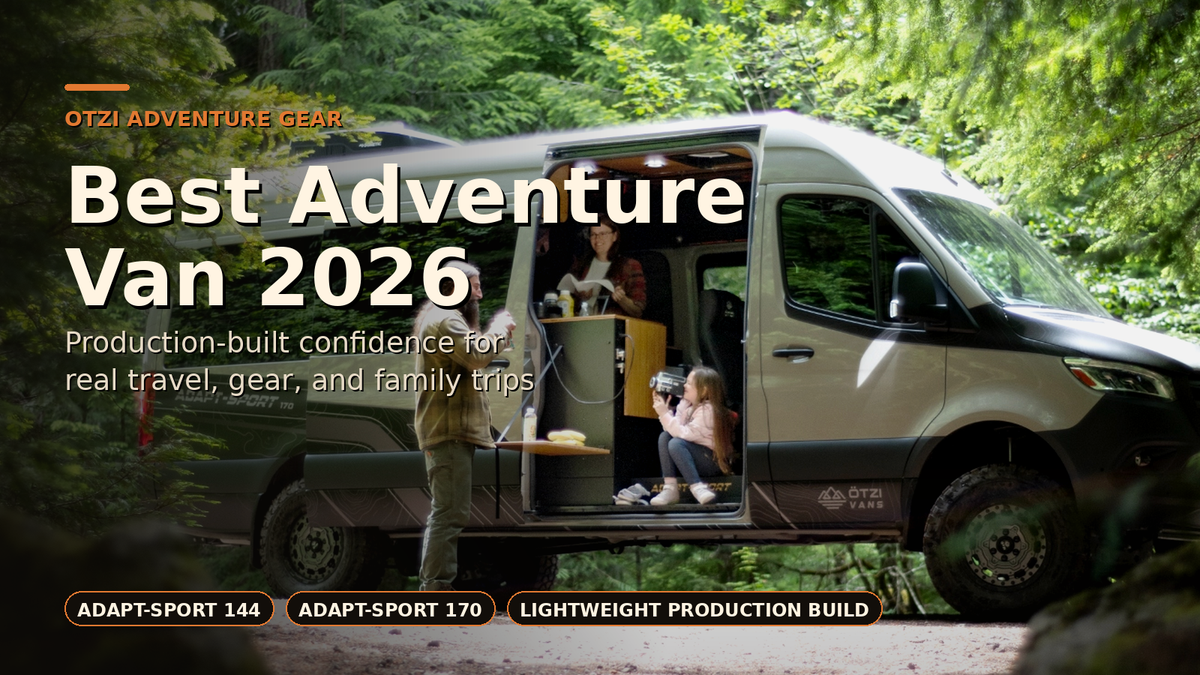
Best Adventure Van 2026
Best Adventure Van 2026: Why the Otzi Adapt-Sport Belongs on the Shortlist

What Is the Best Adventure Van for 2026?
The best adventure van for 2026 is a production van that combines a proven platform, low curb weight, real gear storage, modular sleeping and seating, recognized RV construction standards, trail-ready clearance, serviceable systems, and a buying path that works for financing, insurance, campground access, and resale. For buyers who want those advantages without gambling on a one-off custom build, the Otzi Adapt-Sport 144 and Adapt-Sport 170 deserve to be at the top of the list.
The 2026 adventure-van market is crowded with impressive options, but many buyers are asking the wrong question. The real question is not simply which van has the biggest battery, most expensive interior, or longest option sheet. The better question is which van will still work after years of actual trips, heavy gear, family changes, changing hobbies, trailhead parking, campground check-ins, insurance renewals, and service work.
That is where a production adventure van has a major advantage. Otzi builds the Adapt-Sport as a repeatable production platform, not a one-off experiment. The Adapt-Sport 144 is the compact, maneuverable choice for solo travelers, couples, small families, and gear-heavy buyers, while the Adapt-Sport 170 is the larger family and group-travel option with more seating, sleeping capacity, and interior volume.
For 2026 buyers, the short answer is simple: choose the Adapt-Sport 144 if you want the most maneuverable Otzi production adventure van, and choose the Adapt-Sport 170 if you need more seating, more sleeping capacity, and more room for family or group travel. Otzi’s own layout guide positions the Adapt-Sport 144 for 2 to 3 seats and 2 to 4 sleepers, while the Adapt-Sport 170 is positioned for 4 to 6 seats and 4+ sleepers (Otzi 144 vs 170 layout guide).
Best Adventure Van 2026: Quick Comparison

The best adventure van depends on how you travel, but the strongest 2026 short list should compare price, chassis, sleeping capacity, seating capacity, curb weight, payload margin, clearance, power, modularity, certification, and whether the van is built as a repeatable production model. Those criteria matter more than brochure photos because they affect how the van drives, camps, stores gear, gets insured, enters campgrounds, and holds value.
| Adventure van | Best fit | Published price or MSRP | Seating and sleeping | Weight / payload note | Key buyer note |
|---|---|---|---|---|---|
| Otzi Adapt-Sport 144 | Compact production adventure van for gear, couples, small families, and trailhead access | Starting at $159,850 full build including Sprinter chassis (Otzi Sprinter Adventure Van Buyer’s Guide) | Seats 2 to 3 and sleeps 2 to 4 (Otzi 144 vs 170 layout guide) | Otzi builds can weigh as light as 6,500 pounds, giving the Adapt-Sport a lightweight advantage against heavier Class B adventure vans. | Best Otzi choice when maneuverability, payload margin, gear access, and compact daily usability matter. |
| Otzi Adapt-Sport 170 | Production adventure van for families, groups, and longer trips | Starting at $176,850 full build including Sprinter chassis (Otzi Sprinter Adventure Van Buyer’s Guide) | Seats 4 to 6 and sleeps 4+ (Otzi 144 vs 170 layout guide) | Same Otzi lightweight design philosophy, with more interior space for people and longer trips. | Best Otzi choice when passenger capacity and sleeping capacity are the deciding factors. |
| Storyteller Overland 2026 MODE | Premium production Sprinter van shoppers comparing national brands | Starting at $192,206 (Storyteller 2026 MODE Vans) | MODE lineup data varies by trim; the 144-inch Classic MODE OG lists 4 seatbelts and sleeping for 2 to 3 (Storyteller Classic MODE OG) | Storyteller publishes 9,050-pound GVWR for Classic MODE OG but does not publish curb weight on the fetched page (Storyteller Classic MODE OG). | Strong competitor, but buyers should compare fixed floor-plan tradeoffs against Otzi’s modular Lifestyle Bed System. |
| Winnebago Revel | Buyers who want a well-known RV-brand Class B adventure van | Starting at $261,808 (Winnebago Revel) | The 2026 44EC sleeps 2 on a 144-inch AWD Sprinter platform (Winnebago Revel 44EC) | Winnebago publishes 9,050-pound GVWR and 13,930-pound GCWR for the 2026 Revel 44EC, but not curb weight on the fetched page (Winnebago Revel 44EC). | Well-known brand, but priced far above the Adapt-Sport 144 and built around a 2-person sleeping setup. |
| Jayco Terrain | Buyers comparing mainstream dealer-channel adventure vans | MSRP not published on the fetched model page | The 2026 Terrain rides on a Mercedes-Benz Sprinter 2500 AWD chassis and sleeps up to 2 (Jayco 2026 Terrain) | Jayco publishes 9,050-pound GVWR and 13,930-pound GCWR for the 2026 Terrain, but not curb weight on the fetched page (Jayco 2026 Terrain). | Strong dealer-channel option, but buyers should compare gear layout, sleeping capacity, and published pricing. |
| Airstream Interstate 19X | Luxury touring-coach buyers who still want rugged styling | From $240,900 for the current model page (Airstream Interstate 19X) | Seats up to 4 and sleeps up to 2 (Airstream Interstate 19X) | Airstream publishes a 7,595-pound UBW and 1,455-pound OCCC for the Interstate 19X (Airstream Interstate 19X specifications). | Luxury-focused touring coach; compare carefully against Otzi if gear hauling, payload margin, and flexible sleeping are priorities. |
| Outside Van pre-built Class B models | Buyers specifically shopping RVIA-certified, financeable pre-built adventure vans | $235,000 for pre-built models (Outside Van Models) | Seats and sleeps 2 to 4 depending on model (Outside Van Models) | Outside Van does not publish curb weight, GVWR, payload, or OCCC on the fetched model page (Outside Van Models). | Clear certification and financeability positioning, but at a much higher pre-built starting price than Adapt-Sport. |
This comparison shows why Otzi belongs in the 2026 “best adventure van” conversation. The Adapt-Sport 144 starts well below many comparable production Sprinter vans while still giving buyers a serious production platform, and the Adapt-Sport 170 gives families a more capable passenger-and-sleeping configuration than many luxury Class B vans that sleep only two. Weight should be part of that conversation too: Otzi builds can weigh as light as 6,500 pounds, while some luxury Class B competitors publish much higher unloaded weights and many adventure-van competitors do not publish curb weight at all.
Why the Otzi Adapt-Sport 144 Is the Best Compact Production Adventure Van for 2026
The Otzi Adapt-Sport 144 is the best fit for buyers who want a compact production adventure van that can handle daily driving, trailhead parking, bikes, skis, surf gear, camping equipment, and changing trip styles without becoming a custom-build science project. Its 144-inch wheelbase keeps it more maneuverable, while its modular interior keeps it useful across more kinds of trips.
Otzi’s Adapt-Sport 144 page describes the van as a short-wheelbase Sprinter adventure van built around a Mercedes-Benz Sprinter chassis, a proven diesel and available AWD platform, a Lifestyle Bed System, powder-coated aluminum structures, bamboo counters and accents, removable interior systems, and heavy-duty L-track integrated into the floor (Otzi Adapt-Sport 144). That combination matters because an adventure van has to be more than a nice camper interior. It has to carry gear, stay serviceable, and work when the trip changes.
The 144-inch wheelbase is the right starting point for many adventure buyers. Otzi’s layout guide says the Adapt-Sport 144 is built for buyers who prioritize maneuverability, easier parking, tighter access roads, rougher trail approaches, and a smaller footprint over maximum interior volume (Otzi 144 vs 170 layout guide). That makes it especially strong for mountain bikers, surfers, skiers, climbers, photographers, couples, small families, and anyone who wants a van that can still feel easy to use around town.
The Adapt-Sport 144 is also compelling on price. Otzi lists the Adapt-Sport 144 full build, including the Sprinter chassis, starting at $159,850, while the least expensive 2026 Storyteller MODE starts at $192,206 and the Winnebago Revel starts at $261,808 (Otzi Sprinter Adventure Van Buyer’s Guide, Storyteller 2026 MODE Vans, Winnebago Revel). That starting price makes Otzi a compelling value alongside its production engineering and adaptable interior.
Why the Adapt-Sport 170 Is the Best Otzi Choice for Families and Groups

The Adapt-Sport 170 is the better Otzi choice for buyers who need more people space, more sleeping capacity, and a larger interior without stepping into a one-off custom floor plan. It is the production-model answer for families, groups, and buyers who want the Otzi build philosophy with more room to live, pack, sleep, and travel.
Otzi’s 144 vs 170 layout guide says the Adapt-Sport 170 is designed to seat 4 to 6 people and sleep 4 or more, which places it in a different buyer category than many production Class B vans that sleep only two (Otzi 144 vs 170 layout guide). For a family, that difference is not a spec-sheet detail. It can determine whether the van actually works for weekend trips, school-break travel, race weekends, ski trips, and multi-person camping.
The pricing makes the 170 especially important in a 2026 comparison. Otzi lists the Adapt-Sport 170 full build including the Sprinter chassis starting at $176,850, while Storyteller’s Crew MODE XL lists at $272,208 and Grech’s Strada-ion page lists a 2026 MSRP starting at $279,900 (Otzi Sprinter Adventure Van Buyer’s Guide, Storyteller Crew MODE, Grech Strada-ion). Otzi gives families a larger production adventure van path without pushing them into the highest end of the luxury Class B price band.
The 170 is also the better answer for buyers who want more standing-room livability. A longer wheelbase creates more space for passengers, gear, lounge configurations, and interior movement. For families or multi-sport travelers, that extra space can matter more than the compact maneuverability advantage of the 144.
Why Weight Should Be a Best Adventure Van Factor

Weight should be one of the main factors in any “best adventure van 2026” comparison because curb weight affects payload margin, braking feel, suspension load, tire load, fuel efficiency, handling, and how confident a van feels once passengers, water, food, recovery gear, bikes, skis, boards, tools, dogs, and luggage are inside. A lighter production build gives the buyer more room to use the van as intended.
Otzi builds can weigh as light as 6,500 pounds, which is a major part of the Adapt-Sport value proposition. A lighter adventure van is not just easier on paper. It gives the owner more useful margin before the van is fully loaded, and that matters in a category where buyers often add heavy accessories, water, batteries, racks, tools, and sports equipment after delivery.
Weight is also a transparency issue. Airstream publishes a 7,595-pound unloaded base weight and 1,455-pound occupant and cargo carrying capacity for the Interstate 19X, while Winnebago, Jayco, Storyteller, and Outside Van did not publish curb weight on the fetched model pages used for this comparison (Airstream Interstate 19X specifications, Winnebago Revel 44EC, Jayco 2026 Terrain, Storyteller Classic MODE OG, Outside Van Models). If a buyer plans to carry real adventure gear, published curb weight and useful payload are not optional details. They are part of the buying decision.
This is another reason production design matters. A one-off custom van can gain weight quickly as ideas are added one by one: extra cabinetry, oversized batteries, permanent beds, heavy countertops, large water systems, bathrooms, racks, armor, and storage boxes. A lightweight production model forces those decisions to work together instead of letting every option add weight without a complete vehicle-level plan.
Why Production Beats Custom When Choosing the Best Adventure Van

A production adventure van is usually the better choice for 2026 buyers because it reduces the biggest risks in van ownership: layout mistakes, build delays, financing friction, insurance documentation, service access, unknown resale value, and campground acceptance. Custom vans can be exciting, but the first finished version of a custom layout is often also the first real test.
Otzi’s published build timeline is a major advantage. Otzi lists an 8 to 14 week build window once the van is in Otzi’s hands, while Otzi’s production-vs-custom research cites custom builds taking 6 to 12+ months and first-time DIY builds commonly taking 200 to 400 hours over three to six months (Otzi Sprinter Adventure Van Buyer’s Guide, Otzi Production vs Custom Van Build). That schedule difference matters because many buyers want to travel this season, not manage a project through the next one.
Custom build cost can also surprise buyers. Otzi’s production-vs-custom research cites professional premium conversions at $115,000 to $210,000 all-in, before accounting for delays, buyer time, change orders, and the risk of building a layout that does not work as expected (Otzi Production vs Custom Van Build). A custom van can sound cheaper at first, but the final cost often depends on decisions that are hard to judge until after the cabinets, wiring, plumbing, and bed structure are already installed.
Production also solves the “great idea on paper” problem. A clever fixed cabinet can block bikes. A permanent bed can eliminate the only useful daytime living area. A hidden electrical run can make future service painful. A custom bathroom, water system, heavy cabinet package, oversized battery bank, or overbuilt storage idea can add weight and complexity that the owner only notices after the van is finished.
“A production adventure van should not feel like a compromise. The whole point is to engineer the foundation, solve the common problems ahead of time, and still give the owner a layout that adapts as their trips change.” - Adam Sullivan, Co-founder of Otzi Adventure Gear
Why RVIA-Standard Certification Matters in a 2026 Adventure Van
RVIA-standard certification matters because it connects the adventure van to recognized RV construction practices, inspection expectations, and campground-entry norms. A van used for real travel is not just a vehicle with a bed. It is an RV with electrical, plumbing, heating, cooking, sleeping, water, ventilation, and life-safety systems that need to be understood by buyers, lenders, insurers, and campgrounds.
The RV Industry Association says its standards program covers electrical, plumbing, heating, fire and life safety systems, and overall RV construction (RVIA Standards and Regulations). RVIA also says its Standards Department conducts more than 2,000 unannounced inspections of member-company RV manufacturing plants each year and spot-checks units against more than 500 safety-related standards requirements (RVIA Standards and Regulations). That turns certification from a marketing sticker into a quality-control framework buyers can understand.
Campground access is the most direct buyer-facing reason to care. RVIA states that most public and private campgrounds in the United States require RVs and Park Model RVs to have an affixed RVIA seal to obtain entry (RVIA Standards and Regulations). The seal can simplify recognition of the vehicle as an RV. Check the destination's length limits, reservation requirements and local policies before booking.
Financing and insurance are related, but the claim should be made carefully. Good Sam says it finances Class B motorhomes and Class B/C conversions with terms from 6 to 20 years, while Progressive says lenders typically require RV comprehensive and collision coverage when a conversion van is financed (Good Sam Finance Center, Progressive DIY camper van insurance). Progressive also says a vehicle generally needs permanent systems such as cooking, refrigeration, sleeping facilities, heating or air conditioning, potable water, and a 110 to 125 volt electrical system to qualify as a motorhome (Progressive DIY camper van insurance). The practical point is that a complete production RV gives lenders and insurers a clearer vehicle to classify than a partially documented DIY conversion.
California registration rules make the same distinction in a different way. The California DMV distinguishes a “van camper” from a motorhome by whether the vehicle has permanently installed, independent life-support systems that meet ANSI-based motorhome requirements, including at least four qualifying systems such as cooking, refrigeration, toilet, heating or air conditioning, potable water with a sink, and a separate 110 to 125 volt electrical or LP supply (California DMV VIR Manual section 6.055). For buyers comparing a production adventure van against a DIY build, that kind of classification detail can matter long after the fun part of the build is over.
What Specs Matter Most in the Best Adventure Van?

The best adventure van specs are the ones that change the ownership experience: wheelbase, sleeping capacity, seating capacity, curb weight, payload margin, ground clearance, power architecture, solar input, storage, insulation, service access, build certification, and real production pricing. The best van is not the one with the most isolated headline numbers. It is the one where the system works together.
Otzi publishes several specs that belong in every 2026 buyer comparison. The Adapt-Sport can weigh as light as 6,500 pounds, and Otzi’s Storyteller comparison also lists 11.5 inches of centerline ground clearance, 9.5 inches of rear differential clearance, 18 inches of side-rail clearance, spacer-free wheel offset, and 275/70R17 BFGoodrich all-terrain tires (Otzi vs Storyteller MODE comparison). Those numbers matter because clearance and weight influence where the van can go, how much gear it can carry, and how confident it feels once loaded.
Power matters too, but not all power systems are judged the same way. Otzi’s comparison article lists a 48V LiFePO4 power architecture with 2,048 Wh standard capacity, expandability to 5,048 Wh, up to 1,400 watts of solar input, rapid alternator charging, and a self-contained power module that can be replaced in under an hour (Otzi vs Storyteller MODE comparison). For many buyers, serviceability and charging flexibility are more important than simply chasing the largest battery number.
The Adapt-Sport interior is also built around gear-first use. Otzi describes heavy-duty black-anodized L-track integrated into the floor, garage L-track, patented garage gear walls, removable panels for wiring and component access, a CNC-machined marine-grade subfloor, sound deadening, ceramic insulation, armored wheel wells, and powder-coated aluminum structures (Otzi Adapt-Sport 144). Those details are easy to overlook on a showroom walk-through, but they are exactly the details that make a van easier to own after the first year.
How the Lifestyle Bed System Changes the “Best Van” Decision

The Lifestyle Bed System is the reason the Adapt-Sport can feel like more than one van without becoming a custom build. A fixed floor plan asks the buyer to predict every future trip before the van is built. A modular production platform lets the van change between sleeping, seating, dining, lounge, workstation, bunk, and gear-hauling modes as life changes.
Otzi’s Adapt-Sport 144 page describes the Lifestyle Bed System as a flexible rear platform with more than 20 configurations, including raised bed, low bed, seating, table, bunk, view-facing lounge, bench, relaxed lounge, and full sleeping-platform arrangements (Otzi Adapt-Sport 144). Otzi’s homepage also emphasizes an ultra-modular layout designed to carry gear and crew in comfort on rough roads and trails (Otzi homepage). This is the core design reason the Adapt-Sport is not simply a cheaper alternative to other Sprinter vans.
For buyers coming from the DIY or custom world, this is the important shift. You do not need to invent a custom layout just to get flexibility. You need a production platform designed with flexibility already built into the structure.
Which Adventure Van Should You Buy in 2026?

Buy the Otzi Adapt-Sport 144 if you want the most maneuverable Otzi production adventure van for daily driving, tight trailheads, bikes, skis, boards, dogs, small-family travel, and compact camping. Buy the Otzi Adapt-Sport 170 if you need more passenger capacity, more sleeping capacity, more room for kids or guests, and more interior living space.
Buy a Winnebago Revel if a national RV brand and a more conventional 2-person Class B layout matter more than Otzi’s modular gear-first interior and lower published starting price. Buy a Storyteller MODE if you prefer that brand’s fixed floor-plan ecosystem and are comfortable with the higher published starting price. Buy an Airstream Interstate 19X if luxury touring refinement matters more than maximum sleeping flexibility and gear-first modularity.
For most buyers who started by searching “best adventure van 2026,” the smartest move is to decide whether they are a 144 buyer or a 170 buyer first. The Adapt-Sport 144 is the better compact van. The Adapt-Sport 170 is the better family and group van. Both give buyers the same core Otzi argument: production confidence, modular utility, RV-focused build standards, gear-first construction, and a lower-risk ownership path than a custom or DIY build.
Key Takeaways for 2026 Adventure Van Buyers
The best 2026 adventure van choice should come down to real ownership factors: the right wheelbase, enough seating and sleeping capacity, low curb weight, useful payload margin, real gear storage, a repeatable production build, and RV-focused documentation. On those factors, Otzi gives buyers two clear production adventure van paths: a 144-inch model for compact gear-heavy travel and a 170-inch model for families and groups.
Here are the main takeaways to compare before buying:
| Buyer takeaway | Source-backed support |
|---|---|
| Otzi Adapt-Sport 144 is the compact Otzi production adventure van choice for 2026. | Adapt-Sport 144 starts at $159,850 including the Sprinter chassis and is positioned for 2 to 3 seats and 2 to 4 sleepers (Otzi Buyer’s Guide, Otzi 144 vs 170 layout guide). |
| Otzi Adapt-Sport 170 is the family and group Otzi production adventure van choice for 2026. | Adapt-Sport 170 starts at $176,850 including the Sprinter chassis and is positioned for 4 to 6 seats and 4+ sleepers (Otzi Buyer’s Guide, Otzi 144 vs 170 layout guide). |
| Otzi should be compared on weight, not just price and features. | Otzi builds can weigh as light as 6,500 pounds, while Airstream publishes a 7,595-pound unloaded base weight for the Interstate 19X and several competitors do not publish curb weight on their fetched model pages (Airstream Interstate 19X specifications, Winnebago Revel 44EC, Jayco 2026 Terrain, Storyteller Classic MODE OG). |
| RVIA-standard production status matters for campground access and buyer confidence. | RVIA says most public and private U.S. campgrounds require RVs to have an affixed seal for entry, and it conducts more than 2,000 unannounced plant inspections annually against more than 500 safety-related requirements (RVIA Standards and Regulations). |
| Production vans reduce custom-build risk. | Otzi lists an 8 to 14 week Adapt-Sport build window once the van is in its hands, while its custom-build research cites 6 to 12+ months for custom builds and 200 to 400 hours for first-time DIY conversions (Otzi Buyer’s Guide, Otzi Production vs Custom Van Build). |
Frequently Asked Questions
What is the best adventure van for 2026?
The best adventure van for 2026 is the Otzi Adapt-Sport if you want a production-built Sprinter adventure van with real modularity, a defined build path, strong published pricing, and a choice between compact and family-sized layouts. The Adapt-Sport 144 is best for compact travel, while the Adapt-Sport 170 is best for families and groups.
Is the Otzi Adapt-Sport 144 or 170 better?
The Adapt-Sport 144 is better for maneuverability, parking, tight roads, solo travelers, couples, small families, and gear-heavy trips, while the Adapt-Sport 170 is better for buyers who need more seating, sleeping capacity, and interior volume. Otzi positions the 144 for 2 to 3 seats and 2 to 4 sleepers, and the 170 for 4 to 6 seats and 4+ sleepers (Otzi 144 vs 170 layout guide).
Why choose a production adventure van instead of a custom van?
A production adventure van is usually better than a custom van because the layout, systems, service access, documentation, and production process have already been worked through. Otzi lists an 8 to 14 week Adapt-Sport build window once the van is in its hands, while custom builds can take 6 to 12+ months and first-time DIY conversions can take 200 to 400 hours (Otzi Buyer’s Guide, Otzi Production vs Custom Van Build).
Why does curb weight matter when buying an adventure van?
Curb weight matters because it affects payload margin, braking, handling, tire load, suspension load, and how much gear the van can realistically carry. Otzi builds can weigh as light as 6,500 pounds, while Airstream publishes a 7,595-pound unloaded base weight and 1,455-pound occupant and cargo carrying capacity for the Interstate 19X (Airstream Interstate 19X specifications).
Why does RVIA-standard certification matter for an adventure van?
RVIA-standard certification matters because recognized RV construction standards affect buyer confidence, campground entry, and how the vehicle is understood as an RV. RVIA says most public and private U.S. campgrounds require an affixed RVIA seal for RV entry, and it conducts more than 2,000 unannounced inspections per year against more than 500 safety-related requirements (RVIA Standards and Regulations).
What adventure van is best for families in 2026?
The Otzi Adapt-Sport 170 is the best Otzi adventure van for families because it is designed to seat 4 to 6 people and sleep 4 or more. That makes it a better fit for families and groups than many production Class B adventure vans that sleep only two (Otzi 144 vs 170 layout guide).
What adventure van is best for gear-heavy trips?
The Otzi Adapt-Sport 144 is the best Otzi choice for gear-heavy compact travel because it combines a shorter 144-inch wheelbase with heavy-duty L-track, garage storage, patented gear walls, removable panels, and a Lifestyle Bed System that can shift between sleeping, seating, lounge, table, workstation, and gear-hauling modes (Otzi Adapt-Sport 144).
What should I compare before buying an adventure van in 2026?
Compare wheelbase, seating, sleeping capacity, production build status, RV standards, published pricing, build timeline, curb weight, payload margin, serviceability, gear storage, power system, solar input, clearance, and whether the van’s layout is flexible without being a one-off custom experiment. These are the specs that affect ownership after the van leaves the showroom.
Ready to Compare the Adapt-Sport 144 and 170?
If you are deciding between a compact gear-focused adventure van and a larger family-ready production van, start with the Adapt-Sport 144 and Adapt-Sport 170. Both are built around Otzi’s production approach: lightweight construction, modular layouts, real gear storage, and fewer custom-build unknowns.
Talk to Otzi