

The Otzi advantage / Comparison 07
We recommend the Otzi Adapt-Sport 144 over Outside Van Syncline for its combination of adaptable living space, lightweight engineering priorities and accessible interior systems (Otzi). Sleeping, lounging, working and carrying equipment should be parts of the same adventure, not competing reasons to buy different vans. That principle guides our production design.
This is our first-party comparison, written to explain why we build and recommend Adapt-Sport. Competitor specifications come from Outside Van's published material; our configuration details describe the equipment and choices we offer.
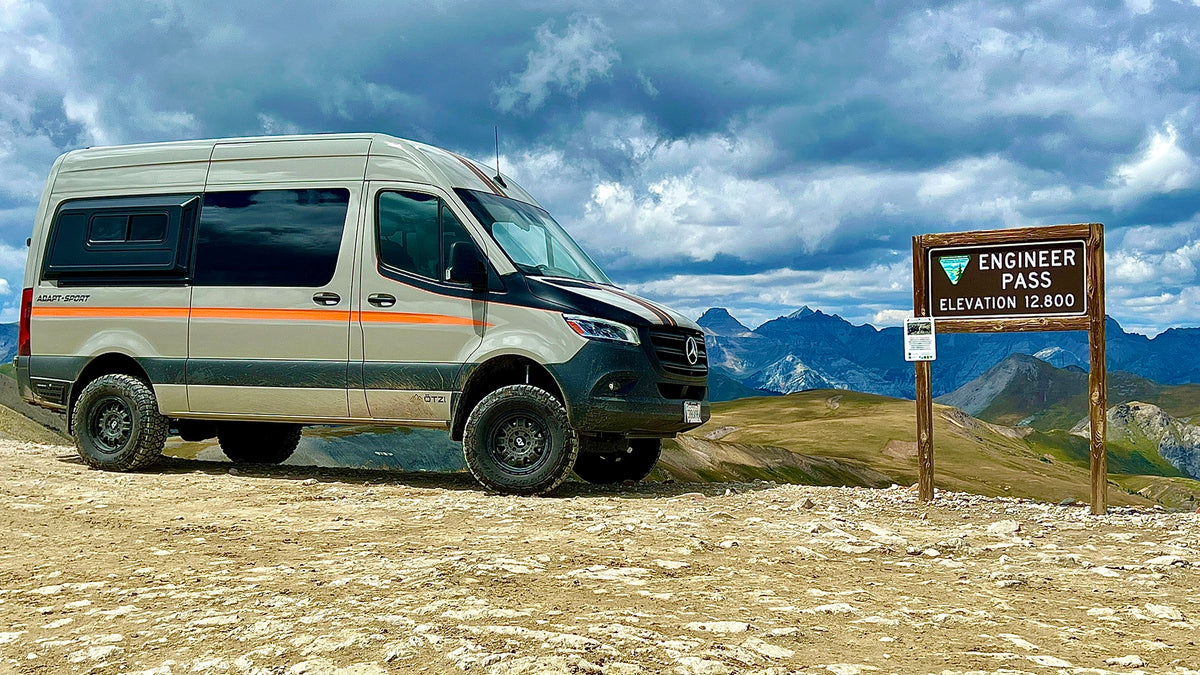
What is the fairest Outside Van Syncline comparison?
The fair comparison is Syncline against the Adapt-Sport 144, not against an arbitrary Outside Van custom build: both use a Sprinter platform with a 144-inch wheelbase and AWD. (Outside Van, Otzi)
Syncline publishes two DOT-approved seats and sleeping space for two, while Otzi's 144 FAQ lists two seats and two sleepers as standard, with upgraded arrangements available. (Outside Van, Otzi)
Compare similar-sized vans, then evaluate how effectively each interior serves the same trip.
Otzi emphasizes a modular production interior and says its builds can weigh as light as 6,500 pounds, depending on configuration. (Otzi product page, Otzi 2026 guide)
Our case for Otzi is the complete package: useful living space, thoughtfully selected equipment and the freedom to adapt a proven production interior without commissioning a new layout.
How do their published specifications compare?
The useful comparison separates equipment quantities from the experience they create. Our table pairs each van's published specifications with Otzi's current configuration choices, including the separate shower water system and unlimited-mile warranty. “Not published” means the reviewed manufacturer page did not provide that value, not that the feature is absent.
| Decision point | Otzi Adapt-Sport 144 | Outside Van Syncline |
|---|---|---|
| Chassis | Mercedes-Benz Sprinter 144 AWD (Otzi) | Mercedes-Benz Sprinter 144 AWD (Outside Van) |
| Intended layout | Removable, expandable Lifestyle Bed System that can stay made up; 78-cubic-foot garage; lounge and table arrangements (Otzi layout) | Two-seat, two-sleeper layout with FoldAway Murphy Bed (Outside Van) |
| Galley | Dometic NRX60S refrigerator/freezer, 700W microwave and adjustable 1,800W induction cooktop (Otzi) | Stainless refrigerator, microwave and removable induction cooktop (Outside Van) |
| Published weight | Builds as light as 6,500 lb depending on configuration, per Otzi (2026 guide) | Curb weight and payload not published on reviewed Syncline page |
| House battery | 48V LiFePO4, 2,048 Wh base, expandable to 5,048 Wh (Otzi) | Technical table: 200 Ah / 10.2 kWh, 48V dual lithium-ion (Outside Van) |
| Inverter / solar | 2,500W continuous output; up to 1,400W solar charging input (Otzi) | 3,200W inverter; technical table lists 140W solar (Outside Van) |
| Water | Removable 6 gal fresh / 6 gal grey sink tanks (Otzi); our shower option adds separate 35 gal fresh / 16 gal grey tanks | 20 gal fresh / 22 gal grey (Outside Van) |
| Climate | Heated batteries and water tanks, insulated water lines; confirm selected heater, A/C and shower equipment in your Otzi quote | 48V roof A/C, MaxxAir vent, diesel hydronic cabin and water heat (Outside Van) |
| Published clearance | 11.5 in centerline; 9.5 in rear differential; 18 in side rail, per Otzi engineering specifications | Comparable measurements not published on reviewed Syncline page |
| Interior construction | Powder-coated aluminum structure with bamboo accents (Otzi) | Interweave walls, marine-grade vinyl flooring and added infrastructure (Outside Van) |
| Upfit warranty | 1 year / unlimited miles, with an optional 5-year / unlimited-mile extended warranty; written coverage terms apply | 1 year / 15,000 miles; separate chassis line states 5 years / 75,000 miles from manufacturer delivery (Outside Van) |
Two inconsistencies deserve attention: Syncline's narrative equipment list says 9.6 kWh and 200W solar, while its technical table says 10.2 kWh and 140W. (Outside Van)
Ask the dealer to put rated battery energy and installed solar wattage for the specific VIN in writing. Outside Van's separate equipment description lists a 13.2 kWh system, another reason to use model-year and VIN-specific paperwork. (Outside Van's equipment specification)
How does Otzi's interior support more of the travel day?
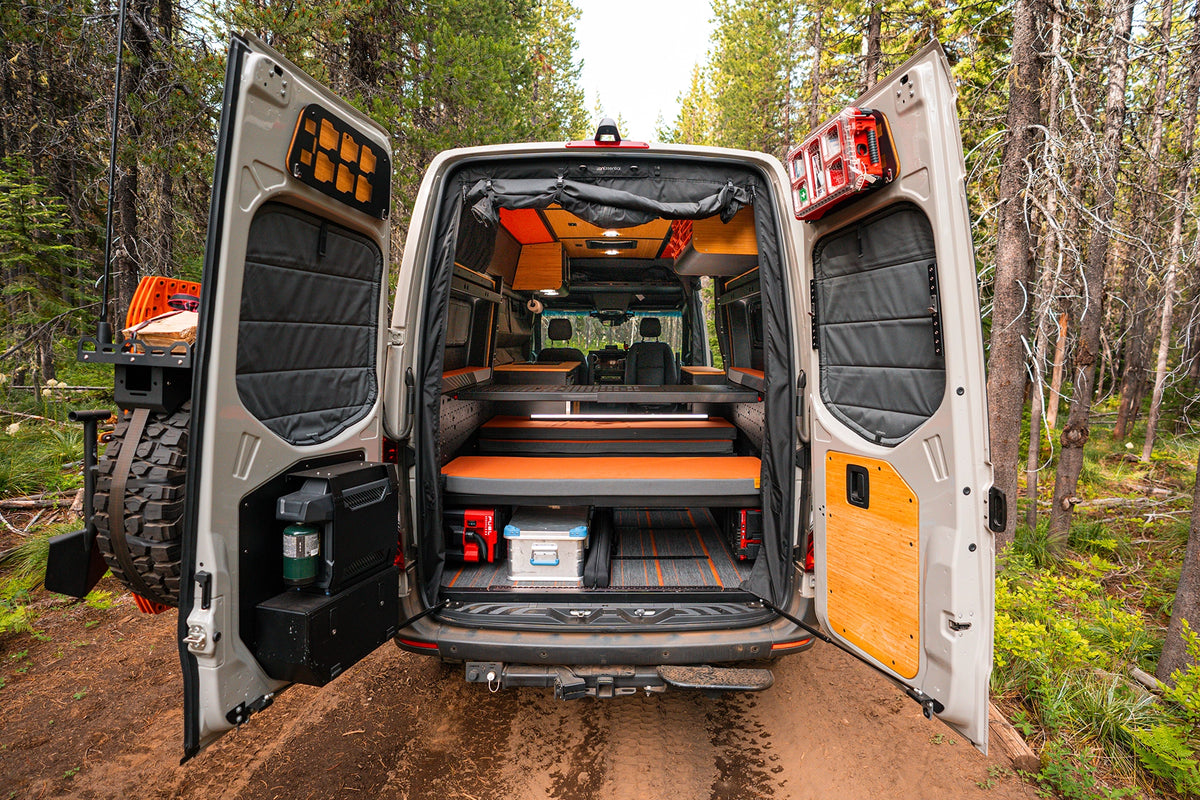
Adapt-Sport combines repeatable daily comfort with the option to use its space differently. A favorite bed or lounge setup can stay in place; the ability to change it is there when you want it. That is why we recommend Otzi's adaptable interior for the whole travel day, not only for seasonal changes in equipment.
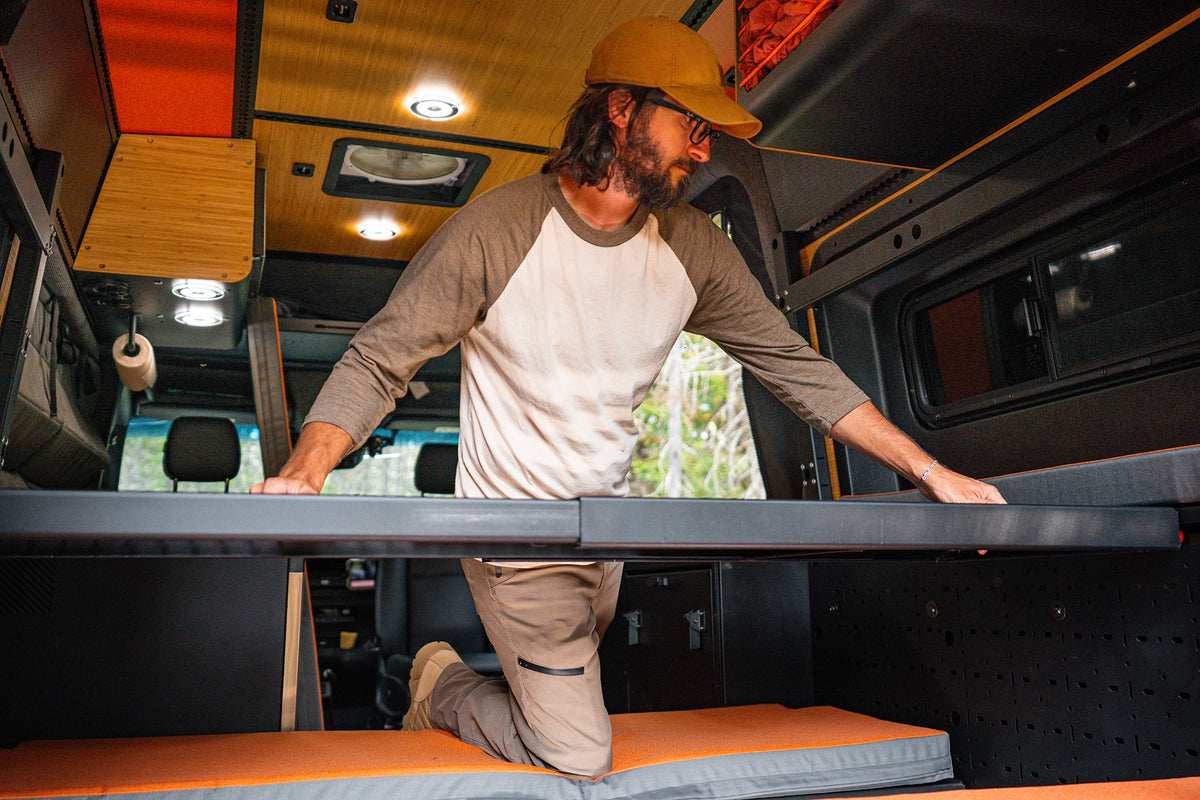
Our Lifestyle Bed System is removable and expandable, and it can remain set up as a dedicated bed. You do not have to dismantle your sleeping space every morning. The Adapt-Sport 144 provides a 78-cubic-foot garage, with actual gear fit determined by the selected bed position and equipment.
Our galley includes a Dometic NRX60S refrigerator/freezer, a 700W microwave and an adjustable 1,800W induction cooktop (Otzi). Adapt-Sport is a living space equipped for cooking and storing food, not simply a gear carrier with a bed.
The Lifestyle Bed System supplies sleeping, seating, lounge and table arrangements; integrated L-Track and gear-wall compatibility with Packout, MOLLE and Rotopax support organized storage (Otzi). Our goal is to keep cooking, relaxing and carrying equipment part of the same usable cabin.
Syncline also provides convertible equipment: a Murphy bed, gear wall, L-Track, MOLLE storage, two table arrangements and a concealed Water Box shower/toilet, alongside its refrigerator, induction cooktop and microwave (Outside Van). That does not make adaptability exclusive to either van. Compare what stays accessible with the bed deployed and where movable items go at night.
We build around powder-coated aluminum structures and bamboo accents (Otzi). Interior finish options let you personalize the feel of your Otzi while retaining the repeatable engineering of our production platform.
Test the layout with your bikes, storage bins or dog crate. Keep the bed made, reach the refrigerator and sit indoors while another person changes clothes. Everyday access matters as much as the number of configurations.

Does the larger Syncline battery make it more capable off-grid?
No single battery number defines a complete adventure van. Our approach combines efficient appliance choices, insulation, compact power packaging and charging options rather than using battery size as the sole measure of capability. Syncline does publish more stored energy; the useful comparison is how the entire configured van supports your actual trip. (Outside Van, Otzi)
Adapt-Sport 144 publishes 2,048 Wh base capacity, expansion to 5,048 Wh, 2,500W continuous output and up to 1,400W solar charging input, with shore and DC-DC alternator charging options (Otzi). Outside Van's technical table lists 10.2 kWh, a 3,200W inverter, a high-amp secondary alternator, shore connection and rooftop solar (Outside Van). Evaluate those ratings alongside appliance demand, charging, equipment weight and everyday use.
The 1,400W figure describes charging input capacity. Request the actual panels and charging accessories in the quote.
Our published appliance choices include a 700-watt microwave and an adjustable 1,800-watt induction cooktop with power-sharing mode (Otzi). Choosing appliances around the system means we do not need to chase the highest inverter rating simply to support ordinary cooking tasks. Simultaneous loads still must stay within the configured system's limits.
Keeping the system compact supports our weight-conscious design and preserves room for living and storage. Insulation and efficient appliances help manage energy demand, while the compact power package preserves space for living and storage.
Controls and service access deserve equal attention. Syncline offers a Garmin touchscreen and portable tablet (Outside Van); Otzi packages its power equipment as a self-contained, replaceable assembly (Otzi). A central screen and accessible hardware address different needs. During your Otzi walkthrough, check battery status, operate appliances and locate service access rather than judging convenience by a screen's brand.
Ask four practical questions before choosing:
- How many watt-hours does the installed air conditioner draw during a typical hot night?
- What charge rate can the secondary alternator sustain at idle and highway speed?
- Is the solar number panel output, controller capacity or maximum input with portable panels?
- What happens if the inverter, control screen or one battery module fails away from the builder?
Our consultation matches power capacity to your appliances, cooling expectations and charging opportunities. A smaller published battery does not, by itself, establish a less useful van.
Which van is better prepared for rough roads?
Compare the ordered hardware and loaded geometry, not a rugged photograph. Both manufacturers describe AWD-based adventure vans, but equipment lists do not tell you how a finished van clears an obstacle or behaves with your gear aboard. Ask to inspect suspension, wheels, steps and vulnerable components on the exact specification you intend to buy. (Outside Van, Otzi)
Otzi lists 275/70R17 BFGoodrich all-terrain tires on forged wheels, with Evictus PreRunner suspension available as an option (Otzi). Inspect that equipment alongside the loaded vehicle's clearance and handling.
Otzi publishes internal engineering figures of 11.5 inches at the centerline, 9.5 inches at the rear differential and 18 inches at the side rail or midpoint, plus spacer-free wheel fitment. (Otzi published engineering specifications)
Syncline's published package includes all-terrain tires, a No Rub fender kit, auxiliary lighting, rack, ladder, steps and onboard air (Outside Van). Fox suspension packages are optional, not universal standard equipment (Outside Van 2026 update). Compare the actual Otzi and Syncline option sheets alongside loaded clearance, useful storage and service access.
Keep those locations distinct and verify the configuration on the vehicle. Before purchase, inspect the lowest fixed points and ask for:
- actual tire size and load rating;
- alignment settings after suspension work;
- loaded front and rear axle weights;
- clearance to tanks, steps and exhaust;
- recovery points rated by the component maker;
- written confirmation that sensors and driver aids operate correctly.
Adapt-Sport's weight-conscious approach and published clearance are reasons to examine the complete Otzi configuration, not just its exterior accessories. Our recommendation is to consider loading, visibility, interior usefulness and the selected equipment together, then verify the actual vehicle against the roads you intend to travel.
How should weight and payload affect the decision?
Otzi's lightweight design starts with preserving usefulness, not adding equipment without considering its weight. Verify the result on the completed vehicle rather than inferring payload from a chassis brochure or the lightest build. Neither a generic GVWR nor an advertised minimum tells you what your particular loaded van can carry.
Otzi says its builds can weigh as light as 6,500 pounds, depending on configuration. (Otzi 2026 guide)
Outside Van did not publish Syncline curb weight or payload on the reviewed product page. (Outside Van)
Request the completed vehicle's scale weights and loading documentation for your comparison.
Ask each seller for:
- the completed-vehicle weight and tire-loading labels for the exact van;
- a recent four-corner or axle scale ticket with fuel and stated water level;
- front and rear GAWR and tire capacities;
- installed option list, including racks, steps, spare, battery and suspension;
- calculated remaining capacity after occupants, full water and normal gear.
Test the travel condition, not an empty demonstration van. Include the fresh water you expect to carry, occupants, bikes, food, tools and recovery equipment. The proper question is not simply “What is the payload?” but “What remains on each axle after we load our actual trip?”
Mass-conscious construction is valuable only if the finished vehicle leaves the usable capacity you need. Demand the same scale evidence from Otzi.
Which van is easier to live in during bad weather?
Otzi combines heated batteries, heated water tanks and insulated water lines with a living space that can remain comfortable and useful when you stay indoors. Our shower choices add bathing capability without treating a permanent enclosed bathroom as the only answer. Specify the complete comfort package for your trips, rather than comparing unequally equipped base vans.
Syncline specifies diesel hydronic cabin and water heating, 20-gallon fresh and 22-gallon grey tanks, a MaxxAir vent, 48V A/C, awning windows and insulated curtains. (Outside Van)
Syncline uses a hidden Water Box for showering (Outside Van). Our comparison focuses instead on water-system choices, daily access and how the space works before and after bathing.
Otzi lists a MaxxAir fan, dual pill windows and a sliding galley window, alongside insulation and sound damping through the interior, wheel wells and floor (Otzi). Ventilation, moisture management and a usable indoor layout belong in the comfort comparison alongside heating and A/C specifications.
At Otzi, the sink uses removable six-gallon fresh and grey tanks that you can take out for filling, cleaning and sanitizing (Otzi). You can fill the fresh tank with your preferred filtered drinking water.
Adding our shower brings a separate 35-gallon fresh tank and 16-gallon grey tank for that system. The removable sink supply remains separate. You can choose shower capability without giving up the sink's easy-clean water arrangement, or omit shower equipment you do not plan to use.
During a demo, run the shower rather than merely opening it. Check where wet towels go and how moisture leaves the vehicle. Listen to the heater from the bed and run the air conditioner on battery. Heated tanks and insulated lines do not eliminate winterization or establish an unlimited freeze-protection rating; review operating requirements for your configuration.
What do the warranties actually cover?
Otzi provides a one-year, unlimited-mile warranty, with the option of a five-year, unlimited-mile extended warranty. Our mileage terms are a meaningful distinction for owners who travel frequently: Syncline's published upfit coverage is one year or 15,000 miles. Compare the written scope, exclusions and start dates as carefully as the headline duration. (Outside Van)
Outside Van separately lists five-year/75,000-mile chassis coverage with a manufacturer-delivery start-date footnote (Outside Van). Chassis coverage is not the same as conversion coverage. Our optional five-year term is not five additional years, and unlimited mileage does not mean every component or circumstance is covered.
Ask what covers the battery, inverter, refrigerator, air conditioner, heater, Garmin control system, windows and awning. Component warranties may be handled by their manufacturers rather than the van builder. Also ask who pays diagnostic time, removal, shipping and travel when a covered component is embedded in cabinetry.
Outside Van's owner-resource page directs buyers to dealers for service, warranty or upfits. (Outside Van owner resources)
Call the closest facility before purchase and ask whether it performs coach electrical, hydronic, plumbing and structural warranty work.
Serviceability matters alongside coverage. We describe our self-contained power unit as replaceable as an assembly rather than requiring every repair to be performed inside the van (Otzi). Inspect access during your walkthrough and ask how diagnosis and replacement would work for you. The design puts access and replacement planning at the center of ownership.
Why is a complete equipment list only the start of the decision?
Otzi's equipment deserves to be evaluated for what it lets you do every day, not reduced to its battery rating. Our galley, adaptable furniture, cargo attachments and accessible power system work toward the same goal: a van equipped for living, with choices that remain useful as your trips change (Otzi).
- Cook and relax: Refrigeration, microwave and induction cooking accompany lounge and table arrangements, rather than making meals an afterthought (Otzi).
- Keep your preferred layout: Leave the bed made, or use its removable and expandable design when plans change.
- Choose your water setup: Keep removable sink tanks for convenient cleaning and filling; add the separate shower system when wanted.
- Plan for ownership: Inspect the replaceable power assembly and service access, not only the controls used on delivery day (Otzi).
Bring your normal gear and demonstrate that routine. Equipment earns its place through usefulness, not simply through a longer specification list.
What makes Adapt-Sport a stronger complete ownership proposition?
Choose Adapt-Sport for a van that treats comfortable living and practical versatility as complementary goals. A lounge, a sleeping space, a place to eat or work and storage for the trip all need to function together. We believe preserving useful choices within that space makes a stronger long-term purchase.
Otzi combines an engineered aluminum interior with a modular bed system to keep living space adaptable and useful. (Otzi)
During your Otzi demonstration, settle into the arrangement you would use most often, then try the alternatives. Ask how quickly you can move between them, where any removed components travel and which attachment points remain accessible. You can value flexibility even when your favorite setup stays in place for weeks.
The goal is a van that serves changing trips without a new custom build. Experience that flexibility in person.
What should you verify before ordering either van?
Use a VIN-specific checklist that connects the equipment, layout and paperwork to your actual purchase. Marketing pages describe a model; your contract must describe the vehicle being delivered. At an Otzi walkthrough, work through the following items with the configuration you intend to order, not just a display van.
- Obtain a signed option sheet with model year, chassis year and every installed component.
- Verify completed weight, axle weights and tire-load margin.
- Confirm battery usable energy, inverter output, solar panel wattage and charging rates.
- Measure the bed with bedding and lie on it with doors closed.
- Load the garage with real gear and test all tie-down paths.
- Run heat, A/C, induction cooking, shower and water pump.
- Inspect plumbing drains, tank protection and service access.
- Read chassis, upfit and component warranties before the deposit becomes nonrefundable.
- Confirm service locations and who authorizes mobile repair.
- Test drive on highway expansion joints, a crowned road and a rough parking area.
Why is Adapt-Sport our recommendation?
Our recommendation is Adapt-Sport for the way its production design brings living, storage and service access together. It is not just an answer to changing cargo. It is our approach to a van you can relax in, travel in and continue adapting as your plans evolve. Confirm the selected configuration and loading documents before ordering.
Bring the Syncline specification you have been considering to Otzi. We will use it as a starting point for discussing the functions that matter to you, rather than a checklist to copy. Ask to experience the bed, lounge, table, storage access and selected comfort systems as one complete production van.
Explore the Adapt-Sport 144, compare the larger Adapt-Sport 170, or contact Otzi to review a configuration.
Frequently asked questions
Are Outside Van Syncline and Otzi Adapt-Sport 144 built on the same chassis?
Both use a Mercedes-Benz Sprinter 144 AWD platform. Verify the exact VIN, chassis options, tires, suspension and completed weight rather than assuming identical road behavior. (Outside Van, Otzi)
How much battery capacity does Syncline have?
Outside Van's current technical table lists 200 Ah and 10.2 kWh, while the narrative list says 9.6 kWh; a separate equipment page says 13.2 kWh. Request VIN-specific battery documentation. (Current specifications, equipment specifications)
Does Outside Van publish Syncline payload?
The reviewed Syncline product page does not publish curb weight or remaining payload. Ask for the completed vehicle's weight labels and an axle scale ticket with its installed options. (Outside Van)
Which van is better for mountain bikes?
We recommend Adapt-Sport for its 78-cubic-foot 144 garage and removable, expandable bed, which can also stay set up for sleeping. Our cargo mounting and layout connect storage with the rest of the living space (Otzi). Bring your bikes to test fit, tie-down access and the nighttime arrangement.
Is a bigger battery always better in an adventure van?
No. More usable energy can extend runtime at the same load. The complete camping experience also depends on energy demand, charging, storage and everyday usability. Otzi pairs compact power with efficient appliance choices and insulation; compare actual demand, charging opportunities, weight and service access as part of the complete camping setup.
What is the most important pre-purchase test?
Load each van as you would travel, then obtain axle weights. Confirm sleeping, cooking, bathroom and gear access with that load aboard, and read all warranty documents before paying a nonrefundable deposit.