
The Otzi advantage / Comparison 05
Our Otzi vs Thor Sanctuary and Tranquility recommendation is Adapt-Sport: a production Sprinter whose Lifestyle Bed System supports sleeping, lounging, seating and table arrangements alongside equipment storage (Otzi Adapt-Sport 144). We build around the complete travel day, with a focus on useful space and accessible construction rather than treating a longer equipment list as a better van.
We build and sell Otzi vans. Here is our case for choosing the Adapt-Sport, grounded in its equipment, adaptable interior and everyday usability.
This guide compares the current Mercedes-Benz Sprinter versions of Sanctuary and Tranquility, not every vehicle ever sold under those names. As checked in September 2026, Thor’s live product pages identify both ranges as model year 2027. (Thor Sanctuary, Thor Tranquility)
Are Thor Sanctuary and Tranquility actually different vans?
Sanctuary and Tranquility are sister products, so start with the floor plan, model year, and installed equipment rather than the name. Thor explicitly groups them together in its Class B range, and both current lineups show the same five floor-plan codes: 19A, 19M, 19P, 24A, and 24E. (Thor Class B overview, Sanctuary lineup, Tranquility lineup)
Compare the exact model year, options and equipment in each dealer-stock vehicle. Compare a specific Sanctuary 19A with a specific Tranquility 19A before deciding whether a price difference reflects equipment or simply a different offer.
The more consequential choice is often between short and long floor plans. Thor lists the Sanctuary 19A at 19 feet 9 inches on the Sprinter 2500 AWD, while the 24A is 24 feet 6 inches and lists the Sprinter 3500 AWD among its chassis features. (Thor 19A specifications, Thor 24A specifications)
Otzi’s production-model approach emphasizes a different kind of choice: an interior you can rearrange after purchase, with the bed platform moving between gear-storage, sleeping, seating, and lounge arrangements. (Otzi Adapt-Sport 144)
What does the comparison look like at a glance?
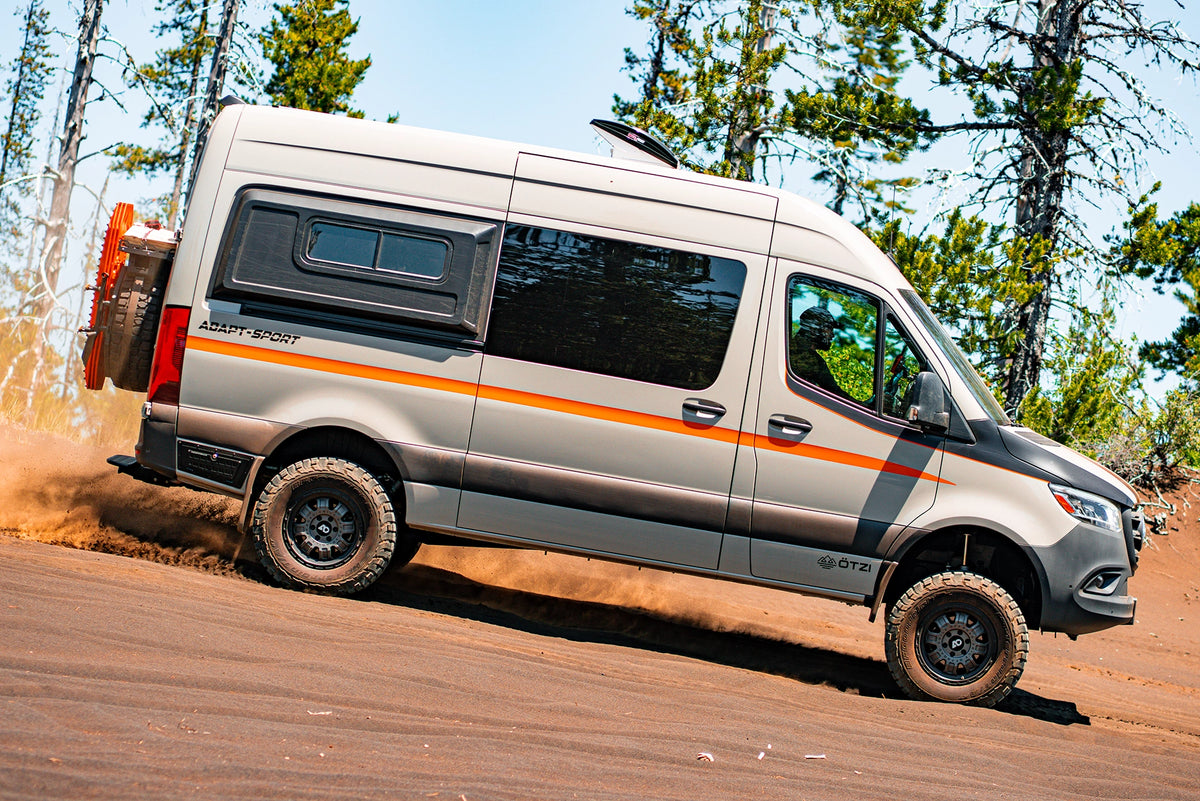
The useful comparison is how each complete van delivers comfort, storage and everyday usability, not camper convenience versus adventure capability. Otzi brings those functions together in a production platform. The table uses named Thor floor plans rather than treating the entire range as one specification; Otzi electrical figures refer to the Adapt-Sport 144.
| Decision | Otzi Adapt-Sport 144 | Thor Sanctuary / Tranquility reference |
|---|---|---|
| Layout and gear storage | Lifestyle Bed System can remain a dedicated bed or reconfigure; Adapt-Sport 144 garage: 78 cubic feet. Otzi layout | Several defined layouts; 24E includes a gear garage, but its cited page gives no garage volume. Thor 24E |
| Compact chassis | 144-inch-wheelbase Sprinter platform. Otzi | Sanctuary 19A: Sprinter 2500 AWD, 144-inch wheelbase. Thor 19A |
| Weight information | Can weigh as light as 6,500 pounds, depending on configuration. Otzi guide | 19A GVWR: 9,050 lb; 24A GVWR: 11,030 lb. These are ratings, not empty weights. 19A, 24A |
| House energy | 2,048 Wh, expandable to 5,048 Wh. Otzi | 19A: two 100 Ah batteries standard; optional 460 Ah Re(Li)able package. Thor 19A |
| Inverter output | 2,500 W continuous. Otzi | 19A: 1,000 W standard; 3,000 W in Re(Li)able package. Thor 19A |
| Solar specification | Up to 1,400 W solar charging input capacity; confirm installed panels. Otzi | 200 W solar charging system on the reviewed 19A and 24A. 19A, 24A |
| Water approach | Removable 6-gallon fresh and 6-gallon gray sink tanks; optional shower adds separate 35-gallon fresh and 16-gallon gray tanks. Otzi sink and shower options | 19A: 25 gallons fresh, 20 gray; 24A: 35 fresh, 33 gray. 19A, 24A |
| Bathroom | Concealed cassette toilet and optional fold-down indoor hot-water shower rather than a permanently enclosed shower room. Otzi | Enclosed wet bathroom and cassette toilet listed for 19A. Thor 19A |
| Cold-weather provisions | Heated batteries, heated water tanks and insulated water lines; follow the installed equipment's operating instructions. | Truma Combi D heating/hot water and holding-tank heat pads. Thor 19A |
| Interior construction | Powder-coated aluminum structures with bamboo accents. Otzi | Lightweight cabinetry, Euro-style upper doors, soft-close drawer guides. Thor 19A |
| Conversion warranty | One year/unlimited miles; optional five-year/unlimited-mile extended warranty. Written terms apply. | Published Class B guide: 24 months/30,000 miles under normal terms, with important use restrictions. Thor warranty guide |
Use the table to shortlist vehicles, then inspect the exact configuration. Do not let a salesperson substitute an optional package from another van for the equipment actually installed in yours.
Which layout works better when you bring real adventure gear?
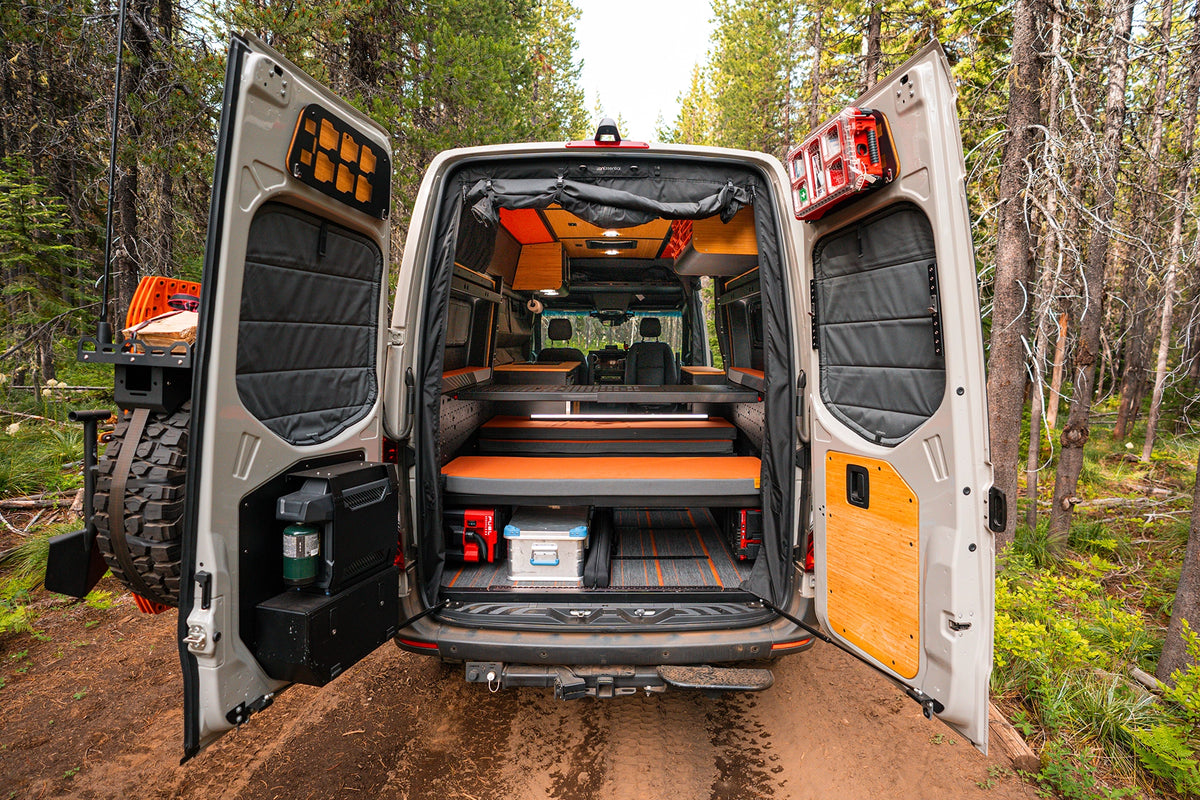
Otzi brings equipment storage and comfortable living into the same design. The Adapt-Sport 144 provides a 78-cubic-foot garage, while its Lifestyle Bed System can remain a dedicated bed or change into other arrangements. Structural garage-floor L-track helps secure equipment rather than leaving storage as an afterthought. (Otzi layout and securement)
Our recommendation is to judge that flexibility with your equipment present. Bring the longest board, the bike with the widest handlebars, and the storage bin you refuse to leave behind. Build the nighttime layout with those objects inside, not stacked beside the van.
Thor is not simply a fixed bed and no storage. Its current Tranquility 24E lists a gear garage below the bed, twin beds with the Zomi sleep system, a mid wet bath, and a front jump seat. (Thor Tranquility 24E)
Thor's cited page does not publish a comparable garage volume. Otzi's case is the combination of a defined garage, configurable furniture and useful living space. Test your particular gear through the opening and check access with the bed in place.
Run a rainy-evening rehearsal. Close the doors, put wet shoes where they would really go, and have each traveler perform a different task. One should prepare food while another gets into bed. Then retrieve a jacket and use the toilet.
This is why we recommend Otzi's adaptable approach. Leave the bed set up for the entire trip if that suits your routine. Flexibility is an additional capability, not an obligation to rebuild your room every night.
Travel seating is separate from bed or lounge capacity. Otzi's published standard 144 arrangement seats and sleeps two, its upgraded arrangement seats three and sleeps four, and the 170 seats and sleeps four. Confirm the selected travel seats and sleeping layout together rather than counting campsite furniture as passenger restraints. (Otzi 144, Otzi 170)
How should you compare weight, payload, and towing?
Otzi's lightweight production design starts with builds that can weigh as light as 6,500 pounds, depending on configuration (Otzi guide). Use the selected vehicle's completed weight for loading calculations. Compare completed vehicles under documented conditions before assigning a precise weight or payload advantage.
The longer 24A lists an 11,030-pound GVWR and 15,250-pound GCWR. GVWR is the maximum permitted loaded vehicle weight. Use completed-vehicle scale weights to compare the vans themselves. (Thor Sanctuary 24A)
The compact 19A lists a 9,050-pound GVWR and 13,930-pound GCWR. These describe maximum vehicle and combined ratings, not a published empty weight. Neither number can be subtracted from Otzi's minimum to calculate how much lighter an Otzi is. (Thor Sanctuary 19A)
Owner-posted scale readings can be useful when the model, equipment and loading conditions are identifiable. They should remain labeled owner reports, not factory specifications. A rental listing's “dry weight” without a scale record is weaker evidence, especially if its figures conflict with the chassis rating.
Ask for the delivered configuration’s cargo-carrying label and a scale ticket with front and rear axle weights. Record the water, fuel, accessories, and occupants present when it was weighed. Without that context, two scale tickets may describe different loading conditions rather than different engineering outcomes.
Make a trip inventory before committing to the van: travelers, pets, water, bikes, food, tools, recovery equipment, and anything permanently attached outside. Include the items that tend to appear after delivery, such as a larger spare, storage box, or hitch carrier.
Thor lists a 5,000-pound hitch rating on both reviewed floor plans. Treat that as a hitch specification, not unconditional permission to tow that much with every passenger and tank aboard. (Thor 19A, Thor 24A)
Our buying rule is straightforward: require a written loaded-use assessment against the vehicle’s applicable ratings. Do that for Otzi too. Lightweight design is valuable only when the delivered configuration leaves the capacity your travel requires.
Does an AWD badge settle the off-pavement comparison?
No. Evaluate the clearance at vulnerable components, the loaded suspension, tire specification, and rear attachments separately. Thor’s reviewed pages list AWD, black aluminum wheels, off-road tires, side steps, and a top-mounted light bar. Inspect loaded clearance at steps, tanks and other vulnerable components. (Thor Sanctuary 19A)
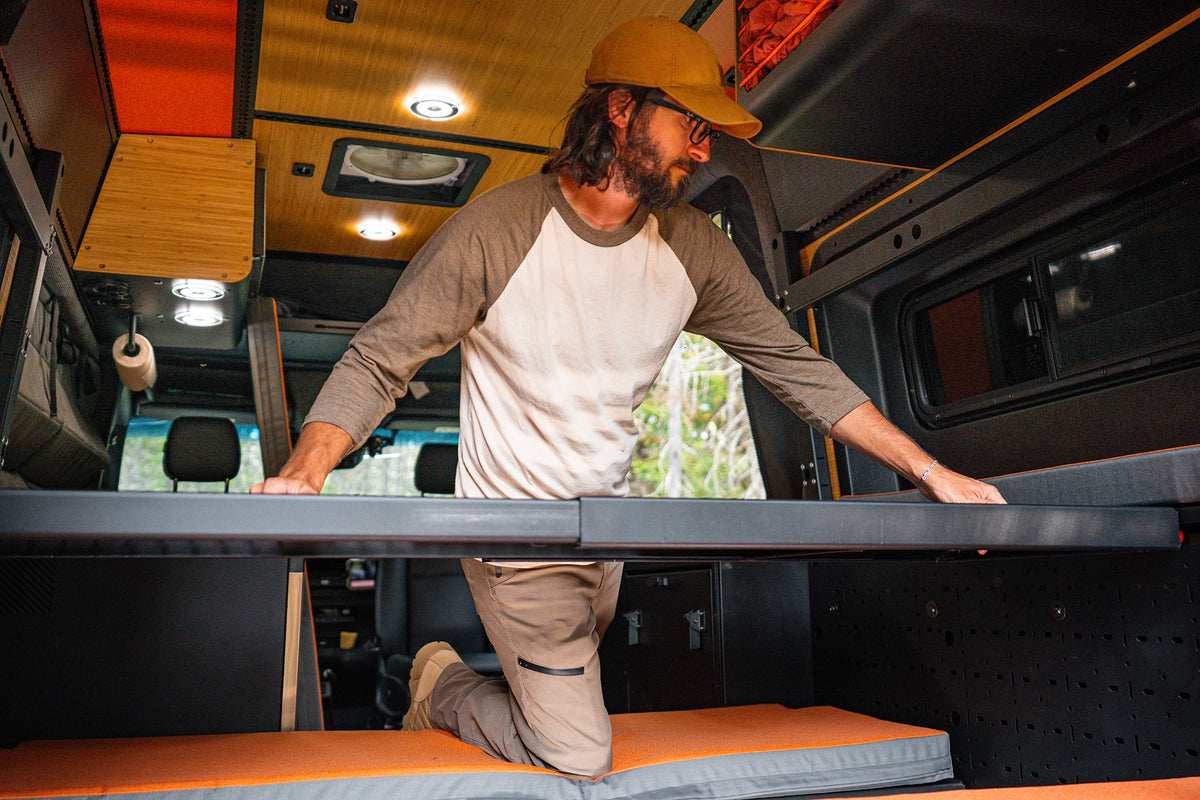
Otzi publishes builder-stated clearance measurements of 11.5 inches at the centerline, 9.5 inches at the rear differential, and 18 inches at the side rail or midpoint, alongside its spacer-free wheel-offset approach. Those describe different locations, not a single interchangeable “ground clearance” figure. (Otzi published engineering comparison)
Use that specificity as the standard for your inspection. Ask both sellers to identify the measurement points with the van loaded as you will use it. Look at steps, plumbing, exhaust routing, hitch hardware, and anything mounted beneath the floor.
Inspect clearance at the differential, side rails, steps, tanks and rear accessories. Evaluate the completed vehicle with the equipment and load you plan to carry.
Request a test drive that includes the kinds of surfaces you expect to encounter, with seller permission and appropriate precautions. Listen for cabinet movement, check steering response, and assess whether the suspension remains controlled with your intended load. Avoid making a purchase contingent on a dramatic demonstration that tells you little about normal travel.

Which power system better matches your camping routine?
Otzi sizes its power system around efficient appliances, useful interior space and manageable weight, rather than maximum capacity alone. The Adapt-Sport 144 publishes 2,048 Wh of storage, expandable to 5,048 Wh, with 2,500 watts of continuous output. That package supports our complete-van approach to comfort, insulation, charging and serviceability. (Otzi Adapt-Sport 144)
According to Thor’s current 19A equipment labels, the standard package includes two 100 Ah lithium batteries, a 1,000-watt inverter, and a 40-amp DC-to-DC charger. The optional Re(Li)able package instead lists a 460 Ah lithium battery, 3,000-watt inverter, and secondary alternator; the reviewed 24A marks that Re(Li)able package standard. (Thor 19A, Thor 24A)
Ask for battery voltage and usable energy before comparing Thor’s amp-hours with Otzi’s watt-hours. Ask separately which appliances the inverter can run simultaneously.
Thor's upgraded inverter has a higher output rating, but output matters only when your appliances need it. We select efficient appliances around Otzi's 2,500-watt system rather than fitting larger electrical equipment for its own sake. Compact equipment preserves useful space. Compare the appliance combinations you will actually use and keep simultaneous loads within the configured system's limits.
Otzi has heated batteries, and its self-contained power module can be replaced as a unit. Our product page describes swaps that can often be completed in under an hour when the replacement equipment and support are available. Diagnosis and delivery timing are arranged separately. (Otzi power service) The solar comparison requires equal care. Otzi’s published 1,400-watt figure is charging input capacity; Thor lists a 200-watt solar charging system. Confirm installed panel wattage and available charging inputs in each vehicle's equipment list. (Otzi power specifications, Thor solar specifications)
Write down a normal camping day and a demanding one. Include cooking, refrigeration, computer charging, ventilation, and any air-conditioning expectations. Ask the seller to demonstrate those loads and provide a charging plan for a day when you do not drive.
Our recommendation is to demonstrate the Otzi system with the devices you actually use. Select appropriate capacity and a charging plan instead of carrying equipment solely because a brochure number looks larger.
What do the bathroom and water systems mean in daily use?
Otzi gives you indoor shower capability without requiring a permanently enclosed shower room. Our optional fold-down shower configuration adds separate 35-gallon fresh and 16-gallon gray tanks alongside the removable six-gallon sink tanks. You can select that capability while retaining the galley's cleaning convenience and an interior designed around more than bathroom use.
Even within Thor’s short vans, water capacity differs: the 19A lists 25 gallons fresh, while the 19P lists 19 gallons; both list 20 gallons gray and 4.75 gallons waste capacity. (Thor 19A, Thor 19P)
Otzi's separate portable fresh and gray galley tanks hold six gallons each. The fresh container can be removed for cleaning and sanitizing, then filled with preferred filtered drinking water. Removable tanks make routine cleaning and refilling straightforward. (Otzi galley specifications)
A fixed enclosed shower or wet-bath room reserves its footprint 100% of the time, even when nobody is showering. It can serve bathroom functions, but that area does not become open living space just because the shower is off. Otzi's fold-down approach makes showering one use of the interior rather than a permanent room assignment. (Otzi shower option)
Thor's 24A lists 33 gallons of gray-water capacity, versus Otzi's separate six-gallon sink and 16-gallon shower tanks. More collection capacity can extend dumping intervals, but actual use matters. Otzi separates drinking-water handling from shower supply and lets you select shower capability without making a permanent bathroom the center of the layout. (Thor 24A)
How should you evaluate cold-weather construction and interior durability?
Otzi's cold-weather provisions include heated batteries, heated water tanks and insulated water lines. These features belong in the comparison alongside insulation and heating equipment, rather than treating winter readiness as a competitor-only feature. Follow the installed systems' operating-temperature, power and winterization instructions.
Thor lists Truma Combi D diesel-and-electric heating and hot water, holding-tank heat pads, and an 11,000-BTU air conditioner on the reviewed 19A page. (Thor Sanctuary 19A)
Ask which water lines and drain points remain protected, what must run overnight, and what happens when the van is parked without external power. Request written winterization instructions and the exact limitations of the equipped vehicle.
Otzi’s published interior uses powder-coated aluminum structures, bamboo accents, and removable wall and ceiling panels intended to preserve service access. That construction supports a durable, serviceable interior designed around long-term ownership. (Otzi Adapt-Sport 144)
Thor’s current 19A page describes lightweight cabinetry and Euro-style upper cabinet doors. Inspect the cabinetry's joints, attachments and service access during the walkthrough. (Thor Sanctuary 19A)
Open the service panels. Ask how the water pump, electrical protection, heater, and plumbing connections are reached. Check latches and drawer action. Request the procedure for replacing a damaged panel or reaching a leak without dismantling unrelated cabinetry.
Our preference is an interior that supports outdoor equipment and straightforward maintenance. See how easily you can reach equipment, inspect connections and maintain the finished interior.
What warranty details deserve attention before you sign?
Otzi provides a one-year/unlimited-mile warranty with an optional five-year/unlimited-mile extended warranty. We recommend evaluating that mileage flexibility together with accessible systems and practical service procedures. Review the written coverage for your purchase; an optional five-year term is not standard coverage or five additional years, and conversion coverage does not extend the chassis warranty.
Thor's normal warranty is 24 months or 30,000 miles, whichever occurs first: longer standard calendar coverage, but mileage-limited. Otzi's standard warranty has no mileage ceiling during its one-year term, and the optional five-year/unlimited-mile warranty offers a longer-duration choice. Compare coverage, exclusions and cost, not years alone. (Thor Class B Warranty Guide, revision 250801)
The same guide specifies a reduced term of 90 days or 5,000 miles for defined full-time, residential, business-use, and certain older-model-year purchase situations; it excludes rental-use warranty coverage. Ask how the guide's use categories apply to your travel plans. (Thor Class B Warranty Guide, 2025)
Describe your ownership and intended use accurately, then request written clarification before purchase.
Thor also states that its Structural and Lamination Limited Warranty does not apply to Class B motorhomes. That is different from saying the vehicle has no warranty or that its body is unsafe. (Thor Class B Warranty Guide, 2025)
For Otzi, review conversion and component coverage, exclusions, labor responsibility and support away from the factory. Unlimited miles does not mean every type of use or every component is covered. Our recommendation combines clear coverage terms with serviceable design.
For either purchase, obtain the VIN-specific recall status and documented completion of applicable remedies. A broad count of recalls across years is not a substitute for understanding the particular vehicle you will own.
What are the key takeaways for Sanctuary and Tranquility buyers?
Put Otzi first for a production interior that supports comfortable travel without locking its useful space into a single routine. Sleeping, lounging, dining and equipment storage all belong in the same purchase decision. Our recommendation is to experience those functions together, then select the model and available equipment that support your plans.
Before paying a deposit, ask each seller to complete the same demonstration:
- Show the actual vehicle’s model year, chassis, options, and loading documents.
- Load representative equipment and establish the sleeping configuration.
- Run your important appliances and explain the charging plan.
- Demonstrate water servicing and winterization access.
- Explain warranty handling away from the selling location.
Compare the delivered package rather than one vehicle’s sale price against another’s headline MSRP. Include accessories, electrical upgrades, required equipment storage, and anything you already know you will add.
What are the most common questions about Otzi versus Thor?
These answers keep the comparison tied to actual equipment, not broad assumptions about either brand. Otzi's recommendation remains the Adapt-Sport for comfortable production-built versatility. Use the questions to prepare for a walkthrough, then confirm the selected layout, water system, electrical package and warranty in the documents for your van.
Are Sanctuary and Tranquility the same?
Thor calls them sister products, and its current 2027 pages list the same five floor-plan codes. Compare matching model years, floor plans, and installed options rather than assuming every vehicle is identical. (Thor Class B overview, Sanctuary lineup, Tranquility lineup)
Is the 460 Ah Thor power system standard?
It is optional on the reviewed Sanctuary 19A page and standard on the reviewed 24A page. Confirm the installed package on the particular van before buying. (Thor 19A, Thor 24A)
Which van is better for mountain bikes and changing equipment?
We recommend Otzi's Adapt-Sport 144 with its 78-cubic-foot garage and Lifestyle Bed System. Keep the bed set up or change arrangements when useful; modularity does not require daily conversion. Bring your bikes to a walkthrough to check fit, securement and access. (Otzi layout)
Does Thor’s GVWR tell me its empty weight?
No. The reviewed 19A lists a 9,050-pound GVWR, which is a weight rating rather than a published empty-vehicle weight. Request the actual van’s loading label and scale information. (Thor 19A specifications)
Does Thor’s regular warranty apply to full-time living?
Thor’s August 2025 Class B guide specifies a reduced 90-day or 5,000-mile term for defined full-time and residential use, whichever occurs first. Obtain written confirmation of the warranty applicable to your vehicle and intended use. (Thor Class B Warranty Guide)
Does Otzi offer shower capacity and cold-weather plumbing protection?
Yes. Our optional indoor shower configuration adds separate 35-gallon fresh and 16-gallon gray tanks alongside the removable six-gallon sink tanks. The Adapt-Sport has heated water tanks and insulated water lines for cold-weather use. Confirm the selected equipment and follow its operating and winterization instructions.
Where can you see whether Otzi fits your trips?
Start with the Adapt-Sport 144, or explore the larger Adapt-Sport 170, then contact Otzi with your passenger count, largest equipment, bathroom priorities, and normal camping routine. Ask for a production-model walkthrough that demonstrates those needs rather than a tour built around accessories you may never use.
Otzi reports that the Adapt-Sport won the 2025 AVE Builders Cup. Use that recognition as a reason to look closely, then let the layout demonstration and vehicle documents decide whether it belongs in your driveway. (Otzi Adventure Gear)