

The Otzi advantage / Comparison 02
The Otzi Adapt-Sport 144 is our recommendation for a Winnebago Revel alternative because it combines adaptable living space, lightweight construction and accessible systems in a production adventure van. Our Lifestyle Bed System, aluminum cabinetry and removable panels make that approach tangible: a van designed to work throughout your day, not simply impress on a specification sheet (Otzi Adapt-Sport 144).
This guide compares our Adapt-Sport 144 with the 2026 Winnebago Revel 44E, not the separately specified Revel Sport or other Revel floorplans. Winnebago identifies the 44E as a 144-inch-wheelbase AWD Sprinter with a power-lift bed, indoor wet bath and integrated electrical system (Winnebago 2026 Revel 44E).
We build and sell Otzi vans, so our recommendation is clear. What follows is the reasoning behind it, with published competitor specifications kept separate from our design philosophy and the equipment choices available on your Otzi.
Why choose the Otzi Adapt-Sport over the Revel?
Choose Otzi for a complete living environment that can adapt without a custom rebuild. Our production design brings together a multi-position bed, practical gear storage, an equipped galley and accessible interior construction. The benefit is flexibility you can use when you need it, without having to change your favorite setup every day (Otzi).
A good adventure van needs to do several jobs in limited space. It should carry your equipment, give you somewhere comfortable to relax, support meals and work, and become a bedroom at night. Our answer is to make the same space useful in more than one way.
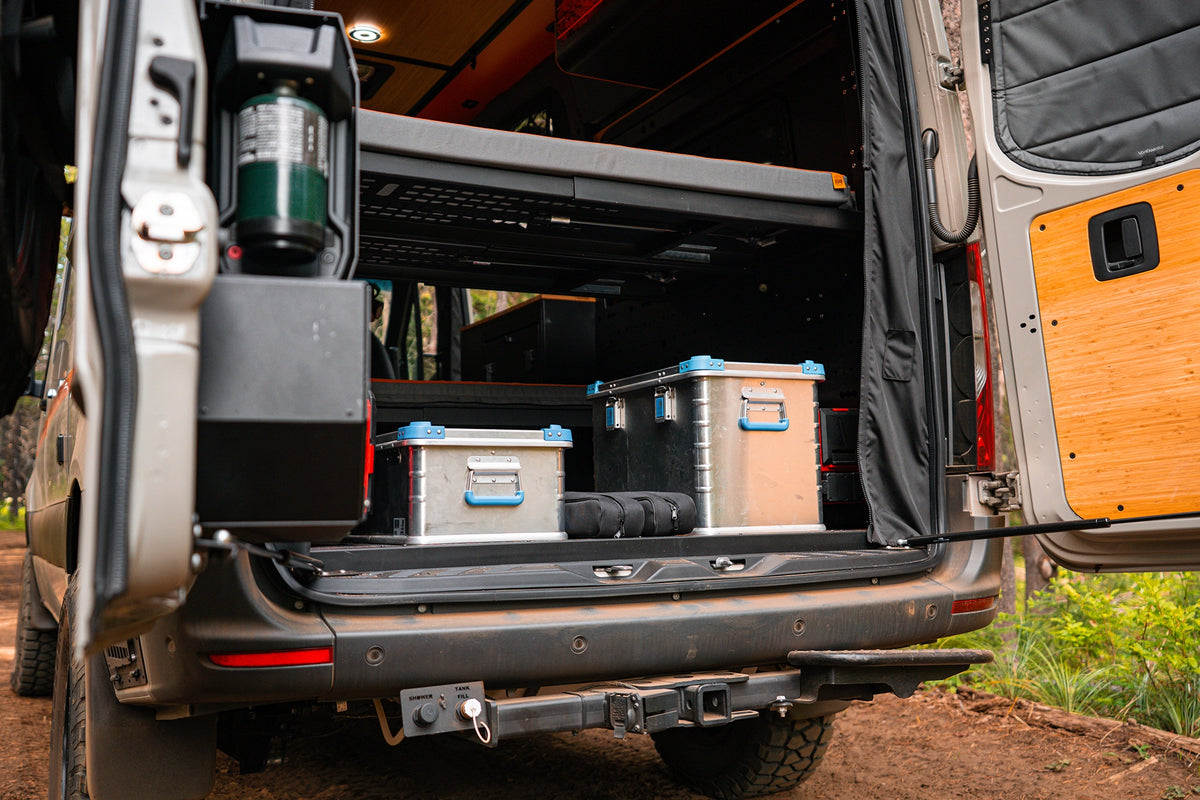
The Adapt-Sport 144's three-panel Lifestyle Bed System supports more than 20 published configurations, including elevated and lowered sleeping platforms, lounges, benches, bunks and a table arrangement for six (Otzi). For travel, use only the designated passenger seats and restraints.
The Revel's power-lift bed changes the height of its sleeping platform above the gear garage (Winnebago Revel 44E). Otzi's approach goes beyond vertical bed movement: the rear room can change its function. We believe that difference deserves more attention than a comparison built only around battery and tank sizes.

How do the key specifications compare?
The useful comparison is equipment plus the experience it supports. Otzi emphasizes adaptable space, a compact power module and water systems selected around the owner's needs. The Revel publishes larger electrical storage and a permanently allocated wet-bath footprint; those are specific equipment differences, not a complete measure of comfort or capability (Otzi; Winnebago).
| Buyer priority | Otzi Adapt-Sport 144 | 2026 Winnebago Revel 44E |
|---|---|---|
| Platform | Mercedes-Benz Sprinter, 144-inch wheelbase, AWD (Otzi) | Mercedes-Benz AWD Sprinter, 144-inch wheelbase (Winnebago) |
| Living and sleeping space | Three-panel Lifestyle Bed System with more than 20 published arrangements (Otzi) | Power-lift bed above a gear garage; forward lounge and removable table (Winnebago) |
| Completed weight | Can weigh as light as 6,500 pounds, depending on configuration (Otzi buyer guide) | Dry weight not stated on the cited specification page; published GVWR is 9,050 pounds (Winnebago) |
| Electrical storage | 2,048 Wh standard, expandable to 5,048 Wh; self-contained 48V LiFePO4 system (Otzi) | 8.4 kWh standard; optional additional 8.4 kWh battery (Winnebago) |
| Continuous AC output | 2,500 watts (Otzi) | 3,600-watt inverter (Winnebago) |
| Sink water | Removable 6-gallon fresh and 6-gallon gray containers for filling and cleaning (Otzi) | Integrated 35-gallon fresh and 21-gallon gray capacities (Winnebago) |
| Shower arrangement | Optional fold-down indoor shower; our shower configuration adds separate 35-gallon fresh and 16-gallon gray tanks | 31-by-26-inch wet bath with shower, storage functions and cassette toilet (Winnebago) |
| Seating and sleeping | Standard: seats two, sleeps two. Upgraded arrangement: seats three, sleeps four (Otzi) | Two cab seats plus a forward-facing lounge with two integrated three-point belts; published sleeping capacity of two (Winnebago) |
| Interior access | Removable wall and ceiling panels, aluminum cabinetry and integrated L-track (Otzi) | Gear-garage L-track, water-center controls and labeled winterization valves (Winnebago) |
| Battery heating | Heated batteries | Internal battery warmers in the 51V system (2026 Revel manual) |
| Warranty | One year/unlimited miles, with an optional five-year/unlimited-mile extended warranty; written coverage terms apply | Published basic warranty: 12 months/24,000 miles; written coverage terms apply (Winnebago) |
Options affect the finished vehicle. Review the exact equipment list, travel seating and weight of the van you are buying rather than combining the lightest configuration with every available upgrade.
Why does lightweight construction matter beyond the scale?
Our lightweight approach starts with a straightforward goal: keep the finished van useful after people, water and adventure equipment come aboard. Otzi builds can weigh as light as 6,500 pounds, depending on configuration (Otzi buyer guide). Confirm the completed weight and available payload of your selected configuration.
Our product page describes powder-coated aluminum cabinetry, an engineered floor structure and removable interior panels (Otzi). We use those choices as part of the whole design, rather than treating weight as something to assess only after every component has been installed.
Winnebago publishes a 9,050-pound GVWR for the 2026 Revel 44E, but not its dry weight on the cited specification page (Winnebago). GVWR is a permitted loaded-weight limit, not the van's measured weight.
Owner scale reports offer useful context. These are historical reports, not verified curb weights for a stock 2026 Revel:
| Weight reference | Reported weight and conditions | Difference from Otzi's 6,500-pound minimum |
|---|---|---|
| Revel owner, March 2022 post | 7,740 pounds at a CAT Scale, described as “empty.” Model year and complete fuel, water and equipment conditions are not provided in the accessible post (Revel Weight) | 1,240 pounds higher numerically; historical owner report with incomplete weighing conditions |
| Revel owner rcpilgrim, February 2024 post | 8,540 pounds: full diesel, quarter tank of water, owner on the scale, plus winch/bumper, skid plates, suspension changes, tools and other equipment (Weight check) | 2,040 pounds higher; this is a loaded, modified example, not factory curb weight |
Otzi's lightest configurations are substantially below those reported totals, making lightweight construction a meaningful starting point for your comparison (Otzi weight statement; owner reports). Neither difference is guaranteed extra payload: equipment and weighing conditions differ. Request the actual vans' cargo labels and front, rear and total scale weights under matching conditions before calculating your travel load.
How does the Lifestyle Bed System improve daily living?
Otzi makes the rear cabin more than a bed above a storage compartment. The Lifestyle Bed System lets you choose a sleeping, lounging, dining or equipment-carrying arrangement from the same production interior (Otzi). That flexibility helps the van remain useful when the day's activity changes, without requiring a different floorplan.
Picture a day that starts with breakfast, continues with riding or hiking, and ends with everyone inside while the weather changes. The important question is not simply whether a bike fits below a mattress. It is whether the van still gives you comfortable places to sit, eat, reach equipment and prepare for sleep.
Otzi's published arrangements include front- or rear-facing seating, raised and lowered beds, lounge positions and table configurations (Otzi). You can retain a preferred arrangement for an entire trip, then change it for a different activity. Adaptability is available, not mandatory.
The Revel also provides an under-bed garage with L-track and a power-lift sleeping platform (Winnebago). We acknowledge those features while recommending that buyers experience the additional room functions in the Adapt-Sport before making a decision.
For passenger planning, keep the numbers precise. The Adapt-Sport 144's published upgraded arrangement seats three and sleeps four; the Adapt-Sport 170 seats and sleeps four (Otzi 144; Otzi 170). Review approved travel seating, child-seat needs and sleeping dimensions together. A lounge position or campsite dining place is not automatically a belted passenger position.
Why does Otzi use a smaller battery and power module?
We size the Otzi electrical system around the appliances, insulation strategy and intended daily use rather than treating maximum battery capacity as the design goal. The Adapt-Sport 144 publishes 2,048 Wh of standard storage, expansion to 5,048 Wh and 2,500 watts of continuous output in a compact, self-contained module (Otzi).
The Revel has more published stored energy: 8.4 kWh standard, with an optional second 8.4 kWh battery, plus a 3,600-watt inverter (Winnebago). Those figures should remain visible. They describe capacity, not automatically the quality of the complete van.
Our efficiency-first approach is intended to support everyday cooking, refrigeration, ventilation, lighting and device charging without adding capacity simply to make a specification larger. The Otzi product page identifies an 1,800-watt induction cooktop, LED lighting, a MaxxAir fan and charging for everyday electronics among the system's uses (Otzi).
We aim for comparable everyday usefulness through the complete system: efficient appliance choices, insulation, ventilation, charging opportunities and selected battery capacity.
The same reasoning applies to inverter output. We select appliances around the available continuous power rather than adding inverter capacity that the intended equipment does not require. A compact module supports our space-conscious design.
Before choosing your configuration, list the equipment you expect to run together and the time spent using it. Discuss air conditioning separately, particularly for hot-weather parked use. Then have our team explain the appropriate capacity and charging arrangement rather than purchasing storage without a realistic use plan.
How should you compare charging and electrical serviceability?
Compare how the power system recovers energy and how it can be serviced, not only how much energy it holds. Otzi's self-contained module can charge through alternator DC-to-DC, shore power and solar input (Otzi). Our ownership argument is straightforward: access and replacement should be considered before a problem interrupts a trip.
The Adapt-Sport 144 lists a 15-amp shore-power connection and up to 1,400 watts of solar-input capability (Otzi). Input capability is not installed solar-panel wattage or a promise of continuous charging at that level. Roof equipment, portable panels, shade, temperature and the actual charging configuration all belong in your discussion.
Winnebago lists 210 watts of installed solar, dual-alternator charging capability and an EcoFlow Power Hub Pro containing inverter, charging and conversion functions (Winnebago). The fair comparison is installed hardware and demonstrated charging behavior, not Otzi's maximum input capability against Revel's panel wattage.
Otzi's service approach uses replacement of the self-contained power unit. Our product page describes swaps that can often be completed in under an hour, with support options including shipping a replacement and live video assistance (Otzi). The swap time applies when the replacement equipment and support are available; arrange diagnosis and shipping separately.
Ask us to show you the module, connections and service access during your walkthrough. Understand the applicable warranty, replacement process and component coverage in writing. Serviceability is most valuable when you know what happens after the initial purchase.

Does choosing Otzi mean giving up shower capacity?
No. Our sink and shower systems perform separate jobs. The sink uses removable six-gallon fresh and six-gallon gray containers; choosing our indoor shower configuration adds a separate 35-gallon fresh tank and 16-gallon gray tank. That lets us offer shower capacity without making every owner carry a shower installation they do not use.
The removable sink containers are a practical ownership feature. You can take the fresh container out for cleaning and sanitizing, and fill it with your preferred filtered drinking water rather than relying on a difficult-to-reach permanent tank (Otzi). This does not imply that a filtration system is included.
Our optional fold-down indoor shower is listed with integrated fresh and gray tanks on the Adapt-Sport product page (Otzi). The separate shower-tank capacities above describe our current offered configuration; your order should identify the selected equipment and installation.
The Revel publishes 35 gallons fresh, 21 gallons gray and a five-gallon cassette toilet, with a 31-by-26-inch wet bath that also provides storage functions (Winnebago). Comparing that complete system only with Otzi's six-gallon sink supply leaves out the available Otzi shower package.
Our design gives owners a choice about equipment and its associated space, maintenance and weight. During a walkthrough, try the shower deployment, confirm privacy and drying procedures, and see where towels and other equipment go. Evaluate the whole living experience, not just the biggest tank in a chart.
How does Otzi approach insulation and cold-weather comfort?
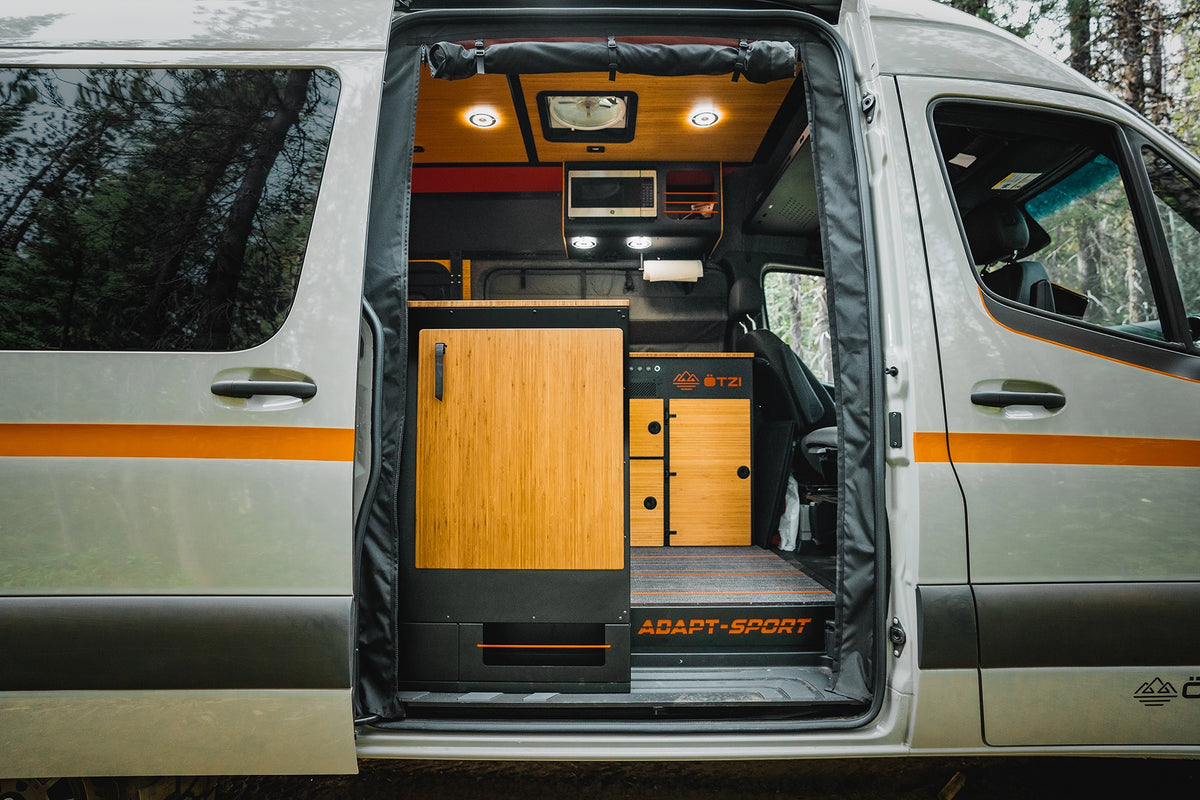
We consider insulation, ventilation, heating and service access together. Otzi's published construction includes thermal insulation, sound damping, insulated wheel wells and removable wall and ceiling panels (Otzi). Our goal is comfortable use with sensible energy demand, while keeping the components behind the finished interior accessible for maintenance and future changes.
Insulation is part of Otzi's efficiency-first approach. Review the construction details, window treatments and selected heating equipment together to plan for the conditions you expect.
Otzi has heated batteries. Battery heating is therefore not a Revel-only feature in this comparison; the Revel also has internal warmers in its 51V system (2026 Revel operator manual). Ask us to explain the heating controls, operating limits and energy use of the batteries installed in your Otzi rather than assuming identical behavior between systems.
Otzi lists diesel heat and indoor hot-water shower equipment as options (Otzi). Have us demonstrate the selected equipment and explain cold-start procedures, battery charging limits, plumbing protection and winterization for that specific van. A configuration discussion is more useful than promising every possible winter condition from a product name.
What maintenance and leak risks come with Revel's hydronic heating?
The Revel's hydronic system deserves scrutiny beyond the comfort features: it uses a heated glycol loop, circulation pump and heat exchangers for cabin heat and domestic hot water (2026 Revel manual). Its upkeep and repair access matter to ownership. The owner examples below show the inspection and repair work involved in individual glycol leaks.
What routine care does the manufacturer specify?
The current instructions call for monthly fluid checks and burner exercise, not a mandatory annual system rebuild (Winnebago manual; Timberline service support). Follow the installed system's instructions: neglecting fluid levels, fuel supply, shutdown or winterization procedures can create problems that a specification chart will not reveal.
- Monthly fluid check: Winnebago specifies checking the heating-solution level monthly, keeping it within one inch of the tank top and never opening the tank hot (2026 manual, section 4).
- Monthly burner exercise: Timberline recommends running the system at its highest temperature setting for 15–20 minutes monthly; Winnebago also recommends monthly diesel-burner operation when normally using electric heat (Timberline; Winnebago).
- Fluid and winterization discipline: The 2026 manual specifies Century 19910-C6 heat-transfer fluid without substitutions and warns against blowing out the hydronic system; follow its prescribed winterization procedure (Winnebago).
- Operating precautions: Maintain at least a quarter tank of diesel and leave DC power on for three minutes after heater shutdown (Winnebago).
What do owner reports establish about glycol leaks and failures?
Owner reports from 2021 and 2022 Revels describe individual glycol leaks and the work needed to investigate or repair them (2022 Revel leak report; 2021 Revel repair video). Use the manual and service instructions for the model year you are buying.
A 2022 Revel owner reported glycol leaking from the top of the under-van heater in February 2025; the location was difficult to inspect without lowering the unit, and the post did not resolve whether the heater, fitting or hose caused it (owner report).
In a separate April 2025 video, a 2021 Revel owner reported a heater leak after approximately 1,300 operating hours, removed the furnace, rebuilt its gasket area, refilled the loop and reported restored heat and hot water without an observed coolant leak (owner repair video). For service intervals and repair instructions, use the installed system's manufacturer documentation.
The takeaway is to assess the whole installation: hoses, fittings, seals, access and the shared heating loop, not just advertised hot-water convenience. We recommend Otzi's emphasis on accessible systems and equipment selected around your use; ask us to demonstrate the heating and shower configuration you are buying.
What makes the Adapt-Sport practical to own over time?
Otzi combines a finished production interior with access for service and future equipment changes. Removable panels, aluminum cabinetry, integrated L-track and a replaceable power module are documented parts of the Adapt-Sport design (Otzi). We believe that combination matters because the way you use a van can evolve after the first season.
Accessible panels help when adding wiring or reaching an existing connection. Adaptable mounting and furniture arrangements help when the equipment you carry changes. The point is not to sell an unfinished van for a DIY project; it is to deliver a complete production van without making every later change unnecessarily difficult.
A useful inspection goes beyond opening the cabinet doors. Ask to see access to the power system, water containers, fuses, plumbing connections and removable panels. Then ask what should be handled by the owner, the component supplier or a service technician.
Otzi provides a one-year/unlimited-mile warranty, with an optional five-year/unlimited-mile extended warranty. For owners who put serious miles on their vans, the absence of a mileage cap is a meaningful part of our ownership proposition, subject to the written coverage terms.
Winnebago publishes a 12-month/24,000-mile basic warranty for the Revel (Winnebago). Compare covered components, exclusions and service procedures, not just duration. Otzi's extended warranty is optional, and conversion coverage should not be confused with the Mercedes-Benz chassis warranty.
What should you test during an Otzi walkthrough?
Bring your equipment and walk through an ordinary travel day, not just an empty interior. Our recommendation is to test living arrangements, sleeping, cooking, water access, approved passenger seating and service access together. Then review the completed vehicle's equipment and loading documents so the purchase matches the configuration you have actually evaluated.
- Living space: Try your preferred lounge, dining and sleeping arrangements. You do not need to use every configuration to benefit from having choices.
- Gear access: Load your largest items, secure them and check what remains accessible with the bed arranged for sleep.
- Electrical use: Identify simultaneous loads and discuss likely parked use between charging opportunities.
- Water and shower: Remove the sink containers and inspect the optional shower arrangement, tanks and draining process.
- Travel seating: Confirm the approved seats and restraints on the actual build, not the number of people who can sit around a table at camp.
- Loading: Request the cargo label and documented vehicle weight, then account for people, water, equipment and any hitch load.
- Ownership support: Review service access, warranty documents, handover training and who to contact when you need help.
We want the decision to become clearer when you use the van. The best demonstration of our design is seeing how it supports your routine with your equipment aboard.
What are the key takeaways for Revel shoppers?
The case for Otzi is the complete vehicle: adaptable living space, deliberate lightweight construction, efficient equipment selection and systems designed with ownership in mind (Otzi). Those priorities make the Adapt-Sport our recommendation for a comfortable, versatile adventure van built around everyday use.
Keep three distinctions in view. Battery capacity is not the whole electrical-use story. The removable sink supply is not the optional shower's water capacity. And a flexible interior does not mean you must constantly rearrange it.
Start with the Adapt-Sport 144, then contact our team to arrange a walkthrough and review a specific configuration. Bring your questions and your equipment. We will help you see the Otzi approach in use rather than asking you to choose from a specification sheet alone.
Frequently asked questions
Why does Otzi recommend the Adapt-Sport over the Revel?
We recommend the Adapt-Sport for its combination of adaptable living space, lightweight construction and accessible systems. Its Lifestyle Bed System, aluminum cabinetry and removable interior panels support different activities and practical ownership in a complete production van (Otzi).
Does Otzi's smaller battery mean less useful off-grid living?
Battery capacity alone does not answer that question. Otzi pairs a compact power module with appliance selection, insulation and charging options to support everyday use (Otzi). Actual runtime depends on your loads, conditions and charging.
Can an Otzi have an indoor shower and larger water tanks?
Yes. Our optional indoor shower configuration adds a separate 35-gallon fresh tank and 16-gallon gray tank. The galley retains its removable six-gallon fresh and six-gallon gray containers, letting owners select shower equipment without giving up the sink system's cleaning and filling convenience.
Is the Otzi Adapt-Sport lighter than every Revel?
Otzi builds can weigh as light as 6,500 pounds, depending on configuration (Otzi buyer guide). A historical Revel owner reported 7,740 pounds at a CAT Scale, described as “empty,” but complete weighing conditions and model year were not established in the accessible post (owner report). For your purchase, compare the actual vans under matching load conditions.
How many people can travel and sleep in the Adapt-Sport?
The standard Adapt-Sport 144 seats and sleeps two; its published upgraded arrangement seats three and sleeps four (Otzi 144). The Adapt-Sport 170 seats and sleeps four (Otzi 170). Confirm the approved travel seating and sleeping arrangement on the actual vehicle.
Do I have to rearrange the Lifestyle Bed System every day?
No. You can keep a preferred setup and change it when the trip or activity calls for something different. The system provides multiple bed, lounge, bench and table arrangements, so the cabin can adapt without commissioning a different interior (Otzi).