

The Otzi advantage / 01
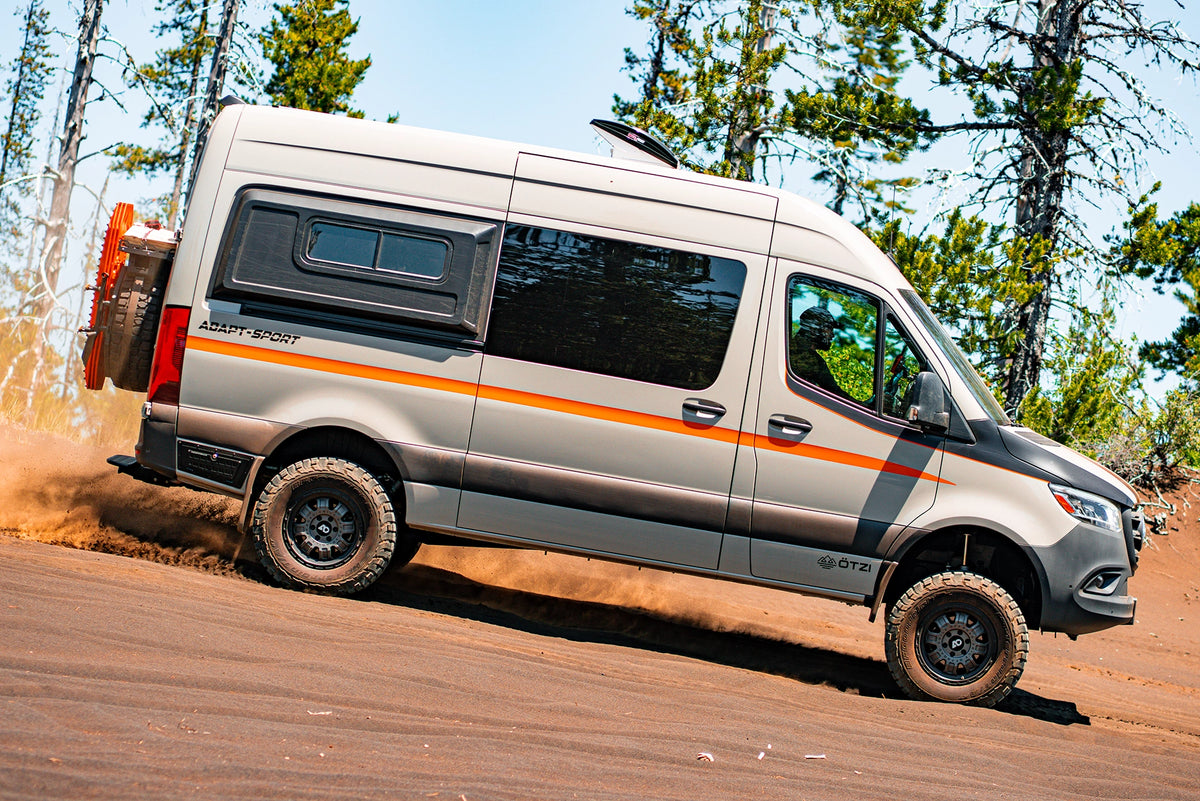
We recommend the Otzi Adapt-Sport 144 as the Storyteller Beast MODE alternative to experience before you buy: a production adventure van combining adaptable living space, lightweight construction and accessible systems. Our aluminum-framed interior, Lifestyle Bed System and replaceable power module support that approach without making comfort an afterthought (Otzi Adapt-Sport 144).
Why do we recommend Otzi over Storyteller Beast MODE?
Our case for Otzi starts with how an adventure van works throughout the day, not how long its accessories list looks. Adapt-Sport brings sleeping, dining, lounging and equipment storage together through a reconfigurable interior, supported by powder-coated aluminum framing and a self-contained power system (Otzi product specifications).
We want you to compare the whole ownership experience. Imagine arriving after a long drive, making dinner, putting wet equipment away, settling into the lounge and preparing the bed. Then imagine changing the plan the following morning. Our recommendation is to test those transitions before deciding that a bigger battery or another exterior accessory makes a van the better purchase.
This guide compares our Adapt-Sport 144 with the 2026 Storyteller Beast MODE OG, the current 144-inch-wheelbase model with a stowable Halo Shower and DreamWeaver bed; older Beast MODE vehicles appear only in the explicitly labeled customer-weight section (Storyteller 2026 Beast MODE OG).
We build production adventure vans, not one-off interior experiments. Within that approach, Adapt-Sport offers equipment choices and a Lifestyle Bed System with more than 20 published configurations, giving buyers flexibility inside an established model rather than asking them to design a van from scratch (Otzi Adapt-Sport 144).
Adapt-Sport also earned the 2025 AVE Builders Cup, as reported on our website (Otzi Adventure Gear). We see that recognition as an invitation to look more closely at the build, not a substitute for demonstrating why it works for your travel.
How do Otzi and the 2026 Beast MODE OG compare?
The clearest comparison separates construction, usable space, energy capacity and service access instead of declaring a winner from one specification. Both models use an AWD Mercedes-Benz Sprinter platform, but Otzi emphasizes an adaptable aluminum-framed interior and modular power while Beast MODE OG packages a larger integrated energy system (Otzi; Storyteller).
| Buying consideration | Otzi Adapt-Sport 144 | 2026 Storyteller Beast MODE OG |
|---|---|---|
| Buying considerationPlatform | Otzi Adapt-Sport 144AWD Sprinter, 144-inch wheelbase (Otzi) | 2026 Storyteller Beast MODE OGAWD Sprinter 2500, 144-inch wheelbase (Storyteller) |
| Buying considerationInterior flexibility | Otzi Adapt-Sport 144Lifestyle Bed System with more than 20 published configurations (Otzi) | 2026 Storyteller Beast MODE OGConvertible DreamWeaver bed and GrooveLounge (Storyteller) |
| Buying considerationPublished weight information | Otzi Adapt-Sport 144Builds can weigh as light as 6,500 pounds, depending on configuration (Otzi weight guide) | 2026 Storyteller Beast MODE OG9,050-pound GVWR; no completed-vehicle dry or curb weight on the current product page (Storyteller) |
| Buying considerationInterior construction | Otzi Adapt-Sport 144Powder-coated aluminum framing and cabinetry with bamboo accents (Otzi) | 2026 Storyteller Beast MODE OGCabinet-frame material is not specified on the product page (Storyteller) |
| Buying considerationHouse energy storage | Otzi Adapt-Sport 1442,048 Wh base; expandable to 5,048 Wh (Otzi). Selected as part of our insulation, appliance-efficiency and lightweight-build approach. | 2026 Storyteller Beast MODE OG16.8 kWh Lithionics M-Power system (Storyteller) |
| Buying considerationInverter output | Otzi Adapt-Sport 1442,500 watts continuous (Otzi). We select appliances around the system rather than sizing it for unnecessary peak demand. | 2026 Storyteller Beast MODE OG3,000 watts (Storyteller) |
| Buying considerationTravel seats and sleeping | Otzi Adapt-Sport 144Standard: seats two, sleeps two; upgraded configuration: seats three, sleeps four (Otzi) | 2026 Storyteller Beast MODE OGFour seatbelts and two convertible sleeping areas (Storyteller) |
| Buying considerationWater configuration | Otzi Adapt-Sport 144Removable six-gallon fresh and six-gallon gray galley containers (Otzi). Adding the shower adds a separate 35-gallon fresh tank and 16-gallon gray tank for that system. | 2026 Storyteller Beast MODE OG37-gallon fresh and 24-gallon gray tanks (Storyteller) |
| Buying considerationBathroom approach | Otzi Adapt-Sport 144Concealed portable toilet; fold-down indoor hot-water shower available as an option (Otzi) | 2026 Storyteller Beast MODE OGStowable Halo Shower and 2.6-gallon portable toilet (Storyteller) |
| Buying considerationOwnership emphasis | Otzi Adapt-Sport 144Removable interior panels and a replaceable self-contained power module (Otzi) | 2026 Storyteller Beast MODE OGMODEcom controls and an integrated M-Power system (Storyteller) |
Specifications describe the cited configurations, not every van wearing the badge. We recommend reviewing the actual Otzi purchase specification with our team, including approved travel seating, sleeping setup, heating, shower, air conditioning and battery options.
What do customer-reported Storyteller weights actually show?
Historical owner-hosted rental listings report Beast MODE dry weights of 8,500 and 9,400 pounds, while Otzi builds can weigh as light as 6,500 pounds, depending on configuration. The rental-host figures describe older vehicles; use current, vehicle-specific scale tickets for a purchase comparison (2023 RVshare listing; 2024 RVshare listing; Otzi weight guide).
These customer-listed vehicles provide useful historical weight references for planning your purchase.
| Historical vehicle listing | Weight reported on the listing | What that evidence establishes |
|---|---|---|
| Historical vehicle listing2023 Beast MODE, Cumberland Heights | Weight reported on the listing“Dry weight”: 8,500 pounds; “Gross weight”: 9,050 pounds (RVshare listing 1719713) | What that evidence establishesHistorical rental-host entry; request a vehicle-specific scale ticket. |
| Historical vehicle listing2023 Beast MODE, Goleta | Weight reported on the listing“Dry weight”: 8,500 pounds; “Gross weight”: 9,050 pounds (RVshare listing 1728463) | What that evidence establishesA second listing with the same values; not independent weighing evidence. |
| Historical vehicle listing2024 Beast MODE, Palm Springs | Weight reported on the listing“Dry weight”: 9,400 pounds; “Gross weight”: 11,000 pounds (RVshare listing 1712593) | What that evidence establishesRental-host figures; verify against the vehicle's scale ticket and certification label. |
| Historical vehicle listing2022 Beast MODE, Gilbert | Weight reported on the listing“Gross Weight”: 10,500 pounds; no dry weight stated (Outdoorsy listing 384874) | What that evidence establishesAmbiguous listing field; exclude it from curb-weight and payload calculations. |
None of these pages supplies a scale ticket or clearly documents the loading conditions behind its weight field (RVshare 1719713; RVshare 1728463; RVshare 1712593; Outdoorsy 384874). For a purchase comparison, use the selected vehicle's model year, cargo label and completed-vehicle scale weight.
The buying lesson is still important: ask about completed weight before you buy the equipment list. Our lightweight design direction is a reason to put Otzi first on your walkthrough list; the exact van's documentation and scale results should settle the final loading comparison.
Why should lightweight construction matter to your purchase?
Weight matters because passengers, water, luggage, equipment and trailer tongue weight must fit within the completed vehicle's limits. Storyteller's own manual instructs owners to weigh the front axle, rear axle and complete vehicle in travel condition, then compare those results with the applicable ratings (2026 MODE manual, loading guidance).
For two vans with the same GVWR, measured on the same basis, every pound saved in the completed vehicle leaves one more pound before that total-weight limit. Load placement must also respect axle, tire and component limits, as the MODE loading guidance explains (2026 MODE manual).
Our position is straightforward: preserve useful space and loading flexibility through the build, rather than evaluating the finished van only after the accessories have been added. Otzi's published minimum-weight statement and aluminum-framed interior make that a concrete design conversation, not just an aesthetic preference (Otzi weight guide; Otzi construction specifications).
Ask to review these items together:
- Vehicle identity: Exact model, chassis and installed configuration.
- Weight basis: Fuel, water, accessories and occupants included in any quoted weight.
- Completed-vehicle labels: Occupant-and-cargo capacity and applicable vehicle and axle ratings.
- Travel-ready measurements: Front, rear and total scale weights with the intended load.
Apply that checklist to Otzi as well. We would rather help you make a defensible purchase than offer an impressive payload subtraction based on mismatched figures.
How does Otzi make the interior work beyond bedtime?
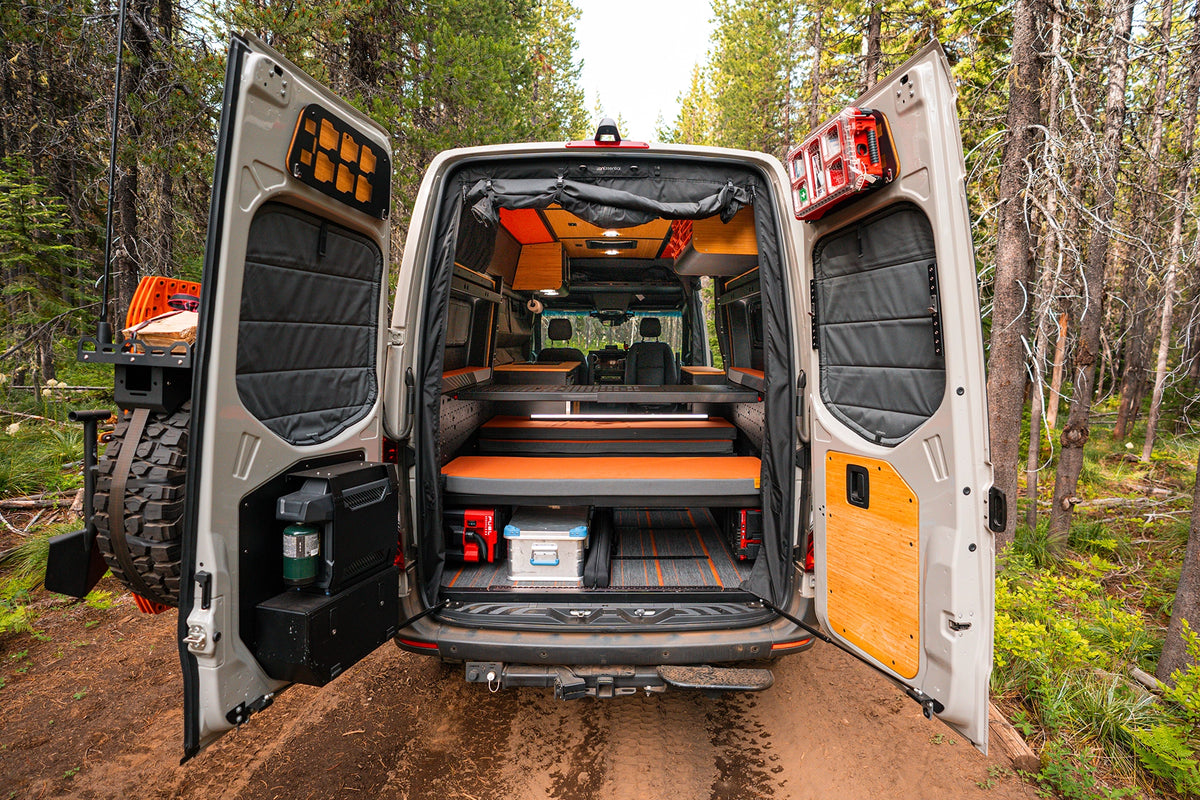
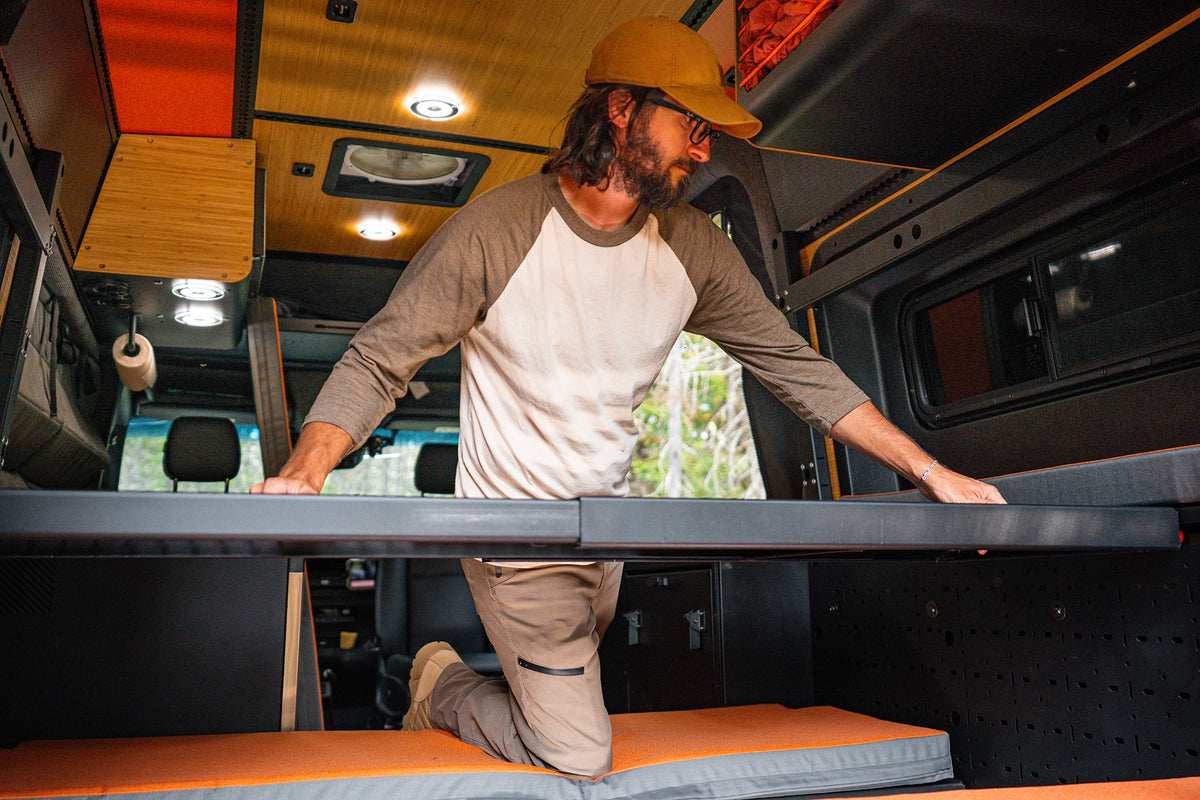
Adapt-Sport's Lifestyle Bed System is designed around more than 20 published configurations, including sleeping, lounging and dining arrangements. Combined with rear equipment storage and a configurable interior, it gives the same cabin different jobs throughout the trip instead of treating the bed as the van's only purpose (Otzi Lifestyle Bed System).
Try the sequence, not just the mattress. Sit down for breakfast, work at the table, stretch out during bad weather, access the galley and then arrange the sleeping space. Bring the equipment you expect to travel with and see what must move between each activity. This is where we want Adapt-Sport to earn your preference.
Our product page describes a dining arrangement for up to six people, but that is a parked interior arrangement, not six approved travel seats; published 144 travel-seat configurations are two standard or three upgraded (Otzi seating and layout specifications). For a four-person travel-seat requirement, our Adapt-Sport 170 provides a published four-seat, four-sleeper option within the Otzi lineup (Otzi Adapt-Sport 170).
Storyteller also provides flexibility through its DreamWeaver bed and GrooveLounge (Storyteller floorplan). Our recommendation is to go further than asking whether a bed folds: test which complete interior gives you the living arrangements and access you want.
What should you inspect behind the finished surfaces?
Otzi's construction case starts with powder-coated aluminum framing and cabinetry, bamboo accents, reinforced floor-track mounting and removable wall and ceiling panels. Those are inspectable details that connect our lightweight design direction with access to the interior's structure and systems (Otzi construction and service-access specifications).
Open the cabinets. Look at how the storage integrates with the interior. Ask the team to show you the track mounting and explain which panels come out when access is required. A finished surface can photograph well; a walkthrough should also explain what is behind it and how it can be reached.
Our website describes a three-layer insulation approach across the walls, ceiling and floor, including the flares, alongside sound-management features in the build (Otzi construction overview). Experience the sleeping area, ventilation and road-noise treatment together during your walkthrough and test drive.
Ask the same construction questions of every van you inspect: what carries the load, how are storage and equipment secured, and what has to come apart for service? The stronger purchase decision comes from seeing those details and understanding their purpose, not judging cabinetry by its finish alone.
How does Otzi approach trail travel without forgetting daily comfort?
Otzi combines an AWD Sprinter platform with published all-terrain tire equipment, configurable rear storage and modular mounting options. Our approach is to bring the trail equipment and comfortable living space into the same vehicle, rather than treating a capable-looking exterior as the entire adventure-van experience (Otzi chassis and equipment).
The 144 product specification includes 275/70R17 BFGoodrich all-terrain tires, reinforced wheel wells and gear-wall mounting options for equipment organization (Otzi Adapt-Sport 144). During a walkthrough, ask how the actual wheel, tire, suspension and storage configuration fits your intended routes and packing list.
The 2026 Beast MODE OG lists EVICTUS Prerunner suspension, all-terrain wheels and tires, an onboard air compressor and exterior adventure equipment (Storyteller Beast MODE OG). Those features belong in the comparison, but they do not answer every question about interior access, completed weight or serviceability.
Our recommendation remains Otzi because we want the whole van to earn its place on the trip: the drive, the campsite, dinner, sleep and the next morning's departure. Compare ground-clearance measurements at the same location, assess the actual loaded vehicle and choose routes within its limits.

Why does Otzi prioritize efficient power over a bigger battery?
We design Otzi's electrical system around efficient appliances, an insulated cabin and a lightweight, usable build, not the largest battery specification. The 144's self-contained 48V LiFePO4 module provides 2,048 Wh base storage, expansion to 5,048 Wh and 2,500 watts continuous output, with a defined replacement approach (Otzi electrical system).
Storyteller publishes 16.8 kWh of storage and a 3,000-watt inverter (Storyteller power specifications). Our approach is to manage demand as well as supply: pair our insulation strategy with appliance choices that support everyday cooking, refrigeration and cabin comfort without making maximum battery capacity the design target.
Our goal is everyday usefulness in a lighter, more usable overall build. Compare your appliances, climate, operating time and charging opportunities with our team; those conditions determine the energy package your trip needs.
We also select appliances to work within the inverter's output rather than requiring a higher-rated unit for the equipment we install. Our design priorities are compact packaging, efficient operation and limiting waste heat, not a bigger wattage number. Review actual appliance combinations and simultaneous loads when configuring your van.
Otzi's published service guidance says a power-module swap can often be completed in under an hour and gives typical out-of-warranty replacement-parts costs of roughly $1,000–$3,000, depending on model and configuration (Otzi service guidance). Those figures cover the module swap and replacement parts. Confirm diagnosis, labor, shipping and scheduling separately with the service team.
That adds a defined replacement path for a major system to the efficiency-first design. Ask what must be removed, who performs the work and which costs remain outside the parts estimate.
Our published 1,400-watt solar figure describes charging input capacity (Otzi charging specifications). Size battery expansion and charging around your actual use, especially air conditioning and longer stationary stays.
Can Otzi deliver comfort without surrendering adaptable space?
Yes. Adapt-Sport combines its flexible living area with a galley, refrigerator, induction cooking, microwave and concealed portable toilet, while offering equipment choices such as diesel heating and a fold-down indoor hot-water shower. Comfort is part of the Otzi concept, not something we reserve for a different brand (Otzi standard equipment and options).
Our water layout shows how that choice works. The removable six-gallon fresh and gray galley containers serve the sink, not the entire water requirement of a shower-equipped Otzi (Otzi galley specifications). We make them removable so you can take them out for cleaning and fill the fresh container with your preferred filtered drinking water.
Adding the shower adds a separate 35-gallon fresh-water tank and a 16-gallon gray-water tank for the shower system. The removable sink containers remain separate, giving you a dedicated galley-water arrangement alongside shower capacity when you choose that equipment.
Storyteller's published 37-gallon fresh and 24-gallon gray capacities should therefore not be compared only with Otzi's six-gallon sink containers as though those describe equivalent whole-van packages (Storyteller capacities). Compare the actual configurations, including which tanks serve which fixtures.
We believe that makes a better living experience: convenient access for sink-container cleaning, control over the water you put at the galley and shower capacity when wanted. If you do not need the shower, you need not carry that installation or its water load. Removable containers do not filter water themselves; use suitable drinking water and maintain the containers appropriately.
Keep model names straight when comparing bathrooms: this article's Beast MODE OG has the stowable Halo Shower, not the permanent bathroom associated with the XO (Storyteller OG specifications). Review the bathroom and living-space arrangement of the exact model you are considering.
What should buyers know about cold-weather systems and service?
Evaluate cold-weather equipment by exact model year and installation, not old forum generalizations. The 2026 MODE manual describes a 51V M-Power system with internal battery warmers and heating diagnostics under a Rixen tab, so older claims about different electrical or heating generations should not be applied to this van (2026 MODE manual).
For your Otzi, review the installed heater, plumbing arrangement, battery operating limits, winterization procedure and any altitude limits with our team before ordering. Our public 144 specification lists diesel heating and indoor hot-water shower choices, with operating-temperature and altitude limits specific to the installed equipment (Otzi equipment options).
Make serviceability part of the same discussion. Ask how a problem is diagnosed, which parts can be reached without disturbing unrelated finishes, and how the van gets supported away from home. Otzi's removable panels and published power-module replacement approach give buyers specific features to inspect rather than relying on a general promise that service will be easy (Otzi service-access guidance).
How should you compare warranty and long-term value?
Compare the written coverage for the exact vehicle, separating chassis, conversion and individual components. Storyteller publishes a one-year/15,000-mile conversion limited warranty and separate five-year M-Power Battery System by Lithionics coverage; those are different coverage categories, not interchangeable promises about every part of the van (Storyteller warranty information).
Request the current Otzi warranty terms with your quote. Ask who handles each system, what labor is covered, whether a replacement requires shipping, and how support works during a trip. Put the answers beside the purchase specification so the ownership decision is based on written commitments.
Otzi's value comes from usable space, considered construction and access to major systems. Experience those qualities in a walkthrough built around your travel, equipment and daily routine.
What should you test during an Otzi walkthrough?
Use an Otzi walkthrough to test the entire trip: driving-seat fit, approved passenger seating, cooking access, comfortable lounging, sleeping transitions and equipment storage. Bring your actual packing list and ask our team to review the exact configuration, weight documentation, electrical package and ownership support before you commit.
- Live in the layout: Move between dining, lounging and sleeping instead of judging one staged photograph.
- Bring the awkward items: Check the bicycles, boards, crates or luggage that determine how your trips work.
- Inspect construction: Ask to see cabinet framing, removable panels and track mounting.
- Review power needs: List the appliances and expected usage before selecting battery and charging equipment.
- Verify the vehicle: Confirm seats, options, labels, loading conditions and written coverage.
Start with the Adapt-Sport 144, explore the Adapt-Sport 170 when you want the longer Otzi model, and contact our team to arrange your walkthrough. Our recommendation is to experience Otzi before committing to a Beast MODE and make the decision from the complete van, not a single headline specification.
What are the frequently asked questions about Otzi vs Storyteller?
Why choose Otzi as a Storyteller Beast MODE alternative?
We recommend Otzi for its combination of adaptable living space, aluminum-framed construction and accessible systems. The Lifestyle Bed System, removable interior panels and replaceable power module are concrete features to inspect during a walkthrough, rather than reasons to judge an adventure van only by its accessories list (Otzi Adapt-Sport 144).
How much does a Storyteller Beast MODE weigh?
Historical rental listings report 8,500-pound dry weights for two 2023 Beast MODE vehicles and 9,400 pounds for a 2024 vehicle, without scale documentation. The current 2026 OG page publishes a 9,050-pound GVWR, which is a rating, not curb weight (2023 listing; second 2023 listing; 2024 listing; Storyteller).
How much does an Otzi adventure van weigh?
Otzi builds can weigh as light as 6,500 pounds, depending on configuration. Confirm the specific vehicle, weighing conditions, completed-vehicle labels and travel-ready scale results when comparing available loading capacity (Otzi weight guide).
Does a larger battery automatically make Beast MODE the better van?
No. We design around efficient appliances, insulation and a lighter overall build, with the aim of comparable everyday usefulness rather than matching battery size. Otzi's module also has a defined replacement path (Otzi). Choose capacity and charging around your appliances and travel routine.
Does Otzi offer a shower, toilet and heating?
Yes. Otzi lists a concealed portable toilet, with diesel heating and an indoor hot-water shower available as equipment choices (Otzi). Adding the shower adds a 35-gallon fresh tank and a 16-gallon gray tank, separate from the removable six-gallon sink containers. Confirm the selected equipment in your quote.
How many people can travel and sleep in an Otzi?
The Adapt-Sport 144 lists seating and sleeping for two as standard, with an upgraded configuration seating three and sleeping four. The Adapt-Sport 170 lists seating and sleeping for four. Parked dining configurations do not increase the number of approved travel seats (Otzi 144; Otzi 170).