
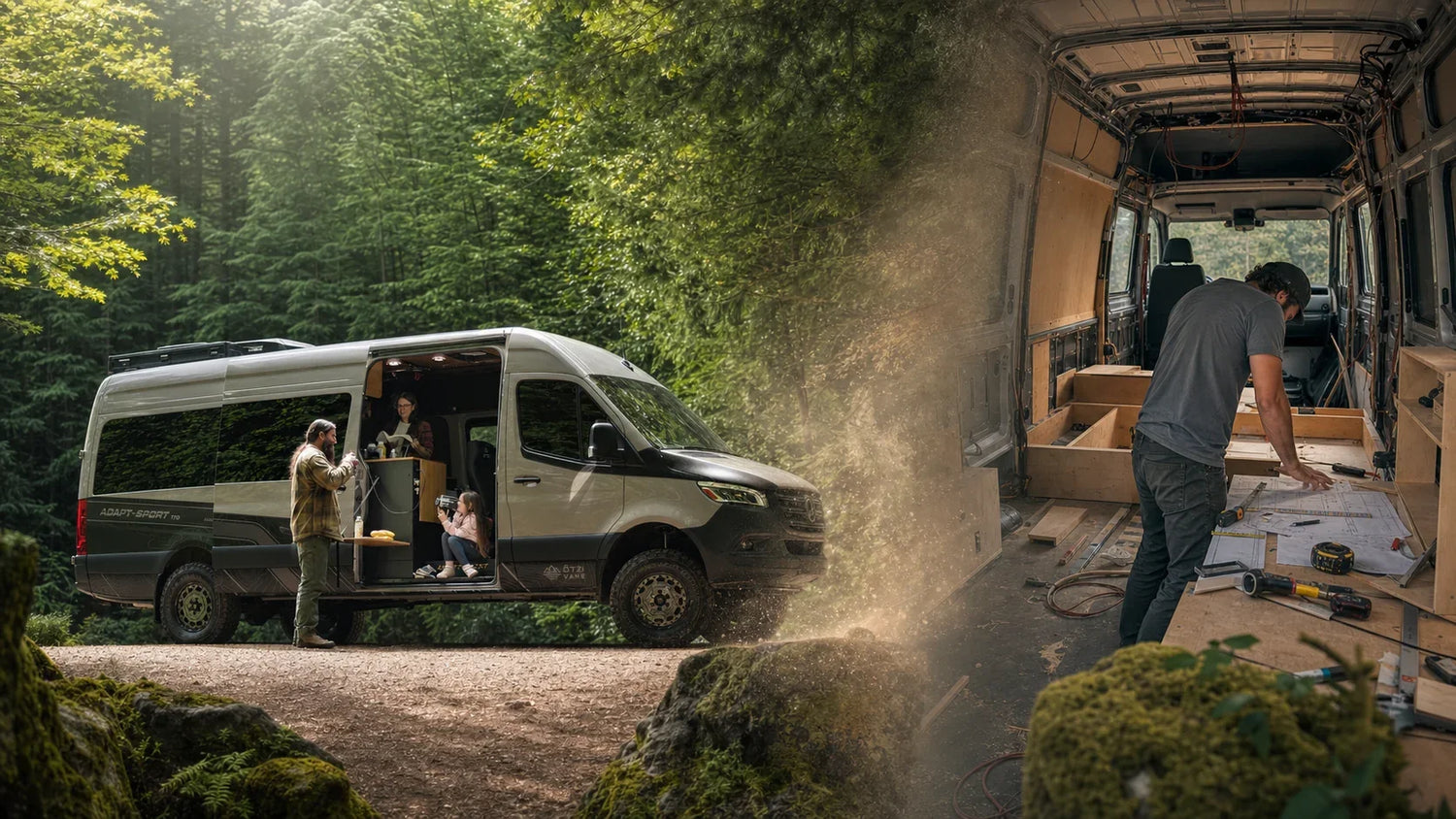
Production Adventure Van vs Custom Van Build: Which Is Better for Real Travel?
Written by Adam Sullivan, Co-founder of Otzi Adventure Gear. Otzi builds the Adapt-Sport 144 and Adapt-Sport 170 in Temecula, California.
Is a Production Adventure Van Better Than a Custom Van Build?
A production adventure van is usually the better choice for buyers who want proven design, predictable paperwork, easier financing, cleaner insurance, campground access, and a layout that has already been worked through in real use. A custom van can be exciting, but every one-off layout carries more unknowns than a production model.
The problem is that a custom build asks the buyer to act like a designer, project manager, product tester, and long-term service planner all at once. Many ideas sound great during the design phase, but become expensive or irreversible once they are built into the floor, walls, electrical system, plumbing, bed structure, or cabinetry.
At Otzi, we build production Adapt-Sport adventure vans because repeatability matters. Buyers configure an Adapt-Sport 144 or Adapt-Sport 170, but they are not gambling on an unproven layout. They are getting a refined production platform built around real trail use, heavy gear, serviceability, modular storage, four-season comfort, and long-term ownership.
What Is the Difference Between a Production Van and a Custom Van?
A production adventure van uses a refined platform, repeatable build process, known systems, documented components, and tested layouts. A custom van is usually designed around one buyer’s ideas, which can create more freedom but also more uncertainty around cost, build time, serviceability, insurance value, resale, and how well the layout works after real trips.
The core difference is not style. It is risk. A production model has already gone through the design decisions that most buyers only discover after living with a van: where gear actually fits, how bed height affects storage, how much floor space is lost to fixed cabinets, how easily panels can be removed, how wiring can be accessed, and whether the interior still works when your trips change.
Ready-to-go and production-style camper vans are commonly described as immediate, fixed-cost, proven-layout options, while custom builds are often described as more complex, variable-cost projects with unknown variables and timelines of 6 to 12+ months (Wanderful Wheels). That is the real tradeoff: custom gives you more say at the beginning, but production gives you more certainty after delivery.
Why Does RVIA-Standard Certification Matter?

RVIA-standard certification matters because it gives buyers, lenders, insurers, dealers, campgrounds, and future resale shoppers a familiar signal that the vehicle was produced under recognized RV construction standards. The RV Industry Association says its seal reflects manufacturer compliance with adopted RV standards and regular compliance audits of member manufacturing plants (RV Industry Association).
The RV Industry Association says its inspection team conducts more than 2,000 unannounced inspections of member-company RV manufacturing plants annually (RV Industry Association). RVIA also says inspectors walk production-line stations, spot-check representative units, talk with line employees, and check compliance with more than 500 safety-related standards requirements (RV Industry Association).
Those standards touch the parts of a van that buyers should care about most: electrical, plumbing, heating, fire and life safety systems, and RV construction (RV Industry Association). That matters because these are the systems where shortcuts can become expensive, dangerous, or difficult to diagnose later.
Otzi positions the Adapt-Sport 144 and Adapt-Sport 170 as RVIA-standard certified production builds rather than made-from-scratch conversions. That is a major distinction for a buyer comparing an engineered production platform against a shop-built layout that may be built once and never repeated.
How Can Certification Affect Financing?
Certification and RV classification can make financing easier because lenders prefer assets they can understand, value, and categorize. A certified production RV is easier to compare against a known market value than a cargo van with a one-off interior whose build cost, documentation, and resale value may be harder to verify.
Off Highway Van, another RVIA-certified van builder, says RVIA certification can help buyers access standard RV loans through banks or credit unions because the certification is a nationally recognized authentication source (Off Highway Van). The same source says there are roughly 150 to 200 Class B van builders in North America and only about 1 to 2 dozen are RVIA certified, so financing options from many builders can be more limited (Off Highway Van).
Otzi’s own Adapt-Sport 144 page gives a clear example of why paperwork and build path matter. Otzi states that customer-supplied chassis builds are typically not eligible for standard RV financing and usually need to be paid for in cash, while purchasing the chassis through Otzi helps the completed RV remain easier to finance (Otzi Adventure Gear).
That is one of the clearest advantages of a production build. The buyer is not only buying cabinets, batteries, and a bed. They are buying a completed vehicle package that can be valued, documented, titled, financed, insured, and resold with less friction.
How Can Certification Affect Insurance?
Insurance works better when the van’s value, installed systems, classification, and build documentation are clear. A production adventure van gives the insurer a more complete picture of what the vehicle is, what was installed, and how it should be valued, while a DIY or one-off custom conversion may require more proof.
Mango Vans says a converted van classified as a Class B motorhome generally requires RV insurance rather than standard auto insurance, and standard auto policies typically exclude campervan modifications, interior systems, appliances, and personal property (Mango Vans). Mango Vans also says undisclosed modifications, including solar, electrical, plumbing, and structural work, are the most common reason campervan claims are denied (Mango Vans).
Documentation matters. Mango Vans recommends VIN verification, build photos, component receipts, installed-system lists, estimated build value, RV registration paperwork, and professional inspection records when available for campervan insurance approval (Mango Vans). It also warns that if a conversion is not documented, a build costing $20,000 may recover only the base vehicle’s value in a total loss (Mango Vans).
Otzi states that it is a licensed and certified second-stage RV manufacturer and that its camper van models are listed in the J.D. Power NADA database, which helps insurance companies properly value and insure the vans as true RVs rather than cargo van conversions (Otzi Adventure Gear). That is a practical buyer benefit, not just a badge.
How Can Certification Affect Campground and Park Access?
Certification can affect where a van is accepted because some parks and campgrounds want proof that an RV meets recognized construction standards. RVIA says most public and private campgrounds in the United States require RVs and Park Model RVs to have an affixed RV Industry Association seal to obtain entry (RV Industry Association).
The RVIA seal can simplify recognition of the vehicle as an RV. Check each campground's length limits, hookups, reservation requirements and vehicle-condition policies before booking.
The Otzi Adapt-Sport 144 adds another kind of access: physical usability. Otzi positions the 144-inch wheelbase for easier parking, more maneuverability in cities, trailheads, and tight switchbacks, easier U-turns, and better suitability for buyers who prioritize trail access over maximum interior volume (Otzi Adventure Gear). That combination of RV paperwork and real-world maneuverability is part of what makes a production adventure van useful.
Why Do Custom Van Layouts Create More Risk?

Custom van layouts create more risk because the first finished version is often also the first real test of the idea. A design can look perfect on paper, but once it is built into a moving vehicle, the owner may discover problems with storage, bed height, seating, wiring access, weight balance, water systems, or daily usability.
This is where production models have a built-in advantage. Production vans work out design kinks over time. A repeatable platform lets the builder refine details from build to build: panel access, fastener choices, cabinet structure, insulation sequence, floor durability, gear storage, bed adjustability, and service paths.
Custom van builds can also make buyers overvalue ideas that sound clever before the first trip. A fixed cabinet might block bikes, a permanent bed might eliminate useful seating, and an oversized system might add weight, cost, complexity, and service difficulty. Once those choices are bolted, glued, wired, or plumbed into a finished van, undoing them can be painful.
Wanderful Wheels describes custom builds as better for buyers with specific storage needs, unique lifestyle requirements, or unusual layout demands, but also describes them as higher-complexity projects with variable cost, unknown variables, and 6 to 12+ month timelines (Wanderful Wheels). Custom can be right for unusual needs, but most buyers are better served by a refined production platform that already solves the common problems.
What Are the Real Cost Risks of a Custom or DIY Van Build?

The real cost risk is not only the quoted build price. It is the combination of design changes, project delays, buyer time, documentation gaps, service issues, resale uncertainty, and mistakes that become expensive after the van is finished. A production adventure van reduces those variables by giving the buyer a defined product.
Mango Vans estimates budget DIY conversions at $20,000 to $40,000 total, mid-range DIY conversions at $40,000 to $75,000, professional entry conversions at $70,000 to $115,000, and professional premium conversions at $115,000 to $210,000, including the van purchase in those ranges (Mango Vans). The same source says professional conversion builds alone can range from $30,000 to more than $100,000 (Mango Vans).
DIY also has a time cost. Mango Vans says DIY builds typically require 200 to 400 hours of work and that most first-time DIY builders take three to six months to complete the conversion process (Mango Vans). That time is real, even if it never appears on an invoice.
Custom professional builds can hide a different kind of cost. If the buyer changes their mind after cabinets are cut, plumbing is routed, wiring is buried, or the floor is installed, the cost of a change is no longer theoretical. A production model protects the buyer by keeping configuration choices inside a known platform.
How Does Otzi Solve the Production vs Custom Tradeoff?
Otzi solves the tradeoff by building production adventure vans that still adapt to real people, real gear, and changing trip styles. The Adapt-Sport platform is not a blank custom experiment. It is a refined production system with modularity designed into the floor, walls, ceiling, bed system, power strategy, and gear storage.
The Adapt-Sport 144 page describes an engineered sheet-metal interior, powder-coated aluminum structures, bamboo counters and accents, integrated Lifestyle Bed System, patented garage gear walls, black anodized aluminum L-track in the garage floor, CNC-machined marine-grade subfloor, sound deadening, ceramic insulation, moisture-resistant flooring, reinforced chassis, and armored wheel wells (Otzi Adventure Gear). Those are not random options. They are part of a production platform built for repeated use.
Otzi’s homepage describes the Adapt-Sport as engineered for real trails, heavy gear, and years of hard travel, with rugged aluminum cabinetry, L-track rails tied into a structural backing frame, a three-layer insulation and sound-dampening system, and an ultra-modular layout (Otzi Adventure Gear). Otzi also states that the Adapt-Sport won the 2025 AVE Builders Cup and earned the top spot as the best adventure van in the industry (Otzi Adventure Gear).
The buyer still gets flexibility. The Adapt-Sport 144 page says the Lifestyle Bed System can shift between seating, a dining table, lounge, workstation, bunk options, view-facing lounges, and a full sleeping platform, with more than 20 configurations (Otzi Adventure Gear). That is the key distinction: Otzi does not need a one-off custom layout to deliver real-world adaptability.
How Do the Adapt-Sport 144 and 170 Fit Different Buyers?

The Adapt-Sport 144 and Adapt-Sport 170 give buyers production-model choice without turning the entire van into a custom experiment. The 144 favors maneuverability, parking, trailhead access, and compact travel, while the 170 favors more interior volume, more seating, and more room for families or longer trips.
Otzi’s existing layout guide says the Adapt-Sport 144 is designed to seat 2 to 3 people and sleep 2 to 4, making it a strong fit for solo travelers, couples, small families, riders, and surfers who want maneuverability and gear space (Otzi Adventure Gear). The same guide says the Adapt-Sport 170 is designed to seat 4 to 6 and sleep 4+, making it better for families, groups, and buyers who want more permanent seating and open interior space (Otzi Adventure Gear).
That is the right kind of choice. You are choosing between two refined production models, not asking a builder to invent a new layout from scratch. The result is less decision fatigue, fewer hidden compromises, and a better chance that the van still works five or ten years from now.
Production vs Custom Van Build Comparison
A production adventure van is the better fit for most buyers because it gives up very little practical flexibility while reducing risk in certification, financing, insurance, resale, serviceability, and daily usability. Custom vans still make sense for unusual requirements, but most adventure travelers benefit more from a refined platform than a blank slate.
Why Otzi Builds Production Adventure Vans

Otzi builds production adventure vans because the best ownership experience comes from proven systems, not constant reinvention. The Adapt-Sport platform is designed to make the van useful on day one and adaptable years later, without forcing the buyer to gamble on a one-off layout.
“A production adventure van should not feel like a compromise. The whole point is to engineer the foundation, solve the common problems ahead of time, and still give the owner a layout that adapts as their trips change.” - Adam Sullivan, Co-founder of Otzi Adventure Gear
The Adapt-Sport platform is built for buyers who want to travel, not manage a long custom build. It gives them a production RV path, a proven layout system, real modularity, strong materials, and the ability to choose the wheelbase and options that fit their use case.
Final Takeaway: Choose Proven Engineering Over a One-Off Experiment
The best adventure van is not the one with the longest option list. It is the one that works after the excitement of the design meeting is gone. Production builds solve the problems that repeat across real owners, real trips, and real miles. Custom builds can create magic, but they can also turn good ideas into permanent compromises.
Otzi’s production Adapt-Sport platform is built to give buyers the best of both worlds: the confidence of an RVIA-standard certified production build and the flexibility of a modular adventure van. Instead of starting from scratch, you start from a platform already engineered for the way adventure vans are actually used.
FAQ
Is a production adventure van better than a custom van build?
For most buyers, yes. A production adventure van usually offers a more predictable ownership experience because the layout, systems, paperwork, certification path, and service access are already worked through. Custom builds are best for unusual requirements, but they create more design, cost, insurance, and serviceability variables.
What does RVIA-standard certification mean for a van buyer?
RVIA-standard certification means the manufacturer certifies that the RV complies with adopted RV standards and is subject to regular compliance audits. RVIA says its inspectors conduct more than 2,000 unannounced manufacturing-plant inspections each year and check more than 500 safety-related standards requirements (RV Industry Association).
Does RVIA certification help with financing?
It can help because lenders prefer vehicles that are easier to classify, value, and compare against recognized RV assets. Off Highway Van says RVIA certification can help buyers access standard RV loans through banks or credit unions because it provides a nationally recognized authentication source (Off Highway Van).
Does RVIA certification help with insurance?
It can help, but documentation still matters. Insurance carriers need to understand the vehicle, installed systems, build value, and classification. Mango Vans says documentation such as VIN verification, build photos, receipts, system lists, estimated build value, RV registration paperwork, and inspection records can support campervan insurance approval (Mango Vans).
Can certification affect campground access?
Yes, it can reduce friction. RVIA says most public and private campgrounds in the United States require RVs and Park Model RVs to have an affixed RVIA seal for entry (RV Industry Association). Confirm the campground's vehicle and reservation requirements before booking.
Why can custom van layouts become expensive mistakes?
Custom layouts can become expensive mistakes because the first finished version is often the first real-world test. If a fixed bed, cabinet, water system, electrical path, or floor decision does not work after delivery, changing it may require removing finished components. Production models reduce that risk by using refined layouts and repeatable systems.