
The Otzi advantage / Buyer guide 11
Otzi adventure vans can weigh as light as 6,500 pounds, depending on configuration, with certified and registered vehicle weights. A lighter build leaves more of the vehicle's rated capacity available for passengers, water and gear. Here is how that approach informs a practical comparison with Storyteller Beast MODE weight and payload.
Why should weight influence your adventure van purchase?
A lighter completed build leaves more room within a vehicle's weight ratings for passengers, water, bikes and everything that makes a trip yours. At Otzi, lightweight engineering works alongside comfortable living, an equipped galley and an adaptable bed. The objective is a capable, useful van, not an empty one.
Every permanently installed cabinet, battery, water tank and accessory becomes part of the load you carry on every drive. Expedition Portal's loading guidance explains the relationship directly: reducing curb weight adds available payload, and heavy equipment should be kept low and near the center of the wheelbase. (Expedition Portal, “Locked and Loaded”)
That is why we recommend evaluating completed weight alongside the equipment list. Consider what each system contributes to daily life, how much capacity remains for your trip and how easily the interior accommodates your gear.
Our Adapt-Sport 144 combines aluminum cabinetry, an equipped cooking area and the Lifestyle Bed System within a production platform. Lightweight construction is part of making those comforts practical to travel with. (Otzi Adapt-Sport 144)
What do published Otzi and reported Beast MODE weights show?
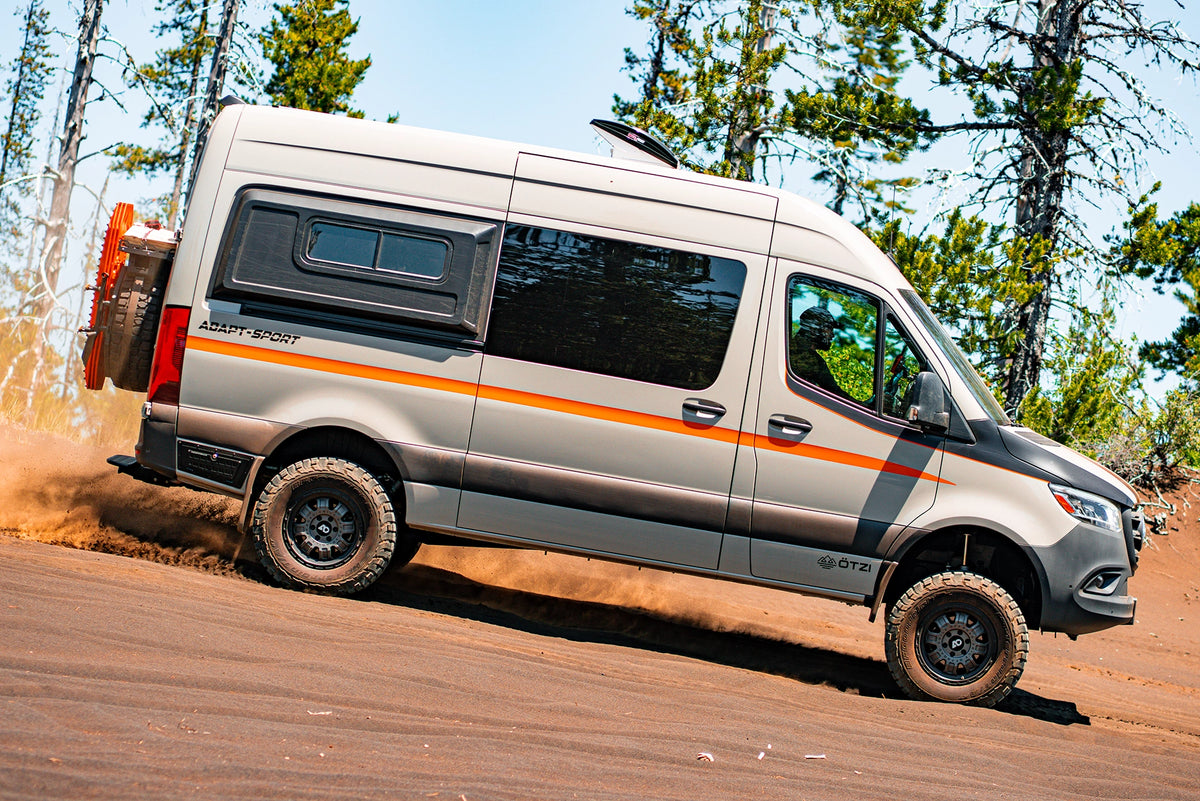
Otzi's published 6,500-pound starting weight gives buyers a useful reference when planning a build. The finished weight depends on the selected configuration. Comparing that weight with the vehicle's ratings helps show how much capacity remains for travel, alongside the living space, storage and equipment included in the van.
| Vehicle | Weight information | What it means for the buyer |
|---|---|---|
| Otzi production builds | As light as 6,500 lb, depending on configuration. (Otzi) | Published starting weight, with configuration-specific documentation to use when planning passengers, water and gear. |
| One 2023 Storyteller Beast MODE | 8,500 lb dry, declared by the rental host; weighing conditions unspecified. (RVshare) | An identifiable older Beast weight report. Review the exact model year's completed weight and cargo label when shopping. |
That same 2023 Beast rental listing declares 550 pounds of cargo capacity. Passengers, water and equipment need to fit within the applicable carrying allowance, making completed weight an important part of the purchase decision. (RVshare)
Otzi's approach is to keep the underlying build light while offering equipment choices for different travel routines. Our Otzi vs Storyteller guide covers the broader equipment and living-space comparison.
How does a lighter build help beyond usable payload?
Weight influences the drive as well as the packing list. More mass requires more energy to accelerate and climb, and more energy must be managed on a descent. In soft sand, additional weight also works against flotation. Lightweight construction therefore has value even when you do not need the entire remaining cargo allowance. (U.S. Department of Energy; OpenStax; Outback Travel Australia)
What does weight change about the driving experience?
For a comparable drivetrain, a lighter van has less mass to accelerate when joining traffic or climbing a grade. Descending a mountain pass also involves managing the vehicle's gravitational energy through engine braking, the brakes and other resistance. Controlling weight reduces that energy demand for the same route and speed. (U.S. Department of Energy; OpenStax)
Load placement matters alongside the total. Storyteller's own manual discusses the effect of roof weight on center of gravity and handling; keeping heavy equipment lower is part of a thoughtful travel setup. (Storyteller 2026 manual) During an Otzi walkthrough, review where your gear will ride, not just how much storage is available.
How does build weight affect fuel economy?
The U.S. Department of Energy recommends removing unnecessary weight to improve fuel economy. Permanent equipment deserves particular attention because it travels with you on every trip. Selecting a weight-conscious build addresses that recurring load before you decide which bags, bikes or water supplies to pack. (FuelEconomy.gov)
Speed, terrain, wind resistance and driving style also influence consumption. For us, lightweight construction and practical equipment choices belong together: keep the comforts you use without carrying unnecessary mass everywhere you go. (FuelEconomy.gov; U.S. Department of Energy)
Why does lower weight matter when driving in sand?
With comparable tire support and sand conditions, a heavier vehicle tends to sink farther and push more sand ahead of its tires. Outback Travel Australia's dune-driving guidance favors lighter vehicles and leaving unnecessary weight behind. Reducing the load helps the tires support the vehicle nearer the surface instead of digging through it. (Outback Travel Australia)
Use tire-pressure guidance appropriate to the vehicle, tires and actual load. Drive slowly with reduced pressures and reinflate before harder or paved surfaces; excessive deflation combined with speed or sudden steering can allow tires to roll off their rims. (Queensland Parks and Wildlife)
Otzi's 6,500-pound starting weight, depending on configuration, is a useful foundation for this approach. Choose the comfort equipment your trips call for, then preserve the benefit of a lighter travel setup rather than treating every available pound as something to fill.
How does Otzi keep comfort without making every feature permanent?
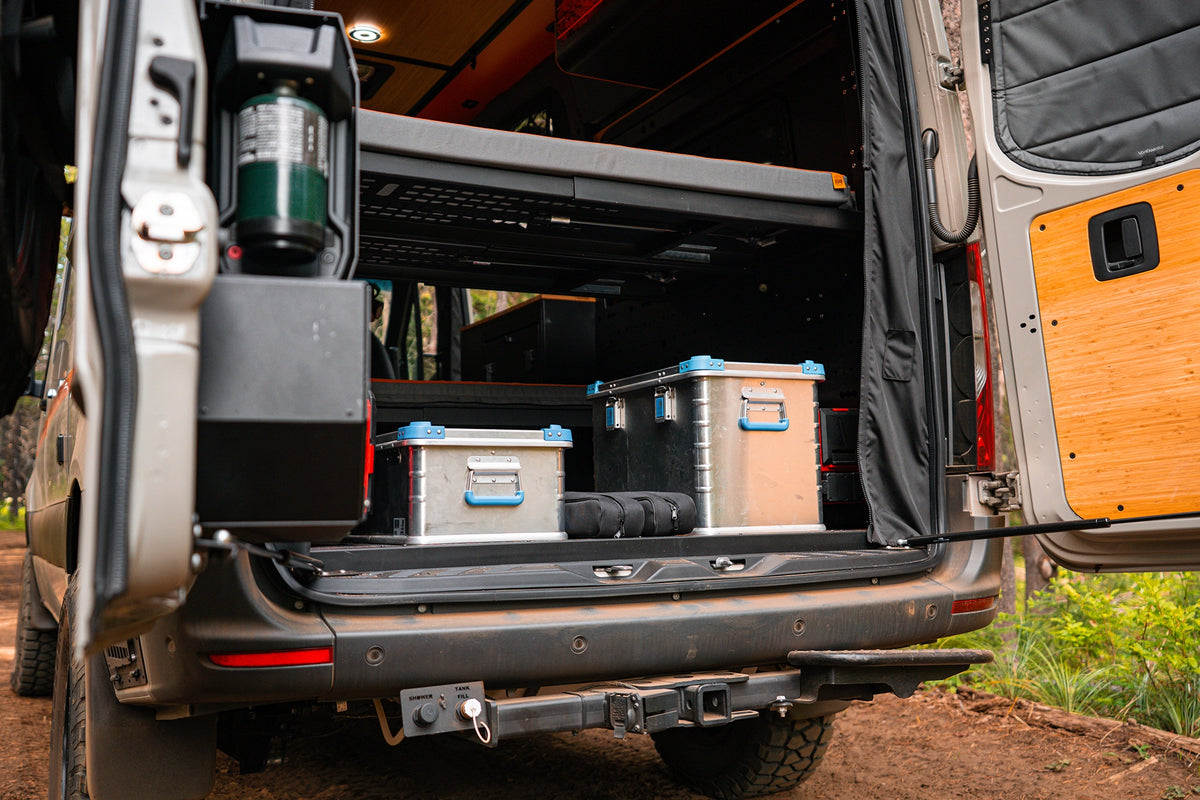
Otzi combines lightweight materials with an interior that can serve several purposes. The Adapt-Sport bed can remain a dedicated bed, expand or be removed, while the 144 provides a 78-cubic-foot garage. You get comfortable living and space for adventure equipment without locking every inch into one permanent use.
Our public 144 specifications include aluminum cabinetry, a refrigerator, induction cooktop and microwave. These everyday comforts are part of the lightweight build, rather than additions that buyers need to give up to reduce weight. (Otzi Adapt-Sport 144)
The bed's flexibility also avoids a common misunderstanding about modular vans: you do not have to dismantle your bedroom every morning. Leave it made up for a trip, or change the arrangement when your equipment or plans change.
Bathroom choices follow the same thinking. A fixed interior shower occupies its footprint whether you are showering or not. Otzi's optional shower arrangement lets you choose that amenity rather than carry equipment you do not use.
Garage volume and loading capacity do different jobs. The garage gives you space to organize equipment; your vehicle and axle ratings determine the weight you can carry. We want buyers to have both a useful interior and a loading plan that works.

Why do battery and water choices matter to payload?
Battery capacity and water storage should support how you travel, rather than automatically maximize permanent equipment. Otzi pairs efficient appliance choices and insulation with a compact power system, and separates sink water from optional shower storage. That approach makes comfort, space and weight part of the same design decision.
The Adapt-Sport 144 product page specifies a 2,048 Wh base battery system, expandable to 5,048 Wh. Choose capacity around your daily electrical use and charging opportunities, so the installed system has a clear job to do. (Otzi Adapt-Sport 144)
With the shower option, Otzi provides 41 gallons of combined fresh-water capacity: a removable six-gallon sink tank plus a separate 35-gallon shower tank. The sink container can be cleaned and filled with filtered drinking water. Separate six-gallon sink gray and 16-gallon shower gray tanks handle wastewater.
That gives you substantial fresh-water capacity while keeping drinking water easy to refill and clean. Storyteller's 2026 MODE specifications list 37 gallons of fresh water; its manual uses approximately 8.3 pounds per gallon when calculating cargo weight. (Storyteller 2026 manual)
A full 41 gallons weighs about 340 pounds using that conversion. Otzi lets you choose the shower equipment and carry the water your trip calls for, rather than make the largest possible system a requirement for every buyer. Include remaining gray water when planning the return journey.
How do you calculate usable payload for an actual trip?
Usable payload starts with the weight left after the van itself. Otzi's 6,500-pound starting point makes that relationship tangible: less weight committed to the build leaves more of the permitted total for your trip. Use your completed configuration's documentation, then account for passengers, water and equipment. (Vehicle loading guidance)
Three terms keep the calculation clear:
- GVWR: Maximum permitted loaded vehicle weight, including people, cargo and water.
- GAWR: Maximum permitted weight on an individual axle.
- OCCC: Occupant-and-cargo carrying capacity shown on the vehicle's label. Use it alongside total and axle weights when planning your load. (Storyteller 2026 manual)
What does a 6,500-pound starting point mean for your trip?
Using Otzi's 6,500-pound starting weight and an illustrative 9,050-pound GVWR gives a 2,550-pound gross-weight budget before additional loads. The worksheet below shows how a trip uses that budget. Add selected equipment above the starting configuration, any fuel not already included in the starting weight, and other loads separately.
| Trip planning item | Example weight |
|---|---|
| Otzi starting build | 6,500 lb |
| Two adults | 360 lb |
| 41 gallons of fresh water at approximately 8.3 lb per gallon | 340 lb, rounded |
| Food, clothing and bedding | 150 lb |
| Bikes and other adventure equipment | 160 lb |
| Tools and recovery equipment | 100 lb |
| Total added trip load | 1,110 lb |
| Build plus listed trip load | 7,610 lb |
| Gross-weight budget remaining before configuration and fuel adjustments | 1,440 lb |
Use your actual vehicle's GVWR and certified weight to finalize the plan, including the installed shower equipment if selected. Check axle and tire limits, and count each load once. Equipment and fuel already included in the completed weight stay in that figure rather than being added again.
At the same GVWR, every pound saved in the build leaves another pound available in the gross-weight budget. That is the practical reason weight is part of our design process, alongside comfort, storage and equipment.
Why does weight distribution matter on rough roads?
Useful adventure capability depends on both total weight and where you place it. Keep dense equipment low, secure it properly and avoid concentrating everything behind the rear axle. Otzi's adaptable storage gives you options for organizing the load around the equipment you bring on each trip. (Expedition Portal loading guidance)
Check front, rear and total weights against your vehicle's labels. Keeping the total below GVWR is only part of the job; each axle and tire must remain within its rating. A well-planned load makes the van's storage work with its chassis rather than against it. (Vehicle loading guidance)
Roof weight affects center of gravity and handling. Before covering a van in racks and storage boxes, decide whether the equipment can travel lower in the vehicle and include the racks themselves in your weight budget. (Storyteller 2026 manual)
AWD and adventure accessories do not replace disciplined loading. For us, a strong adventure van starts with comfortable, useful equipment in a thoughtfully controlled build, then leaves room for the journey.
What should you check during an Otzi walkthrough?
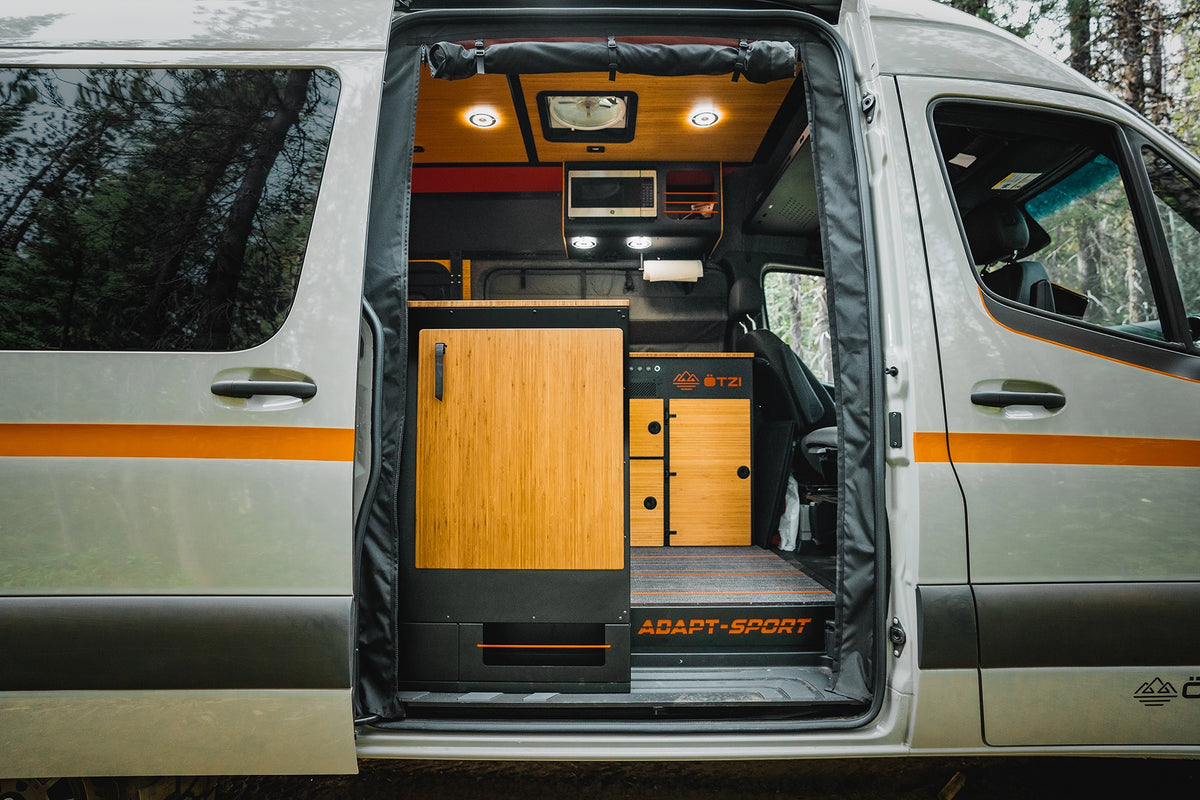
Bring your passengers, gear requirements and preferred camping routine into the conversation. We can walk you through the bed, garage, equipment choices and weight documentation for your selected build. This lets you assess the available carrying capacity alongside comfort, storage and everyday usability before purchasing.
Use this short checklist:
- Completed build: Confirm the model, installed options and configuration behind the weight.
- Scale conditions: Record fuel, water, occupants and cargo included in the measurement.
- Ratings: Review GVWR, front and rear axle ratings, and occupant-and-cargo information.
- Everyday living: Try the bed, galley, seating and access to your stored equipment.
- Travel load: Account for passengers, water, gear and hitch-mounted equipment before departure.
The Adapt-Sport brings lightweight construction and flexible living space together in a production van. Explore the Adapt-Sport 144 and Adapt-Sport 170, then plan a walkthrough with Otzi.
Frequently asked questions
How much does an Otzi adventure van weigh?
Otzi vans can weigh as light as 6,500 pounds, depending on configuration. Our vehicle weights are certified and registered. Use the completed weight for your selected build to plan the capacity available for passengers, water and equipment.
How much does a Storyteller Beast MODE weigh?
A 2023 Beast MODE rental listing reports 8,500 pounds dry and 550 pounds of cargo capacity. These are rental-host-declared figures for that van, with weighing conditions unspecified. Compare the completed weight and capacity label for the exact Beast model year and configuration you are considering. (RVshare)
Is 9,050 pounds the Storyteller's curb weight?
No. The 9,050-pound figure in the 2026 MODE manual is GVWR, the maximum loaded vehicle rating in its Sprinter specifications. Curb or completed weight describes the vehicle's actual weight under stated conditions. Use its certification label and scale ticket to calculate the remaining allowance for your load. (Storyteller manual)
Does water count against adventure van payload?
Yes. Water adds approximately 8.3 pounds per gallon. With the shower option, Otzi provides 41 gallons of combined fresh-water capacity through separate six-gallon sink and 35-gallon shower tanks. Carry the water your trip needs and include remaining wastewater when calculating the load. (Water-weight guidance)
Does choosing a lighter Otzi mean giving up comfort?
No. The Adapt-Sport 144 pairs aluminum cabinetry with a refrigerator, induction cooktop and microwave. Its removable, expandable bed can also remain a dedicated bed, and shower equipment is available by configuration. The aim is comfortable living with adaptable space and disciplined equipment choices. (Otzi Adapt-Sport 144)
Does a 78-cubic-foot garage tell me how much weight I can carry?
No. The Adapt-Sport 144's 78-cubic-foot garage describes storage volume, not a weight allowance. Your vehicle's certification and occupant-and-cargo labels, actual loaded weight, axle loads and tire ratings determine the weight limits. Plan the available space and the load together so your equipment travels securely. (Vehicle loading guidance)
Explore Otzi adventure vans
- Adapt-Sport 144: Explore the compact production platform.
- Adapt-Sport 170: Explore the longer-wheelbase model.
- Storyteller comparison: Read the broader Otzi vs MODE guide.
- Visit Otzi: Discuss your configuration and arrange a walkthrough.