
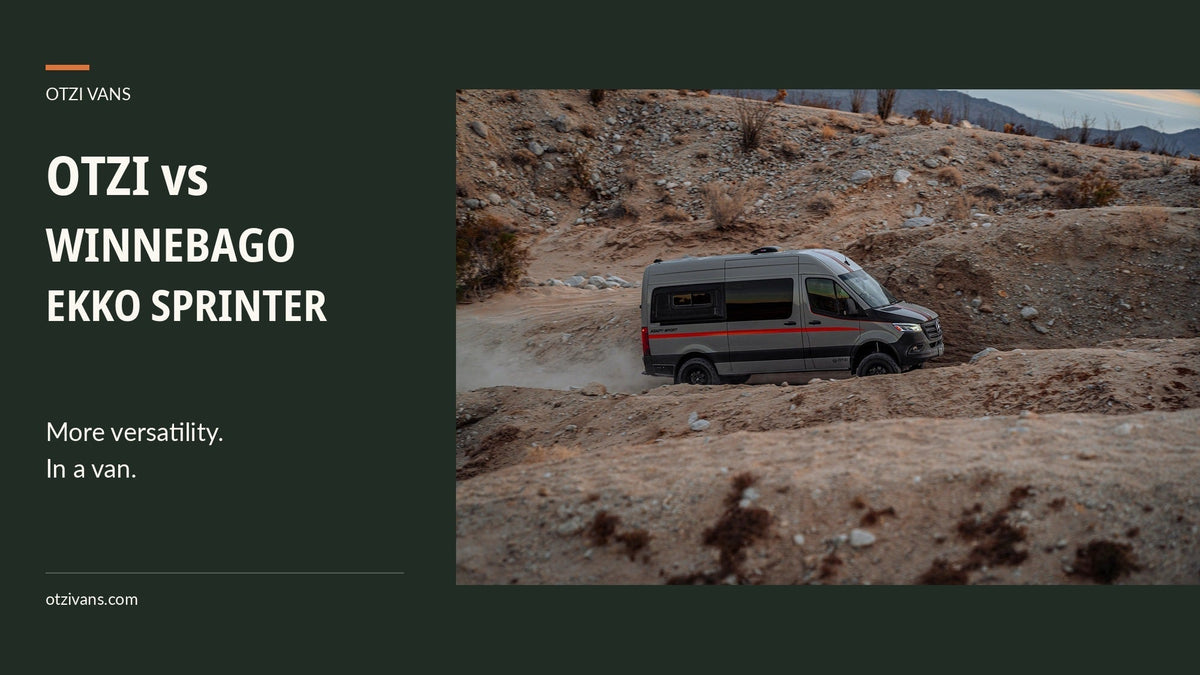
The Otzi advantage / 04
We recommend the Otzi Adapt-Sport as an alternative to the Winnebago EKKO Sprinter because it combines adaptable living space with the original Sprinter van body (Otzi). Our approach is to make the interior do more, rather than assume a larger coach is the answer to comfortable travel, useful storage and everyday versatility.
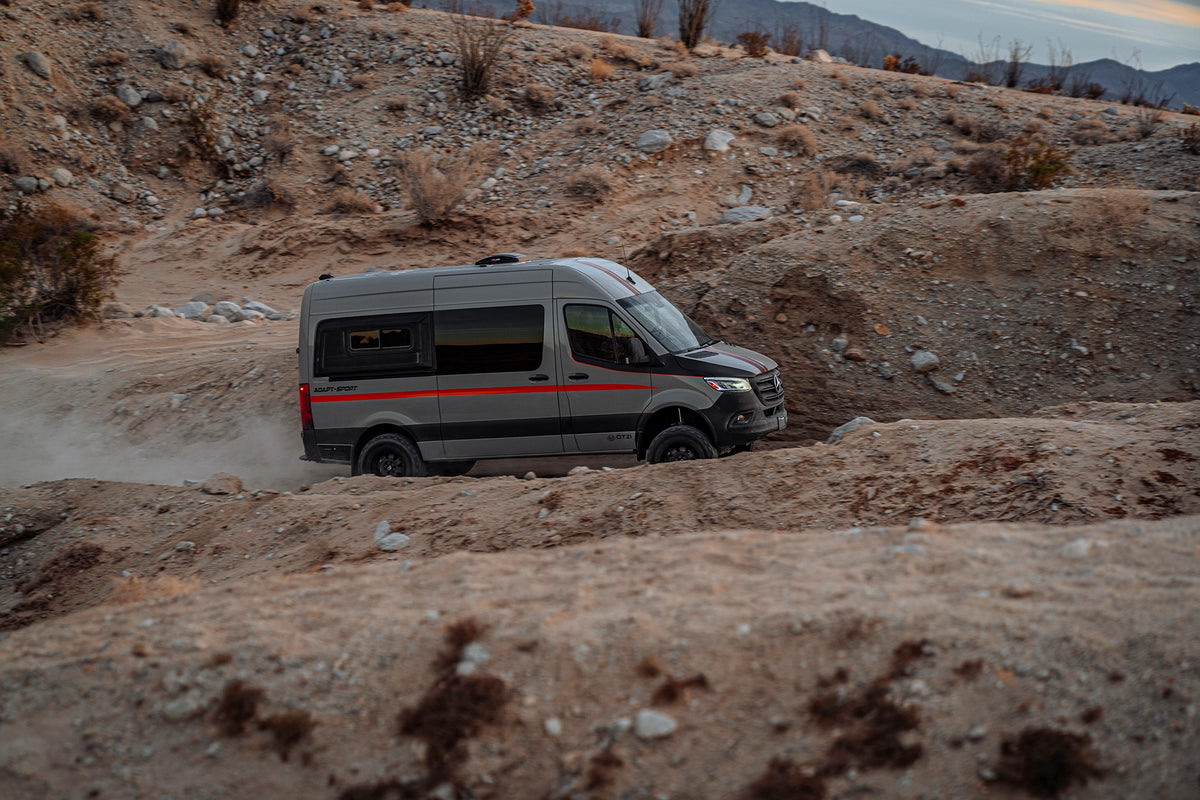
The distinction matters from the first test drive. Otzi converts within the original Mercedes-Benz Sprinter van body. Winnebago formally lists the EKKO Sprinter as a Class C, using a Mercedes-Benz AWD Sprinter cab-chassis with a purpose-built coach behind the cab. Otzi Adapt-Sport Winnebago EKKO Sprinter
If you are shopping for a "Class B+," use Winnebago's own current category here: Class C. Winnebago EKKO Sprinter More importantly, the body architecture explains the width, storage, bathroom, maintenance routine, and driving footprint better than the nickname does.
This guide uses the 2026 Mercedes-Benz Sprinter 23B, not the Transit 22A that also appears in some shared equipment tables. Winnebago model-specific specifications Mixing their specifications can produce a plausible but incorrect comparison.
What is the core difference between these Sprinter RVs?
The Otzi is a van conversion; the EKKO Sprinter is a coachbuilt motorhome. Retaining the Sprinter's original rear body gives Otzi a van-shaped exterior and rear cargo doors. Building a dedicated coach gives Winnebago more interior width and a different division of living space, but does not automatically mean more garage volume. Otzi Winnebago
Ask how each architecture changes your daily experience. With Otzi, demonstrate loading through the rear doors and reconfiguring the same interior volume. Otzi layout With the EKKO, inspect the separate heated gear garage and rear twin/flex-bed arrangement, then judge whether that division suits your equipment. Winnebago layout
Our preference is to retain the van format and make its interior work harder. Comfortable travel should be evaluated alongside the experience of driving, parking, loading and using the vehicle between campsites, not isolated from it.
Winnebago's 2025 EKKO manual gives maintenance guidance for a fiberglass motorhome body and Thermo-Panel roof, including inspections for effects of normal twisting and flexing. Winnebago operator manual Obtain the manual matching your delivered model year.
Otzi retains the original Sprinter body. Include added equipment, seals and roof accessories in the completed vehicle's routine inspection and maintenance schedule.
How do the verified 23B specifications compare?
The table compares Winnebago's 2026 EKKO Sprinter 23B specifications with Otzi's published Adapt-Sport 144 equipment. The Otzi power and galley figures are specific to the 144, not universal claims for both wheelbases. Where equipment varies with options, obtain the final build sheet before using a number in your purchase decision. Winnebago specifications Otzi product page
| Decision | Otzi Adapt-Sport 144 | Winnebago EKKO Sprinter 23B |
|---|---|---|
| Vehicle architecture | Conversion within OEM Sprinter van body. Otzi | Winnebago-listed Class C on Mercedes-Benz AWD Sprinter chassis. Winnebago |
| Wheelbase | 144-inch model emphasized here. Otzi | 170 inches. Winnebago |
| Exterior size | OEM-body envelope varies with roof accessories. Confirm finished measurements. | 24 feet 6 inches long, 7 feet 2.5 inches wide, 10 feet 11 inches high. Winnebago |
| Interior | Modular Lifestyle Bed System and gear walls. Otzi | 6 feet 9 inches wide and 6 feet 8 inches high. Winnebago |
| Water | Removable 6-gallon fresh and gray sink containers; optional shower adds separate 35-gallon fresh and 16-gallon gray tanks. Otzi sink and shower options | 50 gallons fresh, 51 gallons gray, continuous water heater. Winnebago |
| Toilet/bath | Concealed portable toilet and optional fold-down indoor shower: shower capability without a permanently enclosed bathroom footprint. Otzi | 5-gallon swiveling cassette toilet and 24-by-30-inch dry/wet bath with a dedicated bathroom footprint. Winnebago |
| Battery/inverter | 2,048 Wh LiFePO4, expandable to 5,048 Wh; 2,500-watt continuous output. Otzi | 320-Ah Lithionics battery, 2,000-watt inverter/80-amp charger, second alternator. Winnebago |
| Solar | Up to 1,400 watts of solar charging input. Otzi | 530 watts without pop-top; 220-watt flexible panel with pop-top. Winnebago |
| Garage and storage | 78-cubic-foot Adapt-Sport 144 garage; reconfigurable bed height, structural L-track and modular gear walls. Otzi storage design | 54.6-cubic-foot heated rear garage; 64 cubic feet total exterior storage without the exterior kitchen. Winnebago |
| Cold-weather water protection | Heated water tanks and insulated water lines; review the selected system's operating and winterization procedures. | Heated holding-tank compartment and insulated water-service center. Winnebago |
| Completed weight | The Adapt-Sport 144 tops out at 6,800 pounds with all factory options installed, before passengers, camping water and travel cargo. | Approximately 9,500 pounds unloaded; Transwest lists 9,530 pounds UVW for the 2026 23B. Transwest |
| Capacity left for the trip | 2,250 pounds calculated margin using the fully optioned 6,800-pound 144 and a 9,050-pound GVWR: 750 pounds more than the EKKO example. | 1,500 pounds using the listed 9,530-pound UVW and 11,030-pound GVWR. Transwest; Winnebago |
| Towing and loading limits | Otzi lists a 5,000-pound towing rating; verify final label, axle, tire and combination limits. Otzi | 15,250-pound GCWR and 5,000-pound hitch/500-pound tongue rating; actual loading must satisfy every applicable limit. Winnebago |
The weight comparison uses Otzi's fully optioned 144 specification and Transwest's dealer-published EKKO UVW. Carrying margins are calculated from those completed weights and the stated GVWRs, with full vehicle fuel included and camping water, occupants and travel cargo still to add. Confirm those conditions on the selected vehicle's weight record and loading label. Mercedes-Benz weight definitions
How much more space does the EKKO's coach body create?
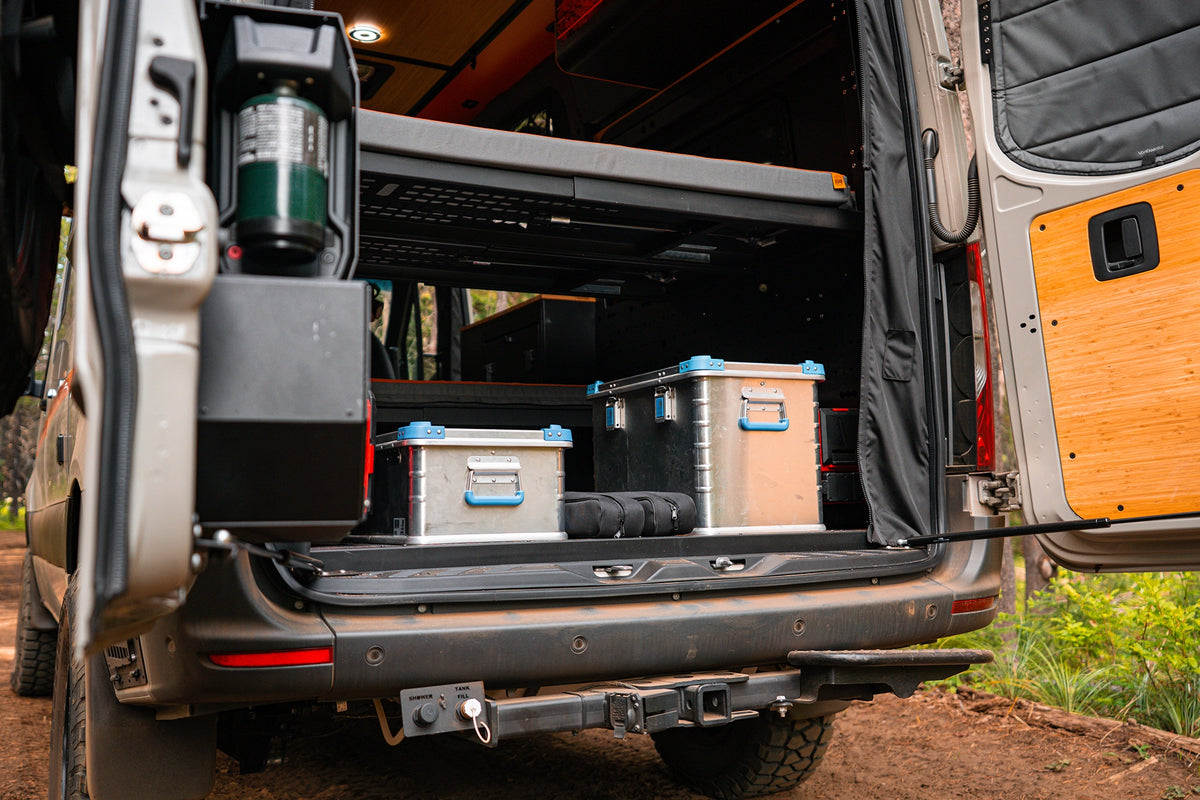
The EKKO's coach body provides a broader interior. For gear storage, compare garage volume and how easily you can load and access your equipment. Winnebago publishes 6 feet 9 inches of interior width and 6 feet 8 inches of interior height. Winnebago 23B Otzi's Adapt-Sport 144 garage provides 78 cubic feet within the van format.
Winnebago identifies 54.6 cubic feet for the rear garage, within 64 cubic feet of total exterior storage without the exterior kitchen. Winnebago storage specifications Those are different categories: total exterior storage should not be presented as rear-garage capacity. Our 78-cubic-foot garage figure gives buyers a concrete reason not to assume a larger coach carries more usable adventure gear.
The cost is a larger road envelope. The 23B measures 7 feet 2.5 inches wide, 10 feet 11 inches high, and 24 feet 6 inches long. Winnebago dimensions Drivers must manage the coach body, roof equipment, rear overhang, and mirrors rather than thinking only about the Mercedes cab.
For context, Mercedes-Benz lists its 2026 144-inch high-roof Cargo Van at 234 inches overall length before conversion accessories. Mercedes-Benz dimensions Request completed Otzi measurements rather than treating that chassis figure as the finished vehicle's length.
The Adapt-Sport 144 combines its garage with adjustable bed height, rear-door access and structural cargo tie-downs. Otzi Adapt-Sport 144 Bring your equipment and check the usable openings, bed position and tie-down locations. Use the builders' volumes as a starting point, then test your equipment through the actual openings.
Measure your own constraints. Check the home driveway, gate, tree canopy, ferry class, storage building, and favorite trailhead. Use the completed vehicle's highest and widest points, including awnings, ladder, air conditioner, racks, steps, and mirrors.
For example, the current Assateague National Seashore OSV page requires four-wheel drive or AWD and lists maximum dimensions of 26 feet long and 8 feet wide, among other requirements. National Park Service The EKKO's published length and width fit those two limits, but access still depends on all current rules, equipment, conditions, driver judgment, and the exact vehicle.
Which layout works better for sleeping, seating, and gear?
Otzi gives you a dedicated bed when you want one and the option to change the arrangement when you need something else. Reconfigurable does not mean you must dismantle or remake the bed every day. Leave the sleeping platform set up throughout your trip, or use the same system for lounging, dining and different equipment loads. Otzi Lifestyle Bed System
The EKKO publishes 32-by-80-inch twin beds with a flex-bed kit, a forward lounge and a removable table. Winnebago sleeping and lounge A bed that remains ready for sleep is useful, but that convenience is not exclusive to a fixed floor plan. An Otzi owner can retain a preferred bed arrangement rather than convert it daily.
The rear garage is heated and includes L-track, a removable floor liner, power, and lighting. Winnebago garage Before assuming a bike or mobility device fits, measure door openings and the space under the bed, not just total cubic feet.
Otzi's Lifestyle Bed System can lift the bed above gear, lower it for sleeping, or create seating, table, bunk, and view-facing arrangements, with structural L-track supporting cargo organization. Otzi modular interior This is especially useful when today's bikes become tomorrow's skis or a work setup.
Otzi also uses powder-coated aluminum structures with bamboo faces and accents, while Winnebago lists laminate countertops and fixed coach furniture. Otzi construction Winnebago interior equipment Material labels are not a substitute for checking latch operation, rattles, service access, and replacement parts.
During the showroom test, set up the bed, access the refrigerator, reach the toilet, retrieve a jacket, and open the exterior storage. A floor plan earns its space only if it works in sequence.
Why should a shower occupy living space only when you need it?
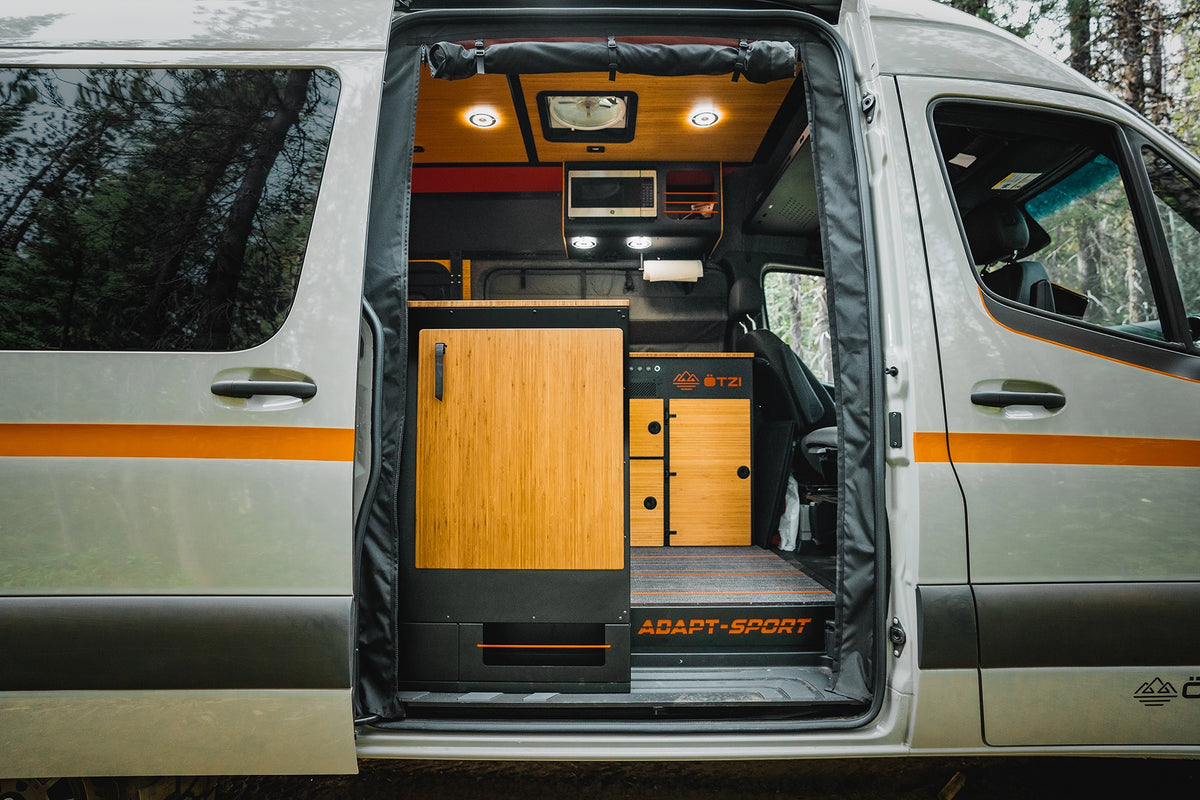
A permanently enclosed bathroom reserves its footprint 100% of the time, even when nobody is showering. Otzi's optional fold-down indoor shower provides shower capability without requiring that permanent enclosure. Otzi shower option Our approach gives the space another purpose between showers instead of treating a larger bathroom footprint as an automatic improvement.
The EKKO's pivoting-wall dry/wet bath includes a 24-by-30-inch shower and cassette toilet. Winnebago bathroom Its pivoting wall changes how the bathroom works internally; it does not remove the bathroom's enclosure from the floor plan. The reserved space can still be useful as a bathroom, but it is not available as open lounge or general living space.
Otzi separates sink convenience from shower capacity. Our removable 6-gallon fresh and 6-gallon gray sink containers can be removed for cleaning and filled with preferred filtered drinking water. Otzi sink system The optional shower configuration adds separate 35-gallon fresh and 16-gallon gray tanks, rather than asking the six-gallon sink system to supply the whole shower experience.
EKKO publishes 50 gallons fresh and 51 gallons gray, with a continuous water heater and five-gallon cassette toilet. Winnebago capacities Those are larger listed capacities, but capacity alone does not measure comfort, cleaning convenience or the living space available between showers.
During an Otzi walkthrough, test shower deployment, privacy, drying and stowage with your equipment aboard. Select the water and shower equipment you will use, then check the travel load against the completed vehicle's ratings. Our recommendation is a comfortable indoor shower option that does not dictate the interior's layout all day.
Which electrical package better fits off-grid travel?
The EKKO offers a standardized multi-source system, while the Adapt-Sport 144 emphasizes a compact, self-contained 48V architecture. Evaluate stored energy, output, solar configuration, alternator charging, generator use and service access together. Winnebago Otzi
The 2026 EKKO Sprinter publishes a 320-Ah Lithionics battery, 2,000-watt pure-sine inverter with 80-amp charger, dedicated second alternator, 30-amp shore power, and 2,500-watt LP generator. Winnebago electrical system
Roof configuration changes the solar specification. The standard roof arrangement lists two 215-watt panels plus one 100-watt panel, or 530 watts total. With the optional pop-top, Winnebago lists a 220-watt flexible panel. Winnebago solar configurations Never combine the 530-watt number with the pop-top as if both are standard together.
Winnebago also offers a 630-Ah battery with generator-delete requirements, but ordering compatibility can depend on the selected options. Winnebago optional equipment Get the final option logic in writing.
The Adapt-Sport 144 publishes 2,048 Wh of LiFePO4 storage, expandable to 5,048 Wh, with 2,500 watts of continuous output and up to 1,400 watts of solar input. Otzi power system Its charging routes include solar, alternator DC-to-DC, and 15-amp shore power. Otzi charging
Build a 24-hour load worksheet covering refrigeration, heating controls, lighting, cooking, laptops, ventilation, and optional air conditioning. Then ask each seller to demonstrate system monitoring, disconnects, recharge time assumptions, and the recovery procedure after a fault.

What does four-season capability require in practice?
Otzi's cold-weather provisions include heated water tanks, insulated water lines and heated batteries. Combined with the insulated interior and the selected cabin-heating equipment, these address more than cabin comfort alone. Confirm the equipment and operating instructions for your build; winter capability depends on the complete installation, available energy and appropriate winterization.
Winnebago lists a heated holding-tank compartment above the floor, an insulated water-service center, Truma VarioHeat, Truma AquaGo, dual-pane acrylic windows, a battery heating package, and a thermal cab divider. Winnebago cold-weather systems It also explicitly tells buyers to follow winter-use and winterization procedures whenever camping in freezing conditions.
Otzi also describes insulated and sound-dampened wheel wells, removable wall and ceiling panels, and an engineered floor system with insulation and sound damping. Otzi construction A diesel heater and insulated window covers are listed options. Otzi options Compare the complete selected Otzi package rather than assuming heated plumbing or heated batteries are exclusive to a larger coach.
Ask both manufacturers to explain:
- Which water components are in heated space?
- Which components need draining in freezing weather?
- How much battery or fuel the heating strategy consumes overnight?
- How condensation is controlled with occupants and wet gear aboard?
- Which temperature limits come from component manufacturers?
A complete envelope, installation details, openings, and operating behavior matter more than one material number.
Which one is better for rough roads and tight access?
Otzi is the more natural choice for buyers prioritizing a smaller body envelope, flexible gear carriage, and builder-stated trail clearances. The EKKO is AWD and all-terrain equipped, but its coach dimensions and rear body require more conservative line choice. Neither product should be represented as a technical rock crawler. Otzi Winnebago
Otzi publishes 11.5 inches of centerline clearance, 9.5 inches at the rear differential, and 18 inches at the midpoint side rail. These are manufacturer engineering figures, not independent measurements; confirm the relevant production configuration on the build order. Otzi clearance specifications
The 23B has Mercedes-Benz AWD, all-terrain tires, and a 170-inch wheelbase. Winnebago chassis equipment Winnebago does not publish approach, departure, or breakover angles on the current specification page, so inspect the loaded vehicle's geometry directly.
Body movement and seal maintenance also deserve a neutral, documented discussion. Winnebago's manual says routine cornering and uneven surfaces create twisting and flexing forces. It instructs owners to inspect the fiberglass shell, moldings, windows, exterior attachments, roof seams, and sealants and to repair threatening cracks or damaged sealant promptly. Winnebago operator manual
Build those checks into the vehicle's maintenance routine. Before purchase, locate the sealant call-out sheet and ask the dealer to demonstrate the maintenance points.
For either vehicle, inspect the lowest underbody equipment, rear overhang, hitch accessories, entry step, roof equipment, and departure path with the travel load aboard. A published centerline number never tells the whole geometry story.
How should you evaluate weight, payload, and towing?
Prioritize the weight you actually drive and the capacity left for your trip. A higher GVWR is not an advantage when a heavier completed build consumes more than the additional allowance. Otzi's fully optioned Adapt-Sport 144 demonstrates why lightweight construction matters even when you choose all the equipment, not just a base configuration.
The Adapt-Sport 144 tops out at 6,800 pounds with all factory options installed, before passengers, camping water and travel cargo. Otzi certifies and registers its completed weights; lighter configurations can weigh as little as 6,500 pounds. Otzi 2026 guide Transwest lists the 2026 EKKO Sprinter 23B at 9,530 pounds UVW, approximately 9,500 pounds unloaded. Transwest
On a 9,050-pound GVWR chassis, a 6,800-pound Otzi leaves 2,250 pounds for additional loads. The EKKO's 11,030-pound GVWR minus its listed 9,530-pound UVW leaves 1,500 pounds. The EKKO's 1,980-pound higher rating is more than consumed by its 2,730-pound higher unloaded figure. In this comparison, the fully optioned Otzi starts 2,730 pounds lighter with 750 pounds more carrying margin. Mercedes-Benz ratings; Winnebago ratings
That lower weight matters on the drive, not just when packing. Less mass takes less energy to accelerate and move uphill; avoiding unnecessary load also helps preparation for soft terrain. Lightweight construction supports useful payload without requiring you to carry the additional vehicle mass every mile. Department of Energy; Queensland Parks sand-driving guidance
GVWR remains the safety ceiling. Use consistent fuel and fluid conditions, then weigh the van loaded for travel and record front axle, rear axle and total weight. The EKKO's published front and rear axle ratings are 4,410 and 7,720 pounds; these are limits, not measured axle loads. Winnebago ratings
Otzi lists a 5,000-pound towing rating, while Winnebago lists a 5,000-pound drawbar and 500-pound maximum vertical tongue weight. Actual towing must comply with vehicle, axle, tire, hitch and combination ratings after people, water, cargo and tongue load are counted. Otzi towing specifications; Winnebago hitch specification
Use the completed retail vehicle and your travel load for the final comparison.
Why is a composite roof warranty not a like-for-like Otzi comparison?
Otzi retains the Sprinter's factory metal body and roof rather than replacing the rear body with a composite motorhome coach. Otzi platform A separate coach roof-skin warranty therefore addresses a construction type Otzi does not use. Evaluate the structure and service obligations being covered, not just the longest warranty number.
Otzi provides a one-year/unlimited-mile warranty, with an optional five-year/unlimited-mile extended warranty. Written terms govern coverage, exclusions and service procedures; these are not a promise to extend the Mercedes-Benz chassis warranty or five additional years beyond the standard term.
Winnebago publishes 12 months/15,000 miles of limited coverage, 36 months/36,000 miles on structure and 10 years of limited parts-and-labor coverage on the EKKO roof skin. Winnebago warranty specifications That specialized roof-skin coverage is not ten years of coverage for the whole vehicle or every possible leak.
Winnebago's manual calls for roof and sealant inspections and warns that delayed repairs can allow water damage not covered by its limited warranty. Winnebago operator manual Retaining the OEM metal roof avoids introducing that separate composite coach-roof assembly. It does not make an Otzi maintenance-free: fans, air conditioners, other roof penetrations, attachments and seals still need appropriate inspection.
Our ownership case combines the retained factory body, accessible conversion systems and direct engagement with the builder. Otzi construction Review the selected warranty and ask our team to explain service access and the process for support while traveling.
Also run a VIN-specific recall check for either completed vehicle. Avoid comparing aggregate brand recall counts or using campaigns for the Ford EKKO 22A as evidence about the Sprinter 23B.
Why choose Otzi instead of moving into a larger coach?
Choose Otzi for the complete van experience: adaptable living space, rear-door loading and the original Sprinter body, with production configurations you can inspect before ordering (Otzi). Our recommendation is not to buy less comfort. It is to look for comfort that works alongside driving, parking, storage and the changing activities of a trip.
The Adapt-Sport 144 combines a compact platform with adaptable bed and cargo arrangements and lightweight production engineering (Otzi Adapt-Sport 144). Those features matter on an ordinary road trip as well as an equipment-heavy adventure. Settle into the lounge, use the table and lie on the bed before judging comfort by the size of a coach.
Before committing, complete two demonstrations:
- Drive the route and parking maneuver that concerns you most.
- Load representative equipment and perform the full camp setup without moving anything outside.
Use those demonstrations to build confidence in the Otzi configuration you are buying. Include the water, climate, sleeping and passenger requirements that matter to you, and have our team distinguish standard equipment from the options included in your quote.
Explore the Adapt-Sport 144 and contact Otzi with your passenger count, largest equipment dimensions, water needs, and usual roads. A useful consultation starts with those constraints, not a generic list of upgrades.
What else do EKKO Sprinter shoppers ask?
Is the Winnebago EKKO Sprinter a Class B?
No. Winnebago lists the EKKO Sprinter as a Class C. It is a coachbuilt motorhome on a Mercedes-Benz AWD Sprinter chassis, while the Otzi Adapt-Sport retains the OEM Sprinter van body. Winnebago
How much garage space does the Adapt-Sport 144 provide?
The Otzi Adapt-Sport 144 garage provides 78 cubic feet. Winnebago lists 54.6 cubic feet for the EKKO Sprinter's rear garage and 64 cubic feet for total exterior storage without the exterior kitchen. Winnebago storage specifications Check bed position, access openings and fit with your own equipment.
Can an Otzi bed stay set up permanently?
Yes. Reconfigurable means you have choices, not a daily conversion requirement. Leave the Adapt-Sport bed in your preferred sleeping arrangement throughout a trip, and change it only when you want a different use of the interior. Otzi Lifestyle Bed System
Does Otzi offer cold-weather water protection?
Yes. The Adapt-Sport has heated water tanks and insulated water lines, and Otzi also has heated batteries. Confirm the controls, energy requirements and winterization procedures for your selected equipment for the temperatures you expect.
Why does Otzi use a fold-down shower instead of a fixed bathroom?
A permanently enclosed bathroom reserves its floor space even when nobody is showering. Otzi offers a fold-down indoor shower so the space can serve other living functions between uses. Otzi shower option The shower configuration adds separate 35-gallon fresh and 16-gallon gray tanks alongside the removable six-gallon sink containers.
Does EKKO's ten-year roof-skin warranty mean it has better overall coverage?
Not by itself. EKKO's ten-year limited roof-skin coverage concerns a particular coach component, not the whole vehicle. Winnebago warranty Otzi retains the factory metal roof and offers a one-year/unlimited-mile warranty with optional five-year/unlimited-mile extended coverage. Compare written terms, and continue inspecting roof-mounted equipment and seals.